Microtubulo associato
Gli inibitori delle proteine associate ai microtubuli prendono di mira le proteine che interagiscono con i microtubuli, i componenti strutturali del citoscheletro della cellula essenziali per la divisione cellulare. Queste proteine regolano la stabilità e la dinamica dei microtubuli durante la mitosi. L'inibizione delle proteine associate ai microtubuli può interrompere la funzione dei microtubuli, portando all'arresto del ciclo cellulare e all'apoptosi, in particolare nelle cellule tumorali a rapida divisione. Questi inibitori sono ampiamente utilizzati nella ricerca sul cancro e nello sviluppo di farmaci. Presso CymitQuimica, offriamo una gamma completa di inibitori di proteine associate ai microtubuli di alta qualità per supportare la tua ricerca sulla divisione cellulare, la dinamica del citoscheletro e la terapia del cancro.
Trovati 283 prodotti di "Microtubulo associato"
Ordinare per
Purezza (%)
0
100
|
0
|
50
|
90
|
95
|
100
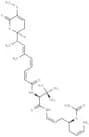
Monomethyl auristatin E intermediate-17
CAS:MonomethylauristatinE intermediate-17 is an intermediate compound used in the synthesis of MonomethylauristatinE. MonomethylauristatinE (MMAE) functions as a microtubule/tubulin inhibitor with anticancer properties. It is widely utilized as the cytotoxic component in antibody-drug conjugates (ADCs).Formula:C27H35NO7SPeso molecolare:517.63PROTAC α-synuclein degrader 6
CAS:<p>PROTACα-synuclein degrader 6 (compound T3) is a PROTAC degrader of α-synuclein and tau, with an EC50 of 1.57 μM and 4.09 μM, respectively. This compound plays a significant role in neurodegenerative disease (ND) research.</p>Formula:C37H39N5O9SPeso molecolare:729.80PM-060184
CAS:PM-060184, a tubulin polymerisation inhibitor, is used potentially for the treatment of solid tumours and breast cancer.Formula:C31H45N3O7Purezza:98%Colore e forma:SolidPeso molecolare:571.7Tubulin polymerization-IN-32
Tubulin polymerization-IN-32: a cancer cell growth inhibitor used for research in cancers like lymphoma.Formula:C29H30N2O7Colore e forma:SolidPeso molecolare:518.56Tubulin polymerization-IN-8
CAS:Compound IIc inhibits tubulin polymerization, arrests cell cycle at G2/M in HCT116 cells, IC50 12.7 μM, potential for cancer research.Formula:C21H24N4O4SColore e forma:SolidPeso molecolare:428.5Utrophin modulator 1
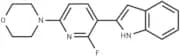
UM1 upregulates utrophin, has EC50 of 0.11 μM, useful in DMD research.Formula:C22H18N6OColore e forma:SolidPeso molecolare:382.42Antitubulin agent 1
Antitubulin agents-1 disrupts microtubules, ups α-tubulin acetylation, and has anticancer properties.Formula:C21H19N3O3Colore e forma:SolidPeso molecolare:361.39OXS007417
OXS007417 induces AML cell differentiation at 48 nM EC50 and shows potent in vivo antitumor effects.Formula:C20H14F3N3OColore e forma:SolidPeso molecolare:369.34Epothilone E
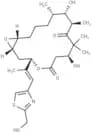
CAS:Epothilone E, a derivative of epothilone, functions by inhibiting microtubule protein activity, thereby halting cell division and exhibiting anti-tumorFormula:C26H39NO7SColore e forma:SolidPeso molecolare:509.66JC168
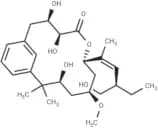
CAS:JC168 is a phenyl analog of peloruside and functions as a microtubule inhibitor with antiproliferative and anticancer properties. It enhances tubulin polymerization, thereby disrupting microtubule dynamics, making it a useful agent in the study of microtubule-associated diseases.Formula:C26H40O7Colore e forma:SolidPeso molecolare:464.592AMXI-5001 hydrochloride
AMXI-5001 hydrochloride, an oral inhibitor of PARP1/2 and microtubules, shows greater potency and selective anti-cancer effects.Formula:C25H21ClFN5O3Colore e forma:SolidPeso molecolare:493.92Tubulin polymerization-IN-35
Tubulin-IN-35 inhibits oxazolylisoindole microtubule formation, targeting VL51 marginal zone lymphoma.Formula:C31H35N3O5Colore e forma:SolidPeso molecolare:529.63Tau ligand-1
CAS:Tau ligand-1 (Compound 75) is a ligand of aggregated tau protein that can penetrate the blood-brain barrier. In tissues affected by Alzheimer's disease, progressive supranuclear palsy, corticobasal degeneration, and Pick's disease, Tau ligand-1 shows high affinity for aggregated tau protein, with equilibrium dissociation constants (KD) ranging from 1 to 3.8 nM. It holds potential as a positron emission tomography (PET) tracer for imaging studies of tau-related diseases within the central nervous system.Formula:C17H16FN3OColore e forma:SolidPeso molecolare:297.327TTBK1/2-IN-1
CAS:TTBK1/2-IN-1 (compound 3) is a potent inhibitor of Tau tubulin kinase 1 (TTBK1) and TTBK2, with IC50 values of 816 nM and 384 nM, respectively.Formula:C17H16N4OColore e forma:SolidPeso molecolare:292.335Icafolin-methyl
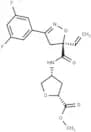
CAS:Icafolin-methyl is a plant-specific herbicide that acts as an inhibitor of tubulin polymerization. In plants, it metabolizes into the carboxylic acid icafolin, potentially inhibiting plant tubulin polymerization by binding to β-tubulin.Formula:C18H18F2N2O5Colore e forma:SolidPeso molecolare:380.343Tubulin polymerization-IN-75
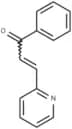
CAS:Tubulin polymerization-IN-75 (Compound 6) is an inhibitor of tubulin polymerization, with an IC50 value of 30 μM. It effectively suppresses the proliferation of cancer cells Huh7 and 293T, demonstrating IC50 values of 14.3 μM and 13.8 μM, respectively.Formula:C14H11NOColore e forma:SolidPeso molecolare:209.243Tubulin inhibitor 15
Tubulin inhibitor 15 is a potent tubulin inhibitor with antiproliferative activity. Tubulin inhibitor 15 exhibits cytotoxicity in HepG2 cells [1].Formula:C16H12FNO2Colore e forma:SolidPeso molecolare:269.27Dictyostatin
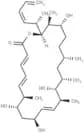
CAS:Dictyostatin: potent microtubule stabilizer & anticancer agent with antiproliferative effects; researched for tauopathies.Formula:C32H52O6Colore e forma:SolidPeso molecolare:532.75AMG28
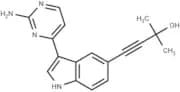
CAS:AMG28 is an inhibitor of Tau tubulin kinase 1 (TTBK1) and TTBK2, with IC50 values of 805 nM and 988 nM, respectively. Additionally, AMG28 suppresses the phosphorylation of tau protein at the Ser422 site, with an IC50 of 1.85 μM.Formula:C20H20N4OColore e forma:SolidPeso molecolare:332.399