Composti di organosilicio
In questa sezione troverai un gran numero di composti organosiliconici. I composti organosiliconici sono caratterizzati da atomi di carbonio legati ad atomi di silicio. Possono essere presenti anche altri composti non metallici. Questi composti sono ampiamente utilizzati nella sintesi organica, nella scienza dei materiali e nei prodotti farmaceutici grazie alle loro proprietà chimiche uniche. Presso CymitQuimica, offriamo una vasta gamma di composti organosiliconici di alta qualità per supportare le tue ricerche e progetti industriali.
Sottocategorie di "Composti di organosilicio"
Trovati 4330 prodotti di "Composti di organosilicio"
Ordinare per
Purezza (%)
0
100
|
0
|
50
|
90
|
95
|
100
4-Phenoxyphenylboronic acid
CAS:<p>4-Phenoxyphenylboronic acid is a chemical inhibitor of protein kinase. It binds to the ATP binding site of the enzyme and prevents ATP from binding, thereby inhibiting the phosphorylation of proteins. This inhibition blocks the activation of downstream pathways that are involved in cell proliferation, leading to apoptotic cell death. 4-Phenoxyphenylboronic acid has been shown to inhibit growth of human cancer cells in vitro. This molecule also inhibits root formation and plant growth, which may be due to its ability to selectively inhibit protein kinases found in plant cells.</p>Formula:C12H11BO3Purezza:Min. 95%Peso molecolare:214.02 g/molRef: 3D-FP33889
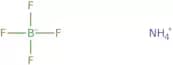
Prodotto fuori produzioneAmmonium tetrafluoroborate
CAS:<p>Ammonium tetrafluoroborate is a salt of the organic compound tetrafluoroborate and ammonium. It is a colorless solid that can be used as a chemical reagent. Ammonium tetrafluoroborate has a higher chemical stability than other salts of tetrafluoroborate, such as ammonium hexafluorophosphate and ammonium hexafluoroarsenate. Ammonium tetrafluoroborate is used to make the dinucleotide phosphate, which is an important component in DNA synthesis. In a redox potential test, ammonium tetrafluoroborate showed no electrochemical activity in water vapor at pH 7. Ammonium tetrafluoroborate reacts with trifluoroacetic acid to produce hydrogen fluoride and ammonium chloride. This reaction is reversible, which means that it can be used for the synthesis of ammonia gas from hydrogen and nitrogen gases or for the</p>Formula:NH4BF4Purezza:Min. 98%Colore e forma:White PowderPeso molecolare:104.84 g/mol6-(4,4,5,5-Tetramethyl-1,3,2-dioxaborolan-2-yl)-2,3-dihydrobenzo-1,4-dioxoline
CAS:<p>Please enquire for more information about 6-(4,4,5,5-Tetramethyl-1,3,2-dioxaborolan-2-yl)-2,3-dihydrobenzo-1,4-dioxoline including the price, delivery time and more detailed product information at the technical inquiry form on this page</p>Formula:C14H19BO4Purezza:Min. 95%Peso molecolare:262.11 g/molRef: 3D-FT160590
Prodotto fuori produzione1,2-Bis(hydroxymethyl)-O-carborane
CAS:Prodotto controllato<p>1,2-Bis(hydroxymethyl)-O-carborane is a cyclic molecule that can be used in the synthesis of organic compounds. It can be prepared by reacting anhydrous sodium chloride with propiolic acid. It has been shown to produce decaborane and anion when reacted with chlorine. The chlorides are catalytic for the formation of methyl alcohol and methacrylates. 1,2-Bis(hydroxymethyl)-O-carborane has been used as a starting material for the synthesis of triflates and methyl alcohols. This compound has also been found to produce diffraction patterns that can be used for structural analysis.</p>Formula:C4H16B10O2Purezza:Min. 95%Peso molecolare:204.28 g/molRef: 3D-FB45717
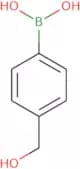
Prodotto fuori produzione4-(Hydroxymethyl)phenylboronic acid
CAS:<p>4-(Hydroxymethyl)phenylboronic acid is an organic compound that has been identified as a reactive, fatty acid. It has shown antibacterial efficacy against gram-positive and gram-negative bacteria in the presence of nanogels. 4-(Hydroxymethyl)phenylboronic acid is also a cross-linking agent that can be used to form hydrogels for tissue engineering applications. This chemical is being studied as a potential treatment for inflammatory bowel disease and diabetes mellitus. 4-(Hydroxymethyl)phenylboronic acid has been shown to have anti-cancer properties by inhibiting the proliferation of cancer cells and inducing apoptosis. The molecule also undergoes structural analysis using confocal microscopy.</p>Formula:C7H9BO3Peso molecolare:151.96 g/molRef: 3D-FH50587
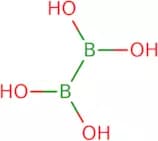
Prodotto fuori produzioneTetrahydroxydiborane
CAS:<p>Tetrahydroxydiborane is an organic compound that contains a hydroxyl group. It has been shown to be an effective nucleophile in the mechanism studies of hydrolysis of halides and nitro compounds. Tetrahydroxydiborane is also used in the Suzuki coupling reaction, which is a chemical reaction between an aryl halide and sodium carbonate, as well as in cationic polymerization. This compound may also have biological applications such as the use of tetrahydroxydiborane as a fluorescence probe for optical sensor detection of autoimmune diseases.</p>Formula:H4B2O4Purezza:Min. 95%Colore e forma:White PowderPeso molecolare:89.65 g/molPotassium dihydrogen arsenate
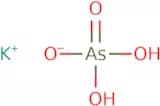
CAS:<p>Potassium dihydrogen arsenate is an inorganic chemical that is used as a pesticide. It prevents the synthesis of proteins by inhibiting soybean trypsin. The optimum concentration for chrysoperla is 1.6 mg/L, which has been shown to be sublethal at levels below 5 mg/L. This chemical has also been shown to have effects on light exposure and thermal expansion. Potassium dihydrogen arsenate belongs to the ferroelectric class of compounds and has a hydrogen bond with water, which may explain its uptake into plants.</p>Formula:H2AsKO4Purezza:Min. 95%Peso molecolare:180.04 g/mol(3,4,5-Trifluorophenyl)boronic acid
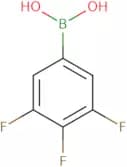
CAS:<p>The trifluorophenylboronic acid is a boronic acid that has been used in the synthesis of vitamin B12. This compound is often used as a catalyst for the Suzuki coupling reaction. It can also be used to synthesize amides and synthons. The trifluorophenylboronic acid is soluble in water, ethanol, and acetone. The pH of the solution depends on the type of base added. For example, when an amine is added to the solution, it increases to approximately 8-9. When a p-hydroxybenzoic acid is added to the solution, it decreases to approximately 2-3.</p>Formula:C6H4BF3O2Purezza:Min. 95%Colore e forma:PowderPeso molecolare:175.9 g/molRef: 3D-FT70125
Prodotto fuori produzioneIron(II) tetrafluoroborate - 40-45% aqueous solution
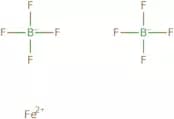
CAS:<p>Iron(II) tetrafluoroborate is a green-yellow crystalline solid that is soluble in water. It has been shown to have structural and optical properties that are similar to those of ferric chloride, but with the advantage of being less toxic. Iron(II) tetrafluoroborate is used as a homogeneous catalyst for organic reactions such as the hydrogenation of nitroarenes and the reduction of ketones. The catalytic activity of Iron(II) tetrafluoroborate arises from its ability to form hydrogen bonding interactions with other molecules and ions in solution.<br>Iron(II) tetrafluoroborate undergoes a number of reactions with other compounds, including cleavage products such as hydrogen sulfate and nitrogen atoms, which may be due to its chelate ligand. In coordination chemistry, Iron(II) tetrafluoroborate can form coordination complexes by reacting with potassium dichromate or calcium carbonate. These complexes are</p>Formula:B2F8FePurezza:About 45%Colore e forma:Slightly Green Clear LiquidPeso molecolare:229.45 g/molRef: 3D-FI105721
Prodotto fuori produzioneEthylammonium Tetrafluoroborate
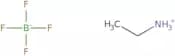
CAS:Prodotto controllato<p>Ethylammonium tetrafluoroborate is an ionic liquid that is a colorless, nonvolatile liquid at room temperature. It has a melting point of -9 °C and a boiling point of 230 °C. This compound is soluble in water and organic solvents, but insoluble in diethyl ether. Ethylammonium tetrafluoroborate can be used as an electrolyte for lithium-ion batteries. The reversible oxidation reaction of ethylammonium tetrafluoroborate can be catalyzed by the addition of fluorine or carbonyl groups to the molecule. The NMR spectra of ethylammonium tetrafluoroborate show that it contains an alcohol group with a phase transition temperature near 35 °C and an activation energy near 15 kJ/mol. This compound also undergoes polymerization reactions with various types of monomers, such as vinyl acetate and methyl methacrylate,</p>Formula:C2H7BF4NPurezza:Min. 95%Colore e forma:PowderPeso molecolare:131.89 g/mol