Silani
Sottocategorie di "Silani"
Trovati 1234 prodotti di "Silani"
n-PROPYLTRICHLOROSILANE
CAS:Alkyl Silane - Conventional Surface Bonding
Aliphatic, fluorinated aliphatic or substituted aromatic hydrocarbon substituents are the hydrophobic entities which enable silanes to induce surface hydrophobicity. The organic substitution of the silane must be non-polar. The hydrophobic effect of the organic substitution can be related to the free energy of transfer of hydrocarbon molecules from an aqueous phase to a homogeneous hydrocarbon phase. A successful hydrophobic coating must eliminate or mitigate hydrogen bonding and shield polar surfaces from interaction with water by creating a non-polar interphase. Although silane and silicone derived coatings are in general the most hydrophobic, they maintain a high degree of permeability to water vapor. This allows coatings to breathe and reduce deterioration at the coating interface associated with entrapped water. Since ions are not transported through non-polar silane and silicone coatings, they offer protection to composite structures ranging from pigmented coatings to rebar reinforced concrete. A selection guide for hydrophobic silanes can be found on pages 22-31 of the Hydrophobicity, Hydrophilicity and Silane Surface Modification brochure.
n-Propyltrichlorosilane; Trichloropropylsilane
ΔHvap: 36.4 kJ/molVapor pressure, 16 °C: 10 mmFormula:C3H7Cl3SiPurezza:97%Colore e forma:Straw LiquidPeso molecolare:177.53BIS(TRIETHOXYSILYL)METHANE
CAS:Alkyl Silane - Dipodal Surface Bonding
Aliphatic, fluorinated aliphatic or substituted aromatic hydrocarbon substituents are the hydrophobic entities which enable silanes to induce surface hydrophobicity. The organic substitution of the silane must be non-polar. The hydrophobic effect of the organic substitution can be related to the free energy of transfer of hydrocarbon molecules from an aqueous phase to a homogeneous hydrocarbon phase. A successful hydrophobic coating must eliminate or mitigate hydrogen bonding and shield polar surfaces from interaction with water by creating a non-polar interphase. Although silane and silicone derived coatings are in general the most hydrophobic, they maintain a high degree of permeability to water vapor. This allows coatings to breathe and reduce deterioration at the coating interface associated with entrapped water. Since ions are not transported through non-polar silane and silicone coatings, they offer protection to composite structures ranging from pigmented coatings to rebar reinforced concrete. A selection guide for hydrophobic silanes can be found on pages 22-31 of the Hydrophobicity, Hydrophilicity and Silane Surface Modification brochure.
Non Functional Alkoxy Silane
Silane coupling agents have the ability to form a durable bond between organic and inorganic materials to generate desired heterogeneous environments or to incorporate the bulk properties of different phases into a uniform composite structure. The general formula has two classes of functionality. The hydrolyzable group forms stable condensation products with siliceous surfaces and other oxides such as those of aluminum, zirconium, tin, titanium, and nickel. The organofunctional group alters the wetting or adhesion characteristics of the substrate, utilizes the substrate to catalyze chemical transformations at the heterogeneous interface, orders the interfacial region, or modifies its partition characteristics, and significantly effects the covalent bond between organic and inorganic materials.
Dipodal Silane
Dipodal silanes are a series of adhesion promoters that have intrinsic hydrolytic stabilities up to ~10,000 times greater than conventional silanes and are used in applications such as plastic optics, multilayer printed circuit boards and as adhesive primers for ferrous and nonferrous metals. They have the ability to form up to six bonds to a substrate compared to conventional silanes with the ability to form only three bonds to a substrate. Many conventional coupling agents are frequently used in combination with 10-40% of a non-functional dipodal silane, where the conventional coupling agent provides the appropriate functionality for the application, and the non-functional dipodal silane provides increased durability. Also known as bis-silanes additives enhance hydrolytic stability, which impacts on increased product shelf life, ensures better substrate bonding and also leads to improved mechanical properties in coatings as well as composite applications.
Bis(triethoxysilyl)methane; 4,4,6,6-tetraethoxy-3,7-dioxa-4,6-disilanonane
Intermediate for sol-gel coatings, hybrid inorganic-organic polymersForms methylene-bridged mesoporous structuresForms modified silica membranes that separate propylene/propane mixturesFormula:C13H32O6Si2Purezza:97%Colore e forma:LiquidPeso molecolare:340.56BIS[m-(2-TRIETHOXYSILYLETHYL)TOLYL]POLYSULFIDE
CAS:Bis[m-(2-triethoxysilylethyl)tolyl]polysulfide
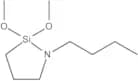
Sulfur functional dipodal silaneDark, viscous liquid Coupling agent for styrene-butadiene rubber, SBRFormula:C30H50O6S(2-4)Si2Purezza:85%Colore e forma:Dark LiquidPeso molecolare:627-691N-n-BUTYL-AZA-2,2-DIMETHOXYSILACYCLOPENTANE
CAS:N-n-Butyl-aza-2,2-dimethoxysilacyclopentane
Amine functional dialkoxy silaneCross-linking cyclic azasilaneCoupling agent for nanoparticlesInterlayer bonding agent for anti-reflective lensesConventional analog available: SIB1932.2Formula:C9H21NO2SiPurezza:97%Colore e forma:Straw LiquidPeso molecolare:203.36ETHYLTRIMETHOXYSILANE
CAS:Alkyl Silane - Conventional Surface Bonding
Aliphatic, fluorinated aliphatic or substituted aromatic hydrocarbon substituents are the hydrophobic entities which enable silanes to induce surface hydrophobicity. The organic substitution of the silane must be non-polar. The hydrophobic effect of the organic substitution can be related to the free energy of transfer of hydrocarbon molecules from an aqueous phase to a homogeneous hydrocarbon phase. A successful hydrophobic coating must eliminate or mitigate hydrogen bonding and shield polar surfaces from interaction with water by creating a non-polar interphase. Although silane and silicone derived coatings are in general the most hydrophobic, they maintain a high degree of permeability to water vapor. This allows coatings to breathe and reduce deterioration at the coating interface associated with entrapped water. Since ions are not transported through non-polar silane and silicone coatings, they offer protection to composite structures ranging from pigmented coatings to rebar reinforced concrete. A selection guide for hydrophobic silanes can be found on pages 22-31 of the Hydrophobicity, Hydrophilicity and Silane Surface Modification brochure.
Ethyltrimethoxysilane; Trimethoxysilylethane; Trimethoxyethylsilane
Viscosity: 0.5 cStΔHcomb: 14,336 kJ/molDevelops clear resin coating systems more readily than methyltrimethoxysilaneTrialkoxy silaneFormula:C5H14O3SiPurezza:97%Colore e forma:LiquidPeso molecolare:150.253-PHENOXYPROPYLDIMETHYLCHLOROSILANE
CAS:Aromatic Silane - Conventional Surface Bonding
Aliphatic, fluorinated aliphatic or substituted aromatic hydrocarbon substituents are the hydrophobic entities which enable silanes to induce surface hydrophobicity. The organic substitution of the silane must be non-polar. The hydrophobic effect of the organic substitution can be related to the free energy of transfer of hydrocarbon molecules from an aqueous phase to a homogeneous hydrocarbon phase. A successful hydrophobic coating must eliminate or mitigate hydrogen bonding and shield polar surfaces from interaction with water by creating a non-polar interphase. Although silane and silicone derived coatings are in general the most hydrophobic, they maintain a high degree of permeability to water vapor. This allows coatings to breathe and reduce deterioration at the coating interface associated with entrapped water. Since ions are not transported through non-polar silane and silicone coatings, they offer protection to composite structures ranging from pigmented coatings to rebar reinforced concrete. A selection guide for hydrophobic silanes can be found on pages 22-31 of the Hydrophobicity, Hydrophilicity and Silane Surface Modification brochure.
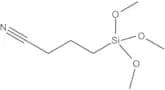
3-Phenoxypropyldimethylchlorosilane; (3-Dimethylchlorosilylpropoxy)benzeneFormula:C11H17ClOSiPurezza:97%Colore e forma:Pale Yellow LiquidPeso molecolare:228.783-CYANOPROPYLTRIMETHOXYSILANE
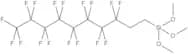
CAS:Formula:C7H15NO3SiPurezza:97%Colore e forma:Straw LiquidPeso molecolare:189.29(HEPTADECAFLUORO-1,1,2,2-TETRAHYDRODECYL)TRIMETHOXYSILANE
CAS:Fluorinated Alkyl Silane - Conventional Surface Bonding
Aliphatic, fluorinated aliphatic or substituted aromatic hydrocarbon substituents are the hydrophobic entities which enable silanes to induce surface hydrophobicity. The organic substitution of the silane must be non-polar. The hydrophobic effect of the organic substitution can be related to the free energy of transfer of hydrocarbon molecules from an aqueous phase to a homogeneous hydrocarbon phase. A successful hydrophobic coating must eliminate or mitigate hydrogen bonding and shield polar surfaces from interaction with water by creating a non-polar interphase. Although silane and silicone derived coatings are in general the most hydrophobic, they maintain a high degree of permeability to water vapor. This allows coatings to breathe and reduce deterioration at the coating interface associated with entrapped water. Since ions are not transported through non-polar silane and silicone coatings, they offer protection to composite structures ranging from pigmented coatings to rebar reinforced concrete. A selection guide for hydrophobic silanes can be found on pages 22-31 of the Hydrophobicity, Hydrophilicity and Silane Surface Modification brochure.
(Heptadecafluoro-1,1,2,2-tetrahydrodecyl)trimethoxysilane; (1H,1H,2H,2H-Perfluorodecyl)trimethoxysilane; Heptadecafluorodecyltrimethoxysilane
Packaged over copper powderTreated surface contact angle, water: 115 °Cγc of treated surfaces: 12 mN/mSurface modification of titanium and silica substrates reduces coefficient of frictionForms inorganic hybrids with photoinduceable refractive index reductionTrialkoxy silaneFormula:C13H13F17O3SiPurezza:97%Colore e forma:Straw LiquidPeso molecolare:568.33-[METHOXY(POLYETHYLENEOXY)6-9]PROPYLTRIMETHOXYSILANE, tech
CAS:Tipped PEG Silane (459-591 g/mol)
Methoxy-PEG-9C3-silanePEO, Trimethoxysilane termination utilized for hydrophilic surface modificationForms charge neutral coatings on CdSe quantum dots which conjugate DNAPEGylation reagentReduces non-specific binding of proteinsHydrogen bonding hydrophilic silaneFormula:CH3O(C2H4O)6-9(CH2)3Si(OCH3)3Colore e forma:Clear Yellow To Amber LiquidPeso molecolare:459-591Ref: 3H-SIM6492.7
25gPrezzo su richiesta2kgPrezzo su richiesta100gPrezzo su richiesta20kgPrezzo su richiestaN-(2-AMINOETHYL)-3-AMINOPROPYLTRIMETHOXYSILANE, tech
CAS:Diamino Functional Trialkoxy Silane
Silane coupling agents have the ability to form a durable bond between organic and inorganic materials to generate desired heterogeneous environments or to incorporate the bulk properties of different phases into a uniform composite structure. The general formula has two classes of functionality. The hydrolyzable group forms stable condensation products with siliceous surfaces and other oxides such as those of aluminum, zirconium, tin, titanium, and nickel. The organofunctional group alters the wetting or adhesion characteristics of the substrate, utilizes the substrate to catalyze chemical transformations at the heterogeneous interface, orders the interfacial region, or modifies its partition characteristics, and significantly effects the covalent bond between organic and inorganic materials.
N-(2-Aminoethyl)-3-aminopropyltrimethoxysilane; N-[3-(Trimethoxysilyl)propyl]ethylenediamine; DAMO
For higher purity see SIA0591.1 Viscosity: 6.5 cStγc of treated surfaces: 36.5 mN/mSpecific wetting surface: 358 m2/gCoefficient of thermal expansion: 0.8x10⁻³Coupling agent for polyamides, polycarbonates (e.g. in CDs), polyesters and copper/brass adhesionFilm-forming coupling agent/primer, berglass size componentFor cyclic version: SID3543.0 For pre-hydrolyzed version: SIA0590.0 Used in the immobilization of copper (II) catalyst on silicaUsed together w/ SID3396.0 to anchor PdCl2 catalyst to silica for acceleration of the Tsuji-Trost reaction in the allylation of nucleophilesDetermined by TGA a 25% weight loss of dried hydrolysates at 390 °CAvailable as a cohydrolysate with n-propyltrimethoxysilane (SIP6918.0) ; see SIA0591.3Formula:C8H22N2O3SiPurezza:techColore e forma:Straw LiquidPeso molecolare:222.36Ref: 3H-SIA0591.0
25gPrezzo su richiesta2kgPrezzo su richiesta16kgPrezzo su richiesta180kgPrezzo su richiestan-PROPYLDIMETHYLMETHOXYSILANE
CAS:Alkyl Silane - Conventional Surface Bonding
Aliphatic, fluorinated aliphatic or substituted aromatic hydrocarbon substituents are the hydrophobic entities which enable silanes to induce surface hydrophobicity. The organic substitution of the silane must be non-polar. The hydrophobic effect of the organic substitution can be related to the free energy of transfer of hydrocarbon molecules from an aqueous phase to a homogeneous hydrocarbon phase. A successful hydrophobic coating must eliminate or mitigate hydrogen bonding and shield polar surfaces from interaction with water by creating a non-polar interphase. Although silane and silicone derived coatings are in general the most hydrophobic, they maintain a high degree of permeability to water vapor. This allows coatings to breathe and reduce deterioration at the coating interface associated with entrapped water. Since ions are not transported through non-polar silane and silicone coatings, they offer protection to composite structures ranging from pigmented coatings to rebar reinforced concrete. A selection guide for hydrophobic silanes can be found on pages 22-31 of the Hydrophobicity, Hydrophilicity and Silane Surface Modification brochure.
n-Propyldimethylmethoxysilane; Methoxypropyldimethylsilane
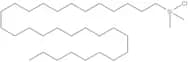
Monoalkoxy silaneFormula:C6H16OSiPurezza:97%Colore e forma:LiquidPeso molecolare:132.28TRIACONTYLDIMETHYLCHLOROSILANE, blend
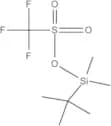
CAS:Formula:C32H67ClSiColore e forma:SolidPeso molecolare:515.42t-BUTYLDIMETHYLSILYLTRIFLUOROMETHANESULFONATE
CAS:Trialkylsilyl Blocking Agent
Used as a protecting group for reactive hydrogens in alcohols, amines, thiols, and carboxylic acids. Organosilanes are hydrogen-like, can be introduced in high yield, and can be removed under selective conditions. They are stable over a wide range of reaction conditions and can be removed in the presence of other functional groups, including other protecting groups. The tolerance of silylated alcohols to chemical transformations summary is presented in Table 1 of the Silicon-Based Blocking Agents brochure.
tert-Butyldimethylsilyltrifluoromethanesulfonate; TBS-OTf; t-Butyldimethylsilyltriflate
More reactive than SIB1935.0Converts acetates to TBS ethersUsed for the protection of alcohols, amines, thiols, lactams, and carboxylic acidsClean NMR characteristics of protecting groupFacile removal with flouride ion sourcesSummary of selective deprotection conditions is provided in Table 7 through Table 20 of the Silicon-Based Blocking Agents brochureFormula:C7H15F3O3SSiColore e forma:Straw LiquidPeso molecolare:264.33TRIMETHYLETHOXYSILANE
CAS:Formula:C5H14OSiPurezza:97%Colore e forma:Clear To Straw LiquidPeso molecolare:118.25PHENYLDIMETHYLCHLOROSILANE
CAS:Phenyl-Containing Blocking Agent
Used as a protecting group for reactive hydrogens in alcohols, amines, thiols, and carboxylic acids. Organosilanes are hydrogen-like, can be introduced in high yield, and can be removed under selective conditions. They are stable over a wide range of reaction conditions and can be removed in the presence of other functional groups, including other protecting groups. The tolerance of silylated alcohols to chemical transformations summary is presented in Table 1 of the Silicon-Based Blocking Agents brochure.
Aromatic Silane - Conventional Surface Bonding
Aliphatic, fluorinated aliphatic or substituted aromatic hydrocarbon substituents are the hydrophobic entities which enable silanes to induce surface hydrophobicity. The organic substitution of the silane must be non-polar. The hydrophobic effect of the organic substitution can be related to the free energy of transfer of hydrocarbon molecules from an aqueous phase to a homogeneous hydrocarbon phase. A successful hydrophobic coating must eliminate or mitigate hydrogen bonding and shield polar surfaces from interaction with water by creating a non-polar interphase. Although silane and silicone derived coatings are in general the most hydrophobic, they maintain a high degree of permeability to water vapor. This allows coatings to breathe and reduce deterioration at the coating interface associated with entrapped water. Since ions are not transported through non-polar silane and silicone coatings, they offer protection to composite structures ranging from pigmented coatings to rebar reinforced concrete. A selection guide for hydrophobic silanes can be found on pages 22-31 of the Hydrophobicity, Hydrophilicity and Silane Surface Modification brochure.
Phenyldimethylchlorosilane; Chlorodimethylphenylsilane; Dimethylphenylchlorosilane
Viscosity: 1.4 cStΔHvap: 47.7 kJ/molVapor pressure, 25 °: 1 mmForms cuprateUsed in analytical proceduresSummary of selective deprotection conditions is provided in Table 7 through Table 20 of the Silicon-Based Blocking Agents brochureFormula:C8H11ClSiPurezza:97%Colore e forma:Straw LiquidPeso molecolare:170.71Ref: 3H-SIP6728.0
2kgPrezzo su richiesta16kgPrezzo su richiesta750gPrezzo su richiesta180kgPrezzo su richiesta(3- GLYCIDOXYPROPYL)TRIMETHOXYSILANE
CAS:(3- Glycidoxypropyl)trimethoxysilane; 3-(2,3-epoxypropoxy)propyltrimethoxysilane; trimethoxy-[3-(oxiran-2-ylmethoxy)propyl]silane; 3-(trimethoxysilyl)propyl glycidyl ether; GLYMO
Epoxy functional trialkoxy silaneViscosity: 3.2 cStγc of treated surfaces: 38.55 mN/mSpecific wetting surface area: 331 m2/gComponent in aluminum metal bonding adhesivesCoupling agent for epoxy composites employed in electronic "chip" encapsulationComponent in abrasion resistant coatings for plastic opticsUsed to prepare epoxy-containing hybrid organic-inorganic materialsUsed in microparticle surface modificationEpoxy silane treated surfaces convert to hydrophilic-diols when exposed to moistureFormula:C9H20O5SiPurezza:98%Colore e forma:Straw LiquidPeso molecolare:236.34Ref: 3H-SIG5840.0
2kgPrezzo su richiesta100gPrezzo su richiesta18kgPrezzo su richiesta180kgPrezzo su richiestaETHYLTRICHLOROSILANE
CAS:Alkyl Silane - Conventional Surface Bonding
Aliphatic, fluorinated aliphatic or substituted aromatic hydrocarbon substituents are the hydrophobic entities which enable silanes to induce surface hydrophobicity. The organic substitution of the silane must be non-polar. The hydrophobic effect of the organic substitution can be related to the free energy of transfer of hydrocarbon molecules from an aqueous phase to a homogeneous hydrocarbon phase. A successful hydrophobic coating must eliminate or mitigate hydrogen bonding and shield polar surfaces from interaction with water by creating a non-polar interphase. Although silane and silicone derived coatings are in general the most hydrophobic, they maintain a high degree of permeability to water vapor. This allows coatings to breathe and reduce deterioration at the coating interface associated with entrapped water. Since ions are not transported through non-polar silane and silicone coatings, they offer protection to composite structures ranging from pigmented coatings to rebar reinforced concrete. A selection guide for hydrophobic silanes can be found on pages 22-31 of the Hydrophobicity, Hydrophilicity and Silane Surface Modification brochure.
Ethyltrichlorosilane; Trichloroethylsilane
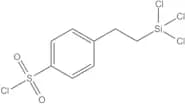
Viscosity: 0.48 cStΔHcomb: -2,696 kJ/molΔHform: -84 kJ/molΔHvap: 37.7 kJ/molΔHfus: 7.0 kJ/molDipole moment: 2.1Vapor pressure, 20 °C: 26 mmVapor pressure, 30.4 °C: 66 mmCritical temperature: 287 °CCoefficient of thermal expansion: 1.5 x 10⁻³Employed in the cobalt-catalyzed Diels-Alder approach to 1,3-disubstituted and 1,2,3-trisubstituted benzenesFormula:C2H5Cl3SiPurezza:97%Colore e forma:Straw LiquidPeso molecolare:163.512-(4-CHLOROSULFONYLPHENYL)ETHYLTRICHLOROSILANE, 50% in toluene
CAS:Formula:C8H8Cl4O2SSiColore e forma:Straw Amber LiquidPeso molecolare:338.1111-AZIDOUNDECYLTRIMETHOXYSILANE, 95%
CAS:Azide Functional Trialkoxy Silane
Silane coupling agents have the ability to form a durable bond between organic and inorganic materials to generate desired heterogeneous environments or to incorporate the bulk properties of different phases into a uniform composite structure. The general formula has two classes of functionality. The hydrolyzable group forms stable condensation products with siliceous surfaces and other oxides such as those of aluminum, zirconium, tin, titanium, and nickel. The organofunctional group alters the wetting or adhesion characteristics of the substrate, utilizes the substrate to catalyze chemical transformations at the heterogeneous interface, orders the interfacial region, or modifies its partition characteristics, and significantly effects the covalent bond between organic and inorganic materials.
11-Azidoundecyltrimethoxysilane, 11-(trimethoxysilyl)undecyl azide
Coupling agent for surface modificationUsed in "click" chemistryAVOID CONTACT WITH METALSFormula:C14H31N3O3SiPurezza:95%Colore e forma:Straw To Amber LiquidPeso molecolare:317.5


![BIS[m-(2-TRIETHOXYSILYLETHYL)TOLYL]POLYSULFIDE](/_next/image/?url=https%3A%2Fstatic.cymitquimica.com%2Fproducts%2F3H%2Fthumb-webp%2FSIB1820.5.webp&w=3840&q=75)


![3-[METHOXY(POLYETHYLENEOXY)6-9]PROPYLTRIMETHOXYSILANE, tech](/_next/image/?url=https%3A%2Fstatic.cymitquimica.com%2Fproducts%2F3H%2Fthumb-webp%2FSIM6492.7.webp&w=3840&q=75)