


Aldeidi
Gli aldeidi sono composti organici che contengono un gruppo carbonilico (C=O) legato ad almeno un atomo di idrogeno. Questi composti versatili sono fondamentali in varie reazioni chimiche, tra cui ossidazione, riduzione e addizione nucleofila. Gli aldeidi sono building blocks essenziali nella sintesi di prodotti farmaceutici, fragranze e polimeri. Presso CymitQuimica, offriamo una vasta selezione di aldeidi di alta qualità per supportare le vostre applicazioni di ricerca e industriali.
Trovati 8551 prodotti di "Aldeidi"
Ordinare per
Purezza (%)
0
100
|
0
|
50
|
90
|
95
|
100
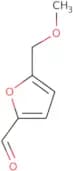
5-(Methoxymethyl)-2-furancarboxaldehyde
CAS:<p>5-hydroxymethylfurfural (5-hmf) is an organic compound that is produced when a carbohydrate or sugar undergoes oxidation. It is used as an additive in animal feed and as an industrial chemical. 5-hmf is a solid catalyst that can be used at high temperatures, making it suitable for use in the production of 2,6-dihydroxybenzoic acid. The reaction mechanism of 5-hmf involves the dehydration of furfural to form 5-hydroxymethylfurfural. This process occurs when a molecule of water reacts with furfural to produce two molecules of 5-hmf. The reaction may be accelerated by introducing heat, which breaks down the hydrogen bonds between the molecules of furfural and water.</p>Formula:C7H8O3Purezza:Min. 95%Colore e forma:Clear LiquidPeso molecolare:140.14 g/molFerrocenecarboxaldehyde
CAS:<p>Ferrocenecarboxaldehyde is a fatty acid with a ferrocene carboxylic acid group. It has been shown to have antimicrobial activity against bacteria, fungi, and yeast when it was mixed with nitric acid. Ferrocenecarboxaldehyde can be synthesized by reacting ferrocene with glycerol in the presence of sulfuric acid. The reaction mechanism of this synthesis is as follows: The structural analysis of ferrocenecarboxaldehyde has been studied using FT-IR spectroscopy and NMR spectroscopy. The chemical structure of ferrocenecarboxaldehyde is as follows: The asymmetric synthesis of ferrocenecarboxaldehyde is shown below:</p>Formula:C11H10FeOPurezza:Min. 95%Colore e forma:PowderPeso molecolare:214.04 g/mol(R)-Perillaldehyde
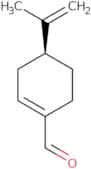
CAS:<p>(R)-Perillaldehyde is an activated cardenolide that binds to flavoproteins and inhibits the oxygenation of 4-hydroxycoumarin. It is a stereoselective, substrate binding, and oxygenated flavoenzyme inhibitor. The orientation of perillaldehyde with respect to the flavin may be important for its activity in the enzyme's active site.</p>Formula:C10H14OPurezza:Min. 95%Peso molecolare:150.22 g/molDexamethasone-δ17,20 21-aldehyde
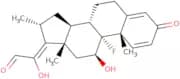
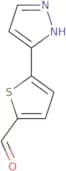
CAS:Prodotto controllato<p>Please enquire for more information about Dexamethasone-δ17,20 21-aldehyde including the price, delivery time and more detailed product information at the technical inquiry form on this page</p>Formula:C22H27FO4Purezza:Min. 95%Colore e forma:PowderPeso molecolare:374.45 g/mol5-(1H-Pyrazol-5-yl)thiophene-2-carbaldehyde
CAS:<p>Please enquire for more information about 5-(1H-Pyrazol-5-yl)thiophene-2-carbaldehyde including the price, delivery time and more detailed product information at the technical inquiry form on this page</p>Formula:C8H6N2OSPurezza:Min. 95%Peso molecolare:178.21 g/mol2-Furaldehyde diethylacetal
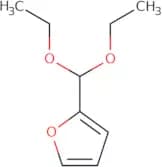
CAS:<p>2-Furaldehyde diethylacetal is a synthetic compound that has been used in the synthesis of calcium carbonate. It is also a potent inhibitor of p. aeruginosa and other bacteria, as well as organic acids and halogen compounds. It reacts with hydroxy groups to form aldehydes, which are then oxidized to form carboxylic acid derivatives. The reaction mechanism for this compound is not well understood, but it is thought that the activation energy for the reaction may be low due to the presence of a furfural functional group.</p>Formula:C9H14O3Purezza:Min. 95%Peso molecolare:170.21 g/mol3-Hydroxy-4-nitrobenzaldehyde
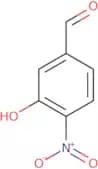
CAS:<p>3-Hydroxy-4-nitrobenzaldehyde is a ternary complex, which consists of three molecules that are bound to each other in a specific way. It has been observed in the nmr spectra and it has been proposed as a fluorescence probe for the detection of hydrogen bonds. 3-Hydroxy-4-nitrobenzaldehyde catalyzes the reaction by forming a covalent bond with the pbr322 dna, which is an important DNA molecule in bacteria. The enzyme mechanism is not fully understood, but it has been shown that it can bind to Toll-like receptor 4 (TLR4), which is an innate immune system protein. This binding event activates TLR4, leading to the inflammatory response. 3-Hydroxy-4-nitrobenzaldehyde has shown efficacy against microglia cells and animal experiments have shown that this compound may be useful for reducing pain after surgery or injury.</p>Formula:C7H5NO4Purezza:Min. 95%Colore e forma:PowderPeso molecolare:167.12 g/mol2,4-Dihydroxy-6-methylbenzaldehyde
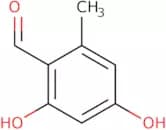
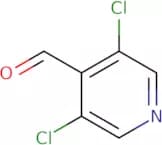
CAS:<p>2,4-Dihydroxy-6-methylbenzaldehyde is a chemical that is found naturally in a variety of plants. It has been shown to have immunomodulatory and anti-inflammatory effects in vitro and in vivo. 2,4-Dihydroxy-6-methylbenzaldehyde has been shown to reduce the production of inflammatory molecules such as tumor necrosis factor alpha (TNFα) and interleukin 12 (IL-12) by inhibiting the activation of microglia cells. This compound also inhibits LPS induced inflammatory response in human carcinoma cells. 2,4-Dihydroxy-6 methylbenzaldehyde is currently undergoing clinical trials for its potential use in regenerative medicine.</p>Formula:C8H8O3Purezza:Min. 95%Peso molecolare:152.15 g/mol3,5-Dichloro-4-pyridinecarboxaldehyde
CAS:<p>3,5-Dichloro-4-pyridinecarboxaldehyde is a synthetic heterocycle that has been studied for its pharmacokinetic properties. The compound has the ability to bind to the active site of metalloporphyrin and inhibit the enzyme's activity. This inhibition leads to an increase in the levels of homologous aldehydes, which are oxidized by hydrogen peroxide to produce electrosprays. 3,5-Dichloro-4-pyridinecarboxaldehyde also has a number of oxidation products that have been found in experiments using purines as substrates.</p>Formula:C6H3Cl2NOPurezza:Min. 95%Peso molecolare:176 g/mol4-Bromobenzaldehyde
CAS:<p>Please enquire for more information about 4-Bromobenzaldehyde including the price, delivery time and more detailed product information at the technical inquiry form on this page</p>Formula:C7H5BrOPeso molecolare:185.03 g/molRef: 3D-B-5782
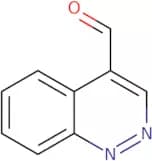
1kgPrezzo su richiesta100gPrezzo su richiesta250gPrezzo su richiesta500gPrezzo su richiesta4-Cinnolinecarboxaldehyde
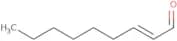
CAS:<p>4-Cinnolinecarboxaldehyde is an organic compound that belongs to the group of cinnoline. It is a colorless liquid that can be used as a precursor in the production of aluminum metal. 4-Cinnolinecarboxaldehyde reacts with lithium aluminum hydride to form a compound that can be used as a reducing agent in organic chemistry. 4-Cinnolinecarboxaldehyde is also used as a precursor for preparing other compounds, such as lithium aluminum hydride and lithium aluminum trihydride.</p>Formula:C9H6N2OPurezza:Min. 95%Peso molecolare:158.16 g/molTrans-2-nonenal
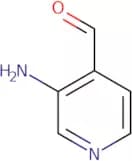
CAS:<p>Trans-2-nonenal is a monoclonal antibody that recognizes the physiological function of cardiac and rat liver microsomes. It has been shown to inhibit enzyme activities in both cell lines. Trans-2-nonenal has also been shown to protect against ischemia/reperfusion injury in rats by reducing the release of intracellular Ca2+ and ATP levels. Trans-2-nonenal is genotoxic and induces oxidative injury, which may be due to its ability to react with caproic acid to form reactive oxygen species.</p>Formula:C9H16OPurezza:Min. 95%Peso molecolare:140.22 g/mol3-Aminopyridine-4-carboxaldehyde
CAS:<p>3-Aminopyridine-4-carboxaldehyde (3APCA) is an acridone that is a colorless, crystalline solid. It has a molecular formula of C8H6N2O2 and a molecular weight of 174.14 g/mol. 3APCA can be synthesized by heating 2-pyridinecarboxylic acid with chloroacetyl chloride in the presence of pyridine as a solvent. The compound can be detected by nmr spectra, which are efficient methods for characterization of this chemical. The spectrum shows peaks at δ 8.22 ppm (1H), 7.61 ppm (1H), 6.99 ppm (2H), 5.87 ppm (1H), 4.06 ppm (2H). 3APCA has been shown to react with alkyl bromides to form carboxylic acids, which are shown by the peaks at δ 8.22 ppm and</p>Formula:C6H6N2OPurezza:Min. 95%Peso molecolare:122.12 g/mol2-Bromo-4-methoxybenzaldehyde
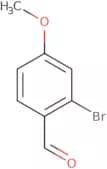
CAS:<p>2-Bromo-4-methoxybenzaldehyde is a cyclic, stereoselectively eliminable, acrylate that can be used in the asymmetric synthesis of sulfamidate and lactam. It can also be used to synthesize quinoline derivatives with aluminium chloride. This product has been shown to yield good yields when reacted with functional groups such as halides and nature. 2-Bromo-4-methoxybenzaldehyde is found in biomolecular reactions.</p>Formula:C8H7BrO2Colore e forma:PowderPeso molecolare:215.04 g/molTetrafluoroterephthaldehyde
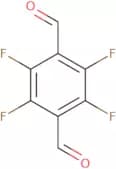
CAS:<p>Tetrafluoroterephthaldehyde (TFPA) is a reactive aldehyde that can be synthesized in the laboratory by the reaction of trifluoromethanesulfonic acid with an aromatic hydrocarbon or ester compound. TFPA has been used to study the synthesis of supramolecular assemblies and supramolecular chemistry. The radiation-induced formation of TFPA is a useful method for the synthesis of polymers, and the thermal expansion of TFPA is high enough to be used as a thermometer. TFPA has shown chemical stability in both acidic and alkaline media, as well as resistance to radiation and oxidation. TFPA also has a high boiling point, making it useful for desolvation during gas chromatography experiments.</p>Formula:C8H2F4O2Purezza:Min. 95%Colore e forma:PowderPeso molecolare:206.09 g/molSuccinaldehyde bis(dimethyl acetal)
CAS:<p>Please enquire for more information about Succinaldehyde bis(dimethyl acetal) including the price, delivery time and more detailed product information at the technical inquiry form on this page</p>Formula:C8H18O4Purezza:Min. 95%Colore e forma:Clear LiquidPeso molecolare:178.23 g/molH-Gly-Phe-Gly-aldehyde semicarbazone acetate salt
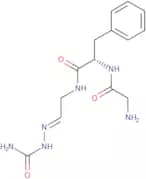
CAS:<p>Please enquire for more information about H-Gly-Phe-Gly-aldehyde semicarbazone acetate salt including the price, delivery time and more detailed product information at the technical inquiry form on this page</p>Formula:C14H20N6O3Purezza:Min. 95%Peso molecolare:320.35 g/molButyraldehyde
CAS:<p>Butyraldehyde is a colorless to yellowish liquid with a strong, pungent odor. It is soluble in water and has an acidic pH of 2.6-3.0. Butyraldehyde is used as a chemical intermediate for the production of polyvinyl acetate and can be made by reacting acetic acid with butanol or butyl acetate. This chemical reacts with human serum albumin at low concentrations and may have biological properties such as catalyzing the conversion of picolinic acid to nicotinic acid, which aids in the prevention against infectious diseases. Butyraldehyde also has synergistic effects when used with picolinic acid, increasing its effectiveness in combating infection.</p>Formula:C4H8OPurezza:Min. 95%Colore e forma:Clear LiquidPeso molecolare:72.11 g/mol6-Chloro-1,3-dimethyl-1H-pyrazolo[3,4-b]pyridine-5-carboxaldehyde
CAS:<p>Please enquire for more information about 6-Chloro-1,3-dimethyl-1H-pyrazolo[3,4-b]pyridine-5-carboxaldehyde including the price, delivery time and more detailed product information at the technical inquiry form on this page</p>Formula:C9H8ClN3OPurezza:Min. 95%Peso molecolare:209.63 g/mol3-(Methylthio)propionaldehyde
CAS:<p>3-(Methylthio)propionaldehyde (MTPA) is a hydroxy methyl fatty acid that is used as an intermediate in the synthesis of ethyl decanoate. MTPA has been shown to be toxic at high doses, with death occurring in rats after a single oral dose of 30 mg/kg. The toxicity of MTPA may be due to its reactive nature and ability to form acrolein and malondialdehyde, which are known to have cytotoxic effects on cells. 3-(Methylthio)propionaldehyde can also inhibit microbial metabolism by inhibiting microbial growth and decreasing microbial activity. This inhibition is mediated by the inhibition of enzymes such as fatty acid synthase and acetyl-CoA carboxylase. 3-(Methylthio)propionaldehyde also inhibits the production of ATP in bacteria, leading to cell death.</p>Formula:C4H8OSPurezza:Min. 95%Colore e forma:Clear LiquidPeso molecolare:104.17 g/mol


![6-Chloro-1,3-dimethyl-1H-pyrazolo[3,4-b]pyridine-5-carboxaldehyde](/_next/image/?url=https%3A%2Fstatic.cymitquimica.com%2Fproducts%2F3D%2Fthumb-webp%2FFC30642.webp&w=3840&q=75)
