Glicoscienza
La glicosienza è lo studio dei carboidrati e dei loro derivati, nonché delle interazioni e delle funzioni biologiche a cui partecipano. Questo campo di ricerca è cruciale per comprendere una vasta gamma di processi biologici, tra cui il riconoscimento cellulare, la segnalazione, la risposta immunitaria e lo sviluppo delle malattie. La glicosienza ha importanti applicazioni nella biotecnologia, nella medicina e nello sviluppo di nuovi farmaci e terapie. Presso CymitQuimica, offriamo un'ampia selezione di prodotti di alta qualità e purezza per la ricerca in glicosienza. Il nostro catalogo comprende monosaccaridi, oligosaccaridi, polisaccaridi, glicoconiugati e reagenti specifici, progettati per supportare i ricercatori nei loro studi sulla struttura, funzione e applicazioni dei carboidrati nei sistemi biologici. Queste risorse sono destinate a facilitare scoperte scientifiche e applicazioni pratiche in vari ambiti delle bioscienze e della medicina.
Sottocategorie di "Glicoscienza"
- Amminozucchero(108 prodotti)
- Glico-anticorpi(282 prodotti)
- Glicolipidi(46 prodotti)
- Glicosaminoglicani (GAGs)(55 prodotti)
- Glicosidi(419 prodotti)
- Monosaccaridi(6.622 prodotti)
- Oligosaccaridi(3.682 prodotti)
- Polisaccaridi(503 prodotti)
Trovati 11041 prodotti di "Glicoscienza"
Ordinare per
Purezza (%)
0
100
|
0
|
50
|
90
|
95
|
100
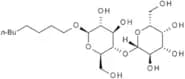
Octyl 4-O-(b-D-galactopyranosyl)-b-D-glucopyranoside
CAS:<p>Octyl 4-O-(b-D-galactopyranosyl)-b-D-glucopyranoside is a galactose derivative of octyl 4-O-(b-D-glucopyranosyl)-b-D-glucopyranoside. It has been used to immobilize the enzyme phospholipase A2 in an exothermic reaction. This product is a white solid that is soluble in water. Octyl 4-O-(b-D-galactopyranosyl)-b-D-glucopyranoside has been shown to be effective against mycobacteria such as Mycobacterium avium complex and Mycobacterium tuberculosis, but not against other bacteria. This product may be useful for the treatment of mycobacterial infections because it exhibits excisional activity and can cleave phospholipid membranes.</p>Formula:C20H38O11Purezza:Min. 95%Colore e forma:PowderPeso molecolare:454.51 g/molNonanoyl-D-glucopyranoside
CAS:<p>Nonanoyl-D-glucopyranoside is a custom-synthesized carbohydrate that functions as a glycosylation and fluorination agent. Nonanoyl-D-glucopyranoside can be used to modify oligosaccharides, carbohydrates, or polysaccharides. This product has CAS No. 191039-78-8, is synthesized with high purity, and is available in both monosaccharide and disaccharide forms.</p>Formula:C15H28O7Purezza:Min. 95%Peso molecolare:320.38 g/molNonyl β-D-glucopyranoside
CAS:<p>Nonyl β-D-glucopyranoside is an alkylglycoside non-ionic mild detergent used for cell lysis and membrane protein isolation. As it is uncharged it is unlikely to cause protein denaturation or refolding issues, allowing for the isolation of intact macromolecular complexes without affecting protein-protein interactions. Nonyl β-D-glucopyranoside is useful for the solubilization and crystallization of many biological membrane proteins and isolation of membrane-bound proteins. It has also been used for enantiomeric separation by capillary electrophoresis. Nonyl β-D-glucopyranoside is also known as B-Nonylglucoside or Nonyl D-glucoside and has an aggregation number of 133. It is dialyzable from membrane protein preparations and has a Critical Micelle Concentration (CMC) of 6.5mM.</p>Formula:C15H30O6Purezza:Min. 95%Colore e forma:PowderPeso molecolare:306.4 g/molOctyl b-D-thiomaltopyranoside
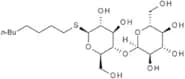
CAS:<p>Octyl b-D-thiomaltopyranoside is a colorless to yellow liquid with a sweet, malty odor. It is soluble in alcohol and ether. This product has been used as an analytical reagent in the analysis of sulfur compounds for GC/MS and LC/MS. It can be used to determine the concentration of dimethylsulfide (DMS) in marine systems. Octyl b-D-thiomaltopyranoside has also been used as a cycling agent for column chromatography, as well as an additive for animal injection compositions. Octyl b-D-thiomaltopyranoside is not toxic to animals at concentrations up to 2000 mg/kg body weight.</p>Formula:C20H38O10SPurezza:Min. 95%Peso molecolare:470.58 g/mol4-Aminophenyl β-D-thiogalactopyranoside
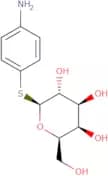
CAS:<p>4-Aminophenyl β-D-thiogalactopyranoside is a custom synthesis of a fluorinated saccharide. It is an oligosaccharide that has been modified with a click modification, which is an atom transfer radical polymerization. The chemical name for 4-aminophenyl β-D-thiogalactopyranoside is 2,5-difluorobenzoyl-(1→4)-4-(4'-aminophenoxy)butyryl-(1→2)-β-D-thiogalactopyranoside. The CAS number for 4-aminophenyl β-D-thiogalactopyranoside is 29558-05-2. This product has high purity and can be used as a substitute for saccharides in the synthesis of polysaccharides or oligosaccharides.</p>Formula:C12H17NO5SPurezza:Min. 95%Colore e forma:PowderPeso molecolare:287.33 g/molHexyl b-D-maltopyranoside
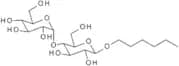
CAS:<p>Hexyl b-D-maltopyranoside is a biopharmaceutical that is used in drug development. It is used as a ligand for the μ-opioid receptor, which is a class of opioid receptors that are activated by morphine and endogenous peptides such as endorphins, dynorphins, and enkephalins. This ligand can be immobilized on a surface for use in immunoassays or other methods of detection. Hexyl b-D-maltopyranoside has been shown to have pharmacological effects in animal studies, although it has not yet been approved for clinical use in humans.</p>Formula:C18H34O11Purezza:Min. 95%Colore e forma:White PowderPeso molecolare:426.46 g/molOctyl b-D-thiogalactopyranoside
CAS:<p>Octyl b-D-thiogalactopyranoside is a methylated derivative of galactose. It is a polysaccharide that is used to modify saccharides and oligosaccharides for research purposes. The product is used in glycosylation reactions and can be custom synthesized to meet specific requirements. Octyl b-D-thiogalactopyranoside has been modified with fluorine, which increases its stability against hydrolysis. The product is also available in high purity, making it ideal for use in synthesis reactions.</p>Formula:C14H28O5SColore e forma:PowderPeso molecolare:308.44 g/mol(4R,5S)-4,5-Dihydroxyhexanal
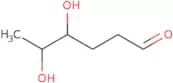
CAS:<p>(4R,5S)-4,5-Dihydroxyhexanal is a mutant of the parent strain Streptomyces lividans. It has been shown to produce glycosylations and inhibitory effects on tumor cells. This compound also has potent antitumor activity and antibacterial activity against Gram-positive bacteria. (4R,5S)-4,5-Dihydroxyhexanal has been shown to inhibit the proliferation of T cells in vitro.</p>Formula:C6H12O3Purezza:Min. 95%Peso molecolare:132.16 g/mol1-Decanoyl-rac-glycerol
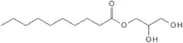
CAS:<p>1-Decanoyl-rac-glycerol is a microbicide that has been shown to have a broad spectrum of activity against viruses and bacteria. It can be used in tissue culture as an antimicrobial agent, and inhibits the growth of human serum, hydroxyl group, and metal hydroxides. 1-Decanoyl-rac-glycerol has also been shown to cause cell lysis in cancer cells, but not normal cells. This drug is lipophilic and easily crosses biological membranes. In vivo models have shown that this compound is nontoxic to humans at doses up to 100 mg/kg body weight. In vitro tests have shown that 1-decanoyl-rac-glycerol does not inhibit the growth of bacteria or fungi at concentrations as high as 500 μg/mL.</p>Formula:C13H26O4Purezza:Min. 95%Colore e forma:PowderPeso molecolare:246.34 g/mol4-Aminophenyl b-D-lactopyranoside
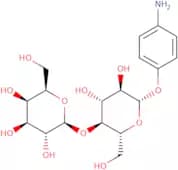
CAS:<p>4-Aminophenyl b-D-lactopyranoside is a chemical compound that has been used to optimize the production of human immunoglobulin. It has been shown to have diagnostic value for several viruses, including Epstein-Barr virus and cytomegalovirus. Electron microscopic studies have revealed organisms agglutinated by 4-aminophenyl b-D-lactopyranoside. The receptor binding properties and antigen concentration of this compound have been determined using agglutinin and lectin techniques. This molecule also has inhibitory potency on the synthesis of polypeptides, which are essential for the growth of certain organisms.</p>Formula:C18H27NO11Purezza:Min. 95%Colore e forma:Off-White PowderPeso molecolare:433.41 g/mol5-O-Decanoyl-D-xylose
CAS:<p>5-O-Decanoyl-D-xylose is a synthetic sugar that is used in the synthesis of oligosaccharides and polysaccharides. 5-O-Decanoyl-D-xylose is a modification of D-xylose that can be synthesized from D-xylose by adding a decanoic acid group to the C5 position. This modification increases the susceptibility of the sugar to reactions with other molecules, such as fluorination or methylation. Click modification reactions have been shown to be particularly useful for this purpose, since they are highly selective and can be carried out under mild conditions.</p>Formula:C15H28O6Purezza:Min. 95%Colore e forma:PowderPeso molecolare:304.38 g/molβ,β-Trehalose
CAS:<p>β,β-Trehalose is a carbohydrate that is synthesized by the expression of a trehalose synthase enzyme from the yeast Saccharomyces cerevisiae. β,β-Trehalose is an acidic sugar with two glucose subunits. It has been shown to have an enzymatic mechanism similar to that of glucose. β,β-Trehalose has been found to increase the solubility and stability of proteins in acidic phs (pHs) by binding to hydroxyl groups on protein surfaces. β,β-Trehalose also binds to alcohols such as ethanol and methanol, which may be due to its ability to form hydrogen bonds between oxygen atoms. This sugar also forms hexamers in solution, which may contribute to its effectiveness as a stabilizer for proteins and other molecules. The optimum ph for β,β-trehalose synthesis is around 5.5-6.0 and it can be used at higher ph</p>Formula:C12H22O11Purezza:Min. 99 Area-%Colore e forma:White Off-White PowderPeso molecolare:342.3 g/molα-D-Mannopyranosyl azide
CAS:<p>a-D-Mannopyranosyl azide is a custom synthesis, modification, fluorination, methylation, monosaccharide, synthetic and glycosylation agent. It can be used as a monosaccharide or oligosaccharide for the synthesis of complex carbohydrates.</p>Formula:C6H11N3O5Purezza:Min. 95%Colore e forma:White PowderPeso molecolare:205.17 g/mol2,3,6,2',3',4',6'-Hepta-O-acetyl-b-lactosyl azide
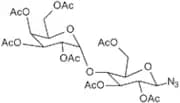
CAS:<p>2,3,6,2',3',4',6'-Hepta-O-acetyl-b-lactosyl azide is a custom synthesis of a carbohydrate that has been modified by the addition of acetyl groups to one end and the attachment of an azide group to the other. The synthesis of this compound has been completed in high purity and is available for purchase. This compound is a complex carbohydrate that is a sugar that can be modified by fluorination. It is also an oligosaccharide or polysaccharide with saccharide units.</p>Formula:C26H35N3O17Purezza:Min. 95%Colore e forma:PowderPeso molecolare:661.57 g/mol2,3,4,6-Tetra-O-allyl-D-glucopyranose
CAS:<p>2,3,4,6-Tetra-O-allyl-D-glucopyranose is a synthetic oligosaccharide that is used in the synthesis of glycoproteins and other complex carbohydrates. The sugar has been fluorinated to produce 2,3,4,6-Tetra-O-fluoro-D-glucopyranose. This sugar can be custom synthesized with methylation or click modification. It is a high purity product with no impurities detected.</p>Purezza:Min. 95%D-Glucose 3-sulfate sodium salt
CAS:<p>D-Glucose 3-sulfate sodium salt is a fluorinated, monosaccharide that can be used as a synthetic, oligosaccharide or complex carbohydrate. It is custom synthesized with glycosylation and polysaccharides and has been shown to be useful in click modification. D-Glucose 3-sulfate sodium salt is also methylated and sugar modified. The CAS number for this product is 89830-83-1. It has high purity and can be purchased at any lab supply store.</p>Formula:C6H11NaO9SPurezza:Min. 98 Area-%Colore e forma:PowderPeso molecolare:282.2 g/mol2-Azidomethyl-2-deoxy-3,4-O-isopropylidene-D-altrono-1.5-lactone
<p>2-Azidomethyl-2-deoxy-3,4-O-isopropylidene-D-altrono-1.5-lactone is a synthetic carbohydrate with the molecular formula C14H22N2O7. It is used in research as a building block for glycosylation and methylation of saccharides.</p>Purezza:Min. 95%Cyclohexyl b-D-glucopyranoside
<p>Cyclohexyl b-D-glucopyranoside is a synthetic sugar that is modified with fluorine. Cyclohexyl b-D-glucopyranoside can be custom synthesized to meet your specific needs. This product has a high purity and is methylated and glycosylated. Cyclohexyl b-D-glucopyranoside's CAS number is 113488-25-8.</p>Purezza:Min. 95%3'-N-Glycolylneuraminyl-D-lactose sodium salt
<p>3'-N-Glycolylneuraminyl-D-lactose sodium salt is a carbohydrate that has been modified by the addition of glycosylation, methylation and fluorination. It belongs to the group of complex carbohydrates and is a monosaccharide. 3'-N-Glycolylneuraminyl-D-lactose sodium salt can be used for the synthesis of oligosaccharides and polysaccharides, such as cellulose, chitin and glycogen. This product is high purity, custom synthesis and synthetic.</p>Purezza:Min. 95%Benzyl 3-O-benzyl-4,6-O-benzylidene-2-deoxy-2-N-phthalamido-a-D-glucopyranoside
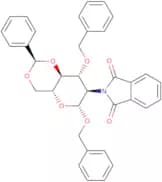
CAS:<p>Benzyl 3-O-benzyl-4,6-O-benzylidene-2-deoxy-2-N-phthalamido-a-D-glucopyranoside is a sugar that is used as a building block for the synthesis of glycosaminoglycans. This sugar can be fluorinated, glycosylated, or methylated and is a synthetically modified oligosaccharide with an average molecular weight of about 880 Da. The monomer unit consists of two glucose residues linked by an α(1→4) glycosidic bond. It has been shown to have antihypertensive properties in vitro and in vivo.</p>Formula:C35H31NO7Purezza:Min. 95%Colore e forma:White to off-white solid.Peso molecolare:577.62 g/mol