Glicoscienza
La glicosienza è lo studio dei carboidrati e dei loro derivati, nonché delle interazioni e delle funzioni biologiche a cui partecipano. Questo campo di ricerca è cruciale per comprendere una vasta gamma di processi biologici, tra cui il riconoscimento cellulare, la segnalazione, la risposta immunitaria e lo sviluppo delle malattie. La glicosienza ha importanti applicazioni nella biotecnologia, nella medicina e nello sviluppo di nuovi farmaci e terapie. Presso CymitQuimica, offriamo un'ampia selezione di prodotti di alta qualità e purezza per la ricerca in glicosienza. Il nostro catalogo comprende monosaccaridi, oligosaccaridi, polisaccaridi, glicoconiugati e reagenti specifici, progettati per supportare i ricercatori nei loro studi sulla struttura, funzione e applicazioni dei carboidrati nei sistemi biologici. Queste risorse sono destinate a facilitare scoperte scientifiche e applicazioni pratiche in vari ambiti delle bioscienze e della medicina.
Sottocategorie di "Glicoscienza"
- Amminozucchero(108 prodotti)
- Glico-anticorpi(282 prodotti)
- Glicolipidi(46 prodotti)
- Glicosaminoglicani (GAGs)(55 prodotti)
- Glicosidi(419 prodotti)
- Monosaccaridi(6.624 prodotti)
- Oligosaccaridi(3.682 prodotti)
- Polisaccaridi(503 prodotti)
Trovati 11046 prodotti di "Glicoscienza"
Ordinare per
Purezza (%)
0
100
|
0
|
50
|
90
|
95
|
100
b-D-Galactose-sp-biotin
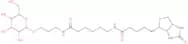
<p>b-D-Galactose-sp-biotin is a glycosylation agent that can be used to modify proteins, polysaccharides, and other complex carbohydrates. It is synthesized by the modification of b-D-galactose with a spacer arm containing biotin. The compound can be modified with fluorine atoms or methyl groups. It can also be modified with click chemistry to produce a reactive site for further chemical modification. This compound has been shown to have high purity and stability, which makes it suitable for use in a variety of applications.</p>Formula:C25H44N4O9SPurezza:Min. 95%Colore e forma:White PowderPeso molecolare:576.7 g/molcis-Zeatin-o-glucoside
CAS:<p>cis-Zeatin-o-glucoside is a naturally occurring cytokinin glycoside, which is a derivative of cis-zeatin conjugated with a glucose molecule. It is synthesized in various plant tissues and acts as an important signaling compound within the plant's hormonal network. The mode of action involves the regulation of cell division and differentiation, primarily through modulating the expression of specific genes and interacting with cytokinin receptors. This glycosylation potentially alters the transport, stability, and activity of the cytokinin, influencing its overall biological effect.</p>Formula:C16H23N5O6Purezza:Min. 95%Colore e forma:PowderPeso molecolare:381.38 g/mol2-Deoxy-2-[(7-nitro-2,1,3-benzoxadiazol-4-yl)amino]-L-glucose
CAS:<p>2-Deoxy-2-[(7-nitro-2,1,3-benzoxadiazol-4-yl)amino]-L-glucose is a fluorophore that is used in biological imaging. It has been shown to have tumor vasculature targeting properties and can be used to diagnose cancer. The optimal reaction for 2DG is aerobic glycolysis, which occurs when the glucose concentration is high enough. This compound can be used as a carbon source for mammalian cells and has been shown to inhibit the growth of cells from tumors.</p>Formula:C12H14N4O8Purezza:Min. 95%Peso molecolare:342.26 g/molD-Glycero-D-talo-heptose
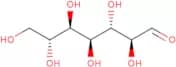
CAS:<p>D-Glycero-D-talo-heptose is a fluorescent probe used in fluorescence spectroscopy. It has been shown to bind to mannose and lyxose, which are carbohydrates with a structural similarity to D-glycero-D-manno-heptose. D-Glycero-D-talo-heptose undergoes dose dependent emission of light when excited at 488 nm. In addition, this compound can be used as a marker for liquid chromatography. The fluorescence of D -glycero -D -talo -heptose is quenched by the presence of ribose.</p>Formula:C7H14O7Purezza:Min. 95%Peso molecolare:210.18 g/mol1,2:4,5-Di-O-isopropylidene-b-D-erythro-2,3-hexodiulo-2,6-pyranose
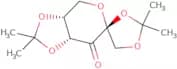
CAS:<p>1,2:4,5-Di-O-isopropylidene-b-D-erythro-2,3-hexodiulo-2,6-pyranose is an acidic compound that is a constituent of the ginseng plant. It has been shown to have biochemical properties as well as bioactivities. It can be synthesized in vivo from the amino acid L-lysine by the enzyme diammonium glyoxalate reductase. The compound has two chiral centers and four stereogenic centers. It is a trisubstituted diastereomer with oxygenated ring opening and chemical structures consisting of a pyranose ring and an ethylene glycol moiety.</p>Formula:C12H18O6Purezza:Min. 95%Peso molecolare:258.27 g/molb-D-Glucopyranosyl fluoride
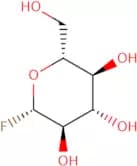
CAS:b-D-Glucopyranosyl fluoride is a kinetic inhibitor of the enzyme fatty acid synthase that is commonly found in human serum. It inhibits the activity of this enzyme by irreversible inhibition, which means that it binds to the active site of the enzyme and prevents it from functioning. The rate at which this inhibitor reacts with the enzyme depends on pH, as well as concentrations of other substances in solution, such as hydrogen fluoride and methyl glycosides. b-D-Glucopyranosyl fluoride has been shown to inhibit HIV infection by inhibiting viral maturation and protease activity. This drug also inhibits cell growth in culture by affecting cellular metabolism.Formula:C6H11FO5Purezza:Min. 95%Peso molecolare:182.15 g/mol2-Acetamido-2-deoxy-β-D-glucopyranosylnitromethane
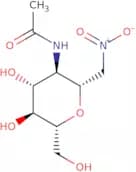
CAS:<p>2-Acetamido-2-deoxy-b-D-glucopyranosylnitromethane is a natural product that can be found in the extract of gladiolus. It has been shown to have antimalarial activity against Plasmodium falciparum and other species. 2-Acetamido-2-deoxy-b-D-glucopyranosylnitromethane inhibits the growth of bacteria by binding to the 50S ribosomal subunit, preventing transcription and replication. The high frequency of human activity has been shown using a patch clamp technique on human erythrocytes. This active form is metabolized through a number of metabolic transformations, including hydrolysis by esterases or glucuronidases, oxidation by cytochrome P450 enzymes, reduction by glutathione reductase, or conjugation with glucuronic acid.</p>Formula:C9H16N2O7Purezza:Min. 95%Colore e forma:PowderPeso molecolare:264.23 g/molMethyl a-L-arabinofuranoside
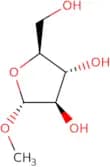
CAS:<p>Methyl a-L-arabinofuranoside is a microbial feed additive that is used to improve the quality of ruminal cellulose. This product has been shown to inhibit the activity of esterases and polysaccharides, which would otherwise break down cellulose so it can be digested by bacteria in the rumen. This supplement also inhibits microbial growth and has been shown to be an effective treatment for infectious diseases. Methyl a-L-arabinofuranoside is detectable in urine, feces, and milk one day after administration. It is broken down by uronic acid esterases into arabinose and methyl alcohol.</p>Formula:C6H12O5Purezza:Min. 95%Peso molecolare:164.16 g/molN-Acetylneuraminic acid 9-phosphate
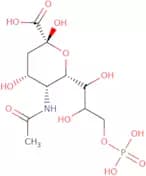
CAS:<p>N-Acetylneuraminic acid 9-phosphate is a sugar phosphate</p>Formula:C11H20NO12PPurezza:Min. 95%Peso molecolare:389.25 g/molGDP-6-deoxy-a-D-talose
<p>GDP-6-deoxy-a-D-talose is a synthetic oligosaccharide that can be modified to include fluorine, methylation, or other modifications. It has been synthesized for use in the modification of saccharides and complex carbohydrates. GDP-6-deoxy-a-D-talose is soluble in water and has a molecular weight of 519.</p>Purezza:Min. 95%L-Allose-6-phosphate disodium salt hydrate
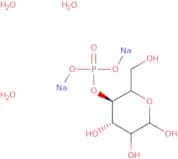
A sugar phosphateFormula:C6H13O9P·Na2·3H2OPurezza:Min. 95%Peso molecolare:358.15 g/mol6-O-Hydroxyethyl-D-glucose
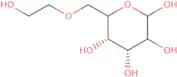
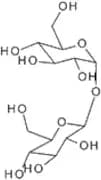
CAS:<p>6-O-Hydroxyethyl-D-glucose (6OHEDG) is a homologue of glucose that has been synthesized by reacting paraformaldehyde with ethylene in the presence of a glucofuranose. It is used as a solute for uptake studies, hydrolyzates for ion-exchanges, and glucoses for preparative chromatographic techniques. 6OHEDG is also used as an analog to glucose in polyethylene glycols and anhydroglucoses.</p>Formula:C8H16O7Purezza:Min. 95%Peso molecolare:224.21 g/molα,β-Trehalose
CAS:<p>α,β-Trehalose is a carbohydrate that is found in many organisms and has been shown to have biochemical properties such as energy metabolism, enzyme activities, and x-ray diffraction data. Trehalose has a phase transition temperature of around 98°C, which makes it an ideal sugar for food preservation. Trehalose can also be used as a sugar substitute with the same sweetness level as sucrose. The chemical stability of trehalose allows it to be used as a preservative in food and beverages. Trehalose has been shown to be nontoxic in animal studies with doses up to 2000 mg/kg body weight. It also has an optimum pH of 7 and is stable at high temperatures.</p>Formula:C12H22O11Purezza:Min. 95 Area-%Colore e forma:White PowderPeso molecolare:342.3 g/mol2,3,5-Tri-O-benzyl-D-arabinofuranose
CAS:<p>2,3,5-Tri-O-benzyl-D-arabinofuranose is a phosphorane that has been synthesised by the reaction of 2,3,5-trihydroxypentanoic acid and benzaldehyde. The synthesis of this compound involves the use of a stereoselective process to produce the desired product. This compound is able to inhibit both bacterial and fungal growth in vitro. Inhibition of bacterial growth is due to its ability to disrupt the synthesis of proteins and nucleic acids while the inhibition of fungal growth is due to its ability to interfere with chitin production.</p>Formula:C26H28O5Purezza:Min. 95%Colore e forma:White PowderPeso molecolare:420.5 g/molAmmonium 8-azido-3,8-dideoxy-D-manno-octulosonate
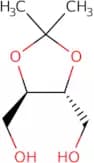
<p>Ammonium 8-azido-3,8-dideoxy-D-manno-octulosonate is an oligosaccharide that is a modification of the natural polysaccharide mannoheptulose. It has been shown to be highly soluble in water and can be easily synthesized. Ammonium 8-azido-3,8-dideoxy-D-manno-octulosonate has been shown to inhibit the activity of glycosyltransferases and methyltransferases. This compound also has a high degree of purity, with minimal impurities or degradation products.</p>Purezza:Min. 95%(-)-2,3-O-Isopropylidene-D-threitol
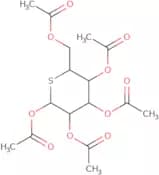
CAS:<p>(-)-2,3-O-Isopropylidene-D-threitol is a chiral compound with two stereoisomers. It is a crystalline solid that melts at 71°C and has a population of 50%. (-)-2,3-O-Isopropylidene-D-threitol is an important intermediate for the synthesis of polyethers with chiral centers. The catalytic asymmetric synthesis of (-)-2,3-O-isopropylidene-D-threitol is achieved by alkylation of (+)-2,3-(dimethoxyphosphinyl)propane with isopropanol. This reaction can be used to produce polyethers with chiral centers in high yields and enantioselectivity.</p>Formula:C7H14O4Purezza:Min. 95%Peso molecolare:162.18 g/mol1,2,3,4,6-Penta-O-acetyl-5-thio-D-glucose
CAS:1,2,3,4,6-Penta-O-acetyl-5-thio-D-glucose is a synthetic sugar that can be used as a building block in the synthesis of glycosides and oligosaccharides.Formula:C16H22O10SPurezza:Min. 95%Peso molecolare:406.41 g/molFructose-3-phosphate sodium salt
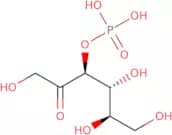
CAS:<p>Fructose-3-phosphate sodium salt is a reactive sugar molecule that belongs to the group of monosaccharides. It can be used as a cross-linking agent in polymerization reactions, such as those used in sample preparation for animal experiments or for magnetic resonance spectroscopy. Fructose-3-phosphate sodium salt is also used as a reactant in nephrology dialysis and has been shown to have beneficial effects on diabetic patients. This compound has the ability to increase the concentration of galactitol, a nonmetabolized form of glucose that can only be obtained from the diet. Galactitol is produced by the liver when blood glucose levels are high and helps to lower blood glucose levels through its action on insulin secretion and peripheral tissue sensitivity. Fructose-3-phosphate sodium salt may also act as an anti-inflammatory agent by inhibiting prostaglandin synthesis, which may be due to its inhibition of prostaglandin synthesis</p>Purezza:Min. 95%D-Erythrose 4-phosphate
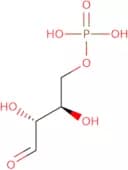
CAS:<p>The utilization of D-Erythrose 4-phosphate extends to various research applications, particularly in studying metabolic pathways and enzyme catalysis relevant to both prokaryotic and eukaryotic organisms.</p>Formula:C4H9O7PPurezza:Min. 95%Peso molecolare:200.08 g/molN-(Succinyl)-2-acetamido-2-deoxy-b-D-glucopyranosylhydroxylamine
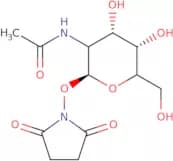
Succinyl activated n-acetylglucosamine.Formula:C12H18N2O8Purezza:Min. 95%Peso molecolare:318.28 g/mol


![2-Deoxy-2-[(7-nitro-2,1,3-benzoxadiazol-4-yl)amino]-L-glucose](/_next/image/?url=https%3A%2Fstatic.cymitquimica.com%2Fproducts%2F3D%2Fthumb-webp%2FMD58731.webp&w=3840&q=75)