Antimicrobici
Gli antimicrobici sono agenti che distruggono o inibiscono la crescita di microrganismi, inclusi batteri, virus, funghi e parassiti. Questi composti sono essenziali nella prevenzione e nel trattamento delle infezioni, svolgendo un ruolo cruciale nella medicina, nell'agricoltura e nell'industria alimentare. Presso CymitQuimica offriamo un'ampia gamma di antimicrobici di alta qualità e purezza, adatti a varie applicazioni scientifiche e industriali. Il nostro catalogo comprende antibiotici, antifungini, antivirali e disinfettanti, tutti progettati per soddisfare le esigenze della ricerca e dello sviluppo, nonché per applicazioni cliniche e di produzione. Con i nostri prodotti, i professionisti possono garantire l'efficacia e la sicurezza nel controllo delle infezioni e nella protezione della salute pubblica.
Sottocategorie di "Antimicrobici"
- Antibiotici(4.129 prodotti)
- Antimicotici(908 prodotti)
- Antiparassitari(702 prodotti)
- Antivirali(765 prodotti)
Trovati 2424 prodotti di "Antimicrobici"
Ordinare per
Purezza (%)
0
100
|
0
|
50
|
90
|
95
|
100
Aspartocin D
CAS:Aspartocin D is a peptide antibiotic, which is derived from microbial fermentation of certain actinomycetes. Its mode of action involves disrupting the integrity of fungal cell membranes, leading to increased permeability and eventual cell death. Aspartocin D is specifically effective against a range of fungal pathogens, making it a useful tool in the study and potential treatment of fungal infections.Formula:C57H89N13O20Purezza:Min. 95%Peso molecolare:1,276.40 g/molLysostaphin, from staphylococcus staphylolyticus
CAS:<p>Lysostaphin, from Staphylococcus staphylolyticus is a zinc metalloenzyme with action on bacterial cell walls by cleaving polyglycine cross-links and is used for treating staphylococcal infections and in research applications.</p>Purezza:Min. 95%Colore e forma:PowderKanamycin A Related Compound 1
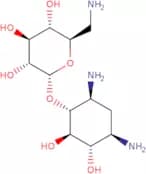
CAS:<p>Kanamycin A Related Compound 1 is an analytical reference standard, which is derived from aminoglycoside antibiotics. Its source stems from the chemical structures related to the aminoglycoside class, primarily used to ensure precise identification and quantification of kanamycin residues or impurities in pharmaceutical formulations. The mode of action of Kanamycin A Related Compound 1 involves serving as a comparator or reference point in chromatographic and spectroscopic methods, facilitating accurate analysis by providing a consistent baseline for research laboratories.</p>Formula:C12H25N3O7Purezza:Min. 95%Peso molecolare:323.34 g/molTetracycline hydrochloride, Antibiotic for Culture Media Use Only
CAS:<p>Tetracycline hydrochloride is a broad-spectrum antibiotic and is an electron transfer agent. It has been shown to be effective against bacterial infections in humans and has been used in cultures for the prevention of bacterial contamination. As an electron transfer agent, it is used in electron microscopy to study the surface of biological cells. Tetracycline hydrochloride enters bacterial cells by diffusion and interacts with the cytoplasmic membrane, where it induces a redox reaction that leads to cell death. The efficacy of tetracycline hydrochloride in treating candida albicans (yeast) was studied using in-vitro activity and showed that carboxymethyl chitosan nanoparticles were able to enhance the treatment efficiency.</p>Formula:C22H25ClN2O8Purezza:Min. 88.0 Area-%Peso molecolare:480.90 g/molRef: 3D-T-1961
1kgPrezzo su richiesta5kgPrezzo su richiesta10kgPrezzo su richiesta25kgPrezzo su richiesta2500gPrezzo su richiesta-Unit-kgkgPrezzo su richiestaMorinamide hydrochloride
CAS:<p>Morinamide hydrochloride is a synthetic antitubercular agent, which is derived from chemical synthesis processes. Its mode of action involves disrupting the synthesis of mycolic acids in the cell walls of Mycobacterium tuberculosis, thereby inhibiting bacterial growth and proliferation. The compound serves primarily as an antimicrobial agent targeting tuberculosis infections. In a laboratory setting, Morinamide hydrochloride is utilized in the study of bacterial resistance mechanisms and the development of novel therapeutic agents. Its specific action on mycolic acid synthesis makes it a valuable tool for researchers aiming to elucidate the pathways involved in mycobacterial cell wall construction and to develop more targeted chemotherapeutic interventions. Due to its crucial role, understanding the mechanisms and efficacy of Morinamide hydrochloride can greatly benefit scientific efforts in combating tuberculosis, especially in light of increasing drug resistance.</p>Formula:C10H15ClN4O2Purezza:Min. 95%Peso molecolare:258.7 g/molBPH715
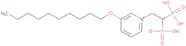
CAS:<p>Please enquire for more information about BPH715 including the price, delivery time and more detailed product information at the technical inquiry form on this page</p>Formula:C17H31NO7P2Purezza:Min. 95%Peso molecolare:423.4 g/molClothianidin-urea
CAS:Clothianidin-urea is an insecticide, which is synthesized from chemical sources and belongs to the neonicotinoid class of compounds. Its mode of action involves binding to nicotinic acetylcholine receptors in the central nervous system of insects, disrupting normal nerve function and leading to paralysis and eventual death. This mode of action is selective to insects, offering a degree of safety to non-target species including humans and animals.Formula:C6H8ClN3OSPurezza:Min. 95%Peso molecolare:205.67 g/molCloxacillin benzathine
CAS:Cloxacillin benzathine is a beta-lactam antibiotic, which is synthesized from Penicillium fungi-derived penicillins. It acts by inhibiting bacterial cell wall synthesis. The mechanism involves the irreversible inhibition of penicillin-binding proteins (PBPs). This disruption in the bacterial cell wall structure ultimately leads to cell lysis and death.Formula:C54H56Cl2N8O10S2Purezza:Min. 95 Area-%Colore e forma:White PowderPeso molecolare:1,112.11 g/mol3-(2-(2,4-Dichlorophenyl)-2-hydroxyethyl)-3,4-imidazolidinedione
CAS:<p>3-(2-(2,4-Dichlorophenyl)-2-hydroxyethyl)-3,4-imidazolidinedione is a synthetic compound, which is a derivative of imidazolidinedione. It is primarily characterized as an antifungal agent with broad-spectrum activity against various fungal species. Its mode of action involves disrupting the synthesis of ergosterol, an essential component of fungal cell membranes. This disruption leads to increased membrane permeability and ultimately, cell death. The efficacy of this compound is attributed to its ability to inhibit the growth of pathogens by targeting critical pathways necessary for fungal survival.</p>Formula:C11H12Cl2N2O3Purezza:Min. 95%Peso molecolare:291.13 g/molSarecycline
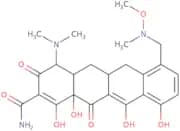
CAS:<p>Sarecycline is a tetracycline-class antibiotic, which is derived from naturally occurring tetracycline antibiotics. Its mode of action involves inhibition of bacterial protein synthesis by binding to the 30S ribosomal subunit, thereby preventing the addition of amino acids to nascent peptide chains. This specific mechanism disrupts bacterial growth, making Sarecycline effective against certain strains of bacteria implicated in dermatological conditions.</p>Formula:C24H29N3O8Purezza:Min. 95 Area-%Peso molecolare:487.5 g/molViolacein
CAS:<p>Violacein is a model system for studying the effects of hydroxyl groups on cell lysis. It is a fatty acid that contains nitrogen atoms and has antimicrobial properties. Violacein has been shown to cause the loss of mitochondrial membrane potential in HL-60 cells, which may be due to its ability to act as a multidrug efflux pump inhibitor. Violacein also exhibits antimicrobial activity against several bacterial strains, including MRSA and methicillin-sensitive Staphylococcus aureus (MSSA). In addition, violacein has been shown to induce cell lysis in vitro via the degradation of proteins and lipids in the cytoplasm.</p>Formula:C20H13N3O3Purezza:Min. 95%Colore e forma:PowderPeso molecolare:343.3 g/mol(-)-Actinonin
CAS:<p>Antibiotic peptide; inhibitor of aminopeptidase M and leucine aminopeptidase</p>Formula:C19H35N3O5Purezza:Min. 95%Peso molecolare:385.5 g/molGalidesivir dihydrochloride
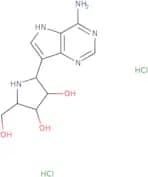
CAS:Galidesivir dihydrochloride is an investigational antiviral drug, which is a synthetic nucleoside analogue with broad-spectrum activity. It is derived from a modified adenosine analog structure, targeting viral RNA-dependent RNA polymerases. Galidesivir functions through the incorporation into viral RNA, leading to premature termination of RNA synthesis, effectively inhibiting viral replication. This mechanism aligns with its utility in combating various RNA viruses.Formula:C11H15N5O3•(HCl)2Purezza:Min. 95%Peso molecolare:338.19 g/molCEF3
CAS:<p>CEF3 is a cephalosporin-based antibacterial agent, which is derived from the fermentation of Streptomyces species. This compound functions by inhibiting bacterial cell wall synthesis, specifically targeting the transpeptidase enzyme involved in the cross-linking of peptidoglycan layers. The disruption of this process results in weakened bacterial cell walls, leading to cell lysis and death, particularly affecting Gram-positive and some Gram-negative bacteria.</p>Formula:C42H74N10O12Purezza:Min. 95%Peso molecolare:911.1 g/molPeramivir
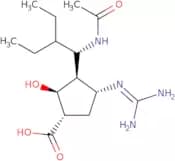
CAS:<p>Selective and potent inhibitor of sialidases (neuraminidases) in influenza A and B viruses. The compound binds tightly to the viral neuraminidase active site in late stages of viral life-cycle. It inhibits shedding sialic acids from host cell surface glycans, which interact with viral hemagglutinin, and consequently prevents release of new viral particles from the host cell surface.</p>Formula:C15H28N4O4Purezza:Min. 95%Colore e forma:PowderPeso molecolare:328.41 g/molAqabamycin G
CAS:Aqabamycin G is a macrolactam antibiotic, which is derived from marine bacteria belonging to the genus Streptomyces. This compound is noted for its complex structure, featuring a macrolactam ring that is crucial for its biological activity. Aqabamycin G's mode of action involves inhibiting bacterial protein synthesis by binding to the bacterial ribosomal subunit, thereby disrupting peptide bond formation. This interference with the protein production machinery of bacterial cells results in effective bacteriostatic or bactericidal outcomes, depending on the concentration and specific bacterial target.Formula:C18H11N3O5Purezza:Min. 95%Peso molecolare:349.3 g/molBottromycin A2
CAS:<p>Bottromycin A2 is a peptide antibiotic, which is a natural product derived from the fermentation of certain Streptomyces strains. It operates by targeting the bacterial ribosome, specifically inhibiting protein synthesis. The mode of action involves binding to the A-site of the 50S ribosomal subunit, thereby preventing the correct positioning of transfer RNA (tRNA) during translation. This inhibition halts the growth of bacteria by disrupting essential protein production processes.</p>Formula:C42H62N8O7SPurezza:Min. 95%Peso molecolare:823.1 g/mol6'-N-Cbz-kanamycin A
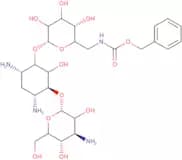
CAS:<p>6'-N-Cbz-kanamycin A is a semi-synthetic aminoglycoside antibiotic derivative, specifically a Cbz (carbobenzyloxy) protected form of kanamycin A. It is derived from the natural product kanamycin, which is an antibiotic obtained from the bacterium *Streptomyces kanamyceticus*. The modification involves the introduction of a protective Cbz group at the 6' position, which can improve solubility, stability, or enable further chemical modifications.</p>Formula:C26H42N4O13Purezza:Min. 95%Peso molecolare:618.63 g/molDequalinium chloride
CAS:<p>Dequalinium chloride is a novel, broad spectrum antimicrobial agent with a mechanism of action that inhibits the mitochondria-dependent respiratory chain. Studies have shown that it inhibits the growth of resistant microorganisms in cell-based experiments and in bacterial infections. Dequalinium chloride also has cytopathic effects on thp-1 cells, which are specific for Mycobacterium tuberculosis. In addition to inhibiting mitochondria-dependent respiration, this compound also increases acetylcholine receptor sensitivity in A549 lung cancer cells. Dequalinium chloride is a quaternary ammonium cation and has been shown to be effective against clinical isolates and inhibitory concentrations of a variety of virus species, including human rhinovirus (HRV) and Coxsackie virus type B4 (CoxB4).</p>Formula:C30H40Cl2N4Purezza:Min. 95.0 Area-%Peso molecolare:527.57 g/molRef: 3D-W-105841
5gPrezzo su richiesta10gPrezzo su richiesta25gPrezzo su richiesta50gPrezzo su richiesta100gPrezzo su richiesta-Unit-ggPrezzo su richiesta1-Naphthol-o-sulfate potassium
CAS:<p>1-Naphthol-o-sulfate potassium is a sulfate ester, which is a derivative of naphthol. It is synthesized from 1-naphthol, a phenolic compound, through sulfation, typically using chlorosulfonic acid or oleum, followed by neutralization with potassium hydroxide to produce the potassium salt form. This particular compound is involved in various biochemical pathways, especially as a conjugated metabolite in phase II metabolism.</p>Formula:C10H8KO4SPurezza:Min. 95%Peso molecolare:263.33 g/mol