Antimicrobici
Gli antimicrobici sono agenti che distruggono o inibiscono la crescita di microrganismi, inclusi batteri, virus, funghi e parassiti. Questi composti sono essenziali nella prevenzione e nel trattamento delle infezioni, svolgendo un ruolo cruciale nella medicina, nell'agricoltura e nell'industria alimentare. Presso CymitQuimica offriamo un'ampia gamma di antimicrobici di alta qualità e purezza, adatti a varie applicazioni scientifiche e industriali. Il nostro catalogo comprende antibiotici, antifungini, antivirali e disinfettanti, tutti progettati per soddisfare le esigenze della ricerca e dello sviluppo, nonché per applicazioni cliniche e di produzione. Con i nostri prodotti, i professionisti possono garantire l'efficacia e la sicurezza nel controllo delle infezioni e nella protezione della salute pubblica.
Sottocategorie di "Antimicrobici"
- Antibiotici(4.131 prodotti)
- Antimicotici(909 prodotti)
- Antiparassitari(703 prodotti)
- Antivirali(766 prodotti)
Trovati 2424 prodotti di "Antimicrobici"
Ordinare per
Purezza (%)
0
100
|
0
|
50
|
90
|
95
|
100
Alamethacin
CAS:<p>Alamethacin is a peptide antibiotic, which is derived from the soil fungus Trichoderma viride. This compound consists of a sequence of amino acids that form a helical structure, enabling its interaction with lipid membranes. Alamethacin functions by inserting itself into cellular membranes and forming voltage-dependent ion channels. As a result, it alters membrane permeability, causing ion imbalance and leading to cell death.</p>Formula:C92H150N22O25Purezza:Min. 95%Colore e forma:SolidPeso molecolare:1,964.31 g/molGatifloxacin related compound E
CAS:<p>Gatifloxacin related compound E is a chemical reference standard, which is often used in pharmaceutical and analytical chemistry research for the identification and quantification of impurities. It is generally synthesized or isolated as part of the quality control and validation process for the production of the antibiotic Gatifloxacin. The mode of action of this compound revolves around its structural similarity to Gatifloxacin, which allows it to serve as a benchmark to ensure the accuracy and reliability of high-performance liquid chromatography (HPLC) and other analytical techniques.</p>Formula:C19H22FN3O4·HClPurezza:Min. 95%Peso molecolare:411.86 g/molMesosulfuron
CAS:<p>Mesosulfuron is a selective herbicide, which is a synthetic chemical compound with a specific mode of action designed to inhibit acetolactate synthase (ALS). This enzyme inhibition disrupts the biosynthesis of essential amino acids such as valine, leucine, and isoleucine, leading to the cessation of cell division and consequent plant growth arrest. The herbicide is primarily utilized in agricultural settings, particularly for post-emergence control of various grass weeds within cereal crops, including wheat and barley. Its application is crucial for managing weed competition that can significantly impact crop yield and quality. Mesosulfuron is absorbed through the foliage and roots of targeted species, providing systemic action that ensures effective control. Its usage is governed by stringent regulations to minimize environmental impact and to manage herbicide resistance through integrated weed management strategies.</p>Formula:C16H19N5O9S2Purezza:Min. 95%Peso molecolare:489.5 g/molCefepime-d3 sulfate
CAS:Prodotto controllato<p>Cefepime-d3 sulfate is an isotopically labeled antibiotic, which is derived from the fourth-generation cephalosporin, cefepime. The source of this compound is synthetic, utilizing deuterium to label the parent cefepime molecule, allowing for detailed metabolic and pharmacokinetic studies. With deuterium's stable, non-radioactive nature, it serves as a powerful tool in mass spectrometry-based analyses.</p>Formula:C19H23D3N6O9S3Purezza:Min. 95%Peso molecolare:581.66 g/molLincomycin 2-palmitate hydrochloride
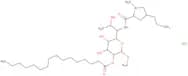
CAS:Lincomycin 2-palmitate hydrochloride is a semi-synthetic antibiotic, derived from the natural antibiotic lincomycin through chemical modification. It is sourced from fermentative processes involving the bacterium *Streptomyces lincolnensis*. The compound exerts its action by inhibiting protein synthesis in susceptible bacteria. This occurs through its binding to the 50S subunit of the bacterial ribosome, thereby hindering peptide chain elongation and ultimately arresting bacterial growth.Formula:C34H65ClN2O7SPurezza:Min. 95%Peso molecolare:681.41 g/molOxacillin sodium
CAS:<p>Oxacillin sodium is a beta-lactam antibiotic with action on bacterial cell wall synthesis and is used for treating infections caused by penicillin-resistant Staphylococcus aureus.</p>Formula:C19H18N3NaO5SPurezza:Min. 95%Colore e forma:PowderPeso molecolare:423.42 g/molN-Demethylclindamycin
CAS:<p>N-Demethylclindamycin is a metabolite of clindamycin, which is a semi-synthetic antibiotic derived from the naturally occurring compound lincomycin. This product is synthesized by enzymatic or chemical processes that remove the N-methyl group from clindamycin's molecular structure, making it an important derivative in the study of antibiotic activity and metabolic pathways.</p>Formula:C17H31ClN2O5SPurezza:Min. 95%Peso molecolare:411 g/molHexazinone metabolite A
CAS:Hexazinone metabolite A is a chemical compound derived from the degradation of the parent herbicide hexazinone, which is commonly used in agriculture and forestry for broad-spectrum weed control. This metabolite is a result of microbial and environmental processes that modify the original chemical structure, altering its behavior and ecological interactions. With a mode of action involving the disruption of photosynthetic processes, Hexazinone metabolite A impacts plant growth by inhibiting photosystem II, thereby impeding electron transfer required for photosynthesis.Formula:C12H20N4O3Purezza:Min. 95%Peso molecolare:268.31 g/molHypothemycin
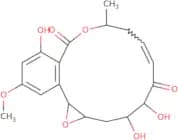
CAS:<p>Hypothemycin is a natural product that serves as a potent inhibitor of protein kinases. It is derived from the fungus Hypomyces subiculosus and belongs to the class of resorcylic acid lactones. Its mode of action involves binding covalently to the ATP-binding site of kinases, leading to the inhibition of their activity. This covalent modification is achieved through the formation of a Michael-type addition with a reactive ene-diene functionality within its structure. By targeting these critical enzymes, hypothemycin disrupts key signaling pathways that are essential for cell growth and proliferation.</p>Purezza:Min. 95%Capsimycin
CAS:<p>Capsimycin is an antibiotic product, which is derived from the bacterium Streptomyces. This compound is part of a class of natural products isolated from soil-dwelling actinomycetes, known for their ability to produce a wide array of bioactive molecules. The mode of action of Capsimycin involves the inhibition of cell wall biosynthesis in susceptible bacterial strains. This specific mechanism disrupts the integrity of the bacterial cell wall, ultimately leading to cell lysis and death, making Capsimycin effective against a variety of Gram-positive bacteria.</p>Formula:C30H40N2O6Purezza:Min. 95%Peso molecolare:524.60 g/molCladosporin
CAS:<p>Cladosporin is a secondary metabolite and natural product, specifically a fungal cyclodepsipeptide, which is isolated from the fungus *Cladosporium cladosporioides*. It exhibits its mode of action by selectively inhibiting the lysyl-tRNA synthetase enzyme in the Plasmodium species, the causative agent of malaria. This inhibition disrupts the protein synthesis pathway crucial for the survival and proliferation of the parasite.</p>Formula:C16H20O5Purezza:Min. 95%Peso molecolare:292.33 g/molVoxilaprevir
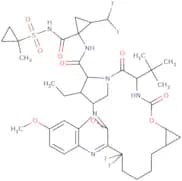
CAS:Voxilaprevir is an antiviral compound, which is a product of chemical synthesis with a unique mode of action targeting the Hepatitis C virus (HCV). It acts as a potent inhibitor of the HCV NS3/4A protease, a crucial enzyme required for the viral replication process. By inhibiting this protease, Voxilaprevir disrupts the viral life cycle, preventing replication and aiding in the clearance of the virus from the host.Formula:C40H52F4N6O9SPurezza:Min. 95%Peso molecolare:868.94 g/moltert-Butyl 4-[3-(4,4,5,5-tetramethyl-1,3,2-dioxaborolan-2-yl)pyrazol-1-yl]piperidine-1-carboxylate
CAS:<p>Tert-Butyl 4-[3-(4,4,5,5-tetramethyl-1,3,2-dioxaborolan-2-yl)pyrazol-1-yl]piperidine-1-carboxylate is a boronic ester compound used primarily in organic synthesis. It is derived from the reaction of a piperidine-based carboxylate with a dioxaborolane moiety, forming a unique structural entity that serves as a versatile building block in molecular modification and drug development.</p>Formula:C19H32BN3O4Purezza:Min. 95%Peso molecolare:377.3 g/molFlutimide
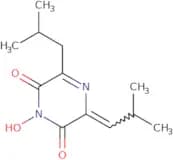
CAS:<p>Flutimide is a nonsteroidal antiandrogen, which is synthesized chemically. It functions by competitively inhibiting the binding of androgens, such as testosterone, to androgen receptors. This interferes with the action of androgens at the cellular level, leading to a reduction in the growth effects mediated by these hormones.</p>Formula:C12H18N2O3Purezza:Min. 95%Peso molecolare:238.28 g/molPSI-352938
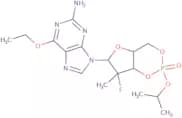
CAS:Please enquire for more information about PSI-352938 including the price, delivery time and more detailed product information at the technical inquiry form on this pageFormula:C16H23FN5O6PPurezza:Min. 95%Peso molecolare:431.36 g/molAcorafloxacin
CAS:Acorafloxacin is a synthetic fluoroquinolone antibiotic, which is derived from the chemical modification of the quinolone core structure. It acts by inhibiting bacterial DNA gyrase and topoisomerase IV, enzymes crucial for bacterial DNA replication and transcription. The bactericidal action results from preventing the supercoiling and relaxation of the bacterial DNA, ultimately interrupting essential cellular processes.Formula:C21H23F2N3O4Purezza:Min. 95%Peso molecolare:419.4 g/mol3-Descyano fludioxonil 3-carboxylic acid
CAS:<p>3-Descyano fludioxonil 3-carboxylic acid is a synthetic compound, which is derived from chemical modification of fludioxonil, a well-known fungicide. The compound acts by disrupting fungal cell osmoregulation through inhibition of the protein kinase pathway. This disruption inhibits spore germination and mycelial growth, contributing to its antifungal properties.</p>Formula:C12H7F2NO4Purezza:Min. 95%Peso molecolare:267.18 g/mol2-Sec-butyl-1-(decyloxy)-4-tritylbenzene
CAS:<p>2-Sec-butyl-1-(decyloxy)-4-tritylbenzene is a synthetic organic compound, typically utilized in chemical research and development. It is sourced through a series of organic synthesis reactions, involving alkylation, etherification, and aromatic substitution, primarily in a controlled laboratory environment.</p>Formula:C39H48OPurezza:Min. 95%Peso molecolare:532.8 g/mol(E)-Cefotaxime
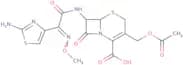
CAS:(E)-Cefotaxime is a third-generation cephalosporin antibiotic, which is derived from the actinomycete mold Acremonium. Its mode of action involves inhibiting bacterial cell wall synthesis by binding to penicillin-binding proteins, leading to cell lysis and death. This mechanism is highly effective against a wide range of Gram-positive and Gram-negative bacteria, including strains resistant to earlier cephalosporins and penicillins.Formula:C16H17N5O7S2Purezza:Min. 95%Peso molecolare:455.5 g/molCefadroxil monohydrate, Antibiotic for Culture Media Use Only
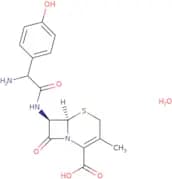
CAS:Cefadroxil is a broad-spectrum bactericidal antibiotic that belongs to the cephalosporin family. It is a semi-synthetic penicillin and inhibits bacterial cell wall synthesis through binding to one or more of the penicillin-binding proteins (PBPs). Cefadroxil monohydrate is used as an antibiotic for culture media and has been proven to be effective against methicillin-resistant Staphylococcus aureus (MRSA). In addition, the drug has been shown to have no significant effect on blood tests or microscopic studies.Formula:C16H19N3O6SPurezza:Min. 97.0 Area-%Peso molecolare:381.40 g/molRef: 3D-Q-200807
1kgPrezzo su richiesta250gPrezzo su richiesta500gPrezzo su richiesta-Unit-ggPrezzo su richiesta



![tert-Butyl 4-[3-(4,4,5,5-tetramethyl-1,3,2-dioxaborolan-2-yl)pyrazol-1-yl]piperidine-1-carboxylate](/_next/image/?url=https%3A%2Fstatic.cymitquimica.com%2Fproducts%2F3D%2Fthumb-webp%2FFP181624.webp&w=3840&q=75)