Antimicrobici
Gli antimicrobici sono agenti che distruggono o inibiscono la crescita di microrganismi, inclusi batteri, virus, funghi e parassiti. Questi composti sono essenziali nella prevenzione e nel trattamento delle infezioni, svolgendo un ruolo cruciale nella medicina, nell'agricoltura e nell'industria alimentare. Presso CymitQuimica offriamo un'ampia gamma di antimicrobici di alta qualità e purezza, adatti a varie applicazioni scientifiche e industriali. Il nostro catalogo comprende antibiotici, antifungini, antivirali e disinfettanti, tutti progettati per soddisfare le esigenze della ricerca e dello sviluppo, nonché per applicazioni cliniche e di produzione. Con i nostri prodotti, i professionisti possono garantire l'efficacia e la sicurezza nel controllo delle infezioni e nella protezione della salute pubblica.
Sottocategorie di "Antimicrobici"
- Antibiotici(4.131 prodotti)
- Antimicotici(909 prodotti)
- Antiparassitari(703 prodotti)
- Antivirali(766 prodotti)
Trovati 2424 prodotti di "Antimicrobici"
Ordinare per
Purezza (%)
0
100
|
0
|
50
|
90
|
95
|
100
Nalidixic acid ethyl ester
CAS:Nalidixic acid ethyl ester is a chemical compound that functions as a pro-drug antibacterial agent, specifically belonging to the quinolone class of antibiotics. It is synthesized from nalidixic acid, which is derived from the older synthetic derivative class of naphthyridines. Nalidixic acid ethyl ester exhibits its antibacterial properties through the inhibition of DNA gyrase and topoisomerase IV. These are essential enzymes for bacterial DNA replication, transcription, and repair, leading to the disruption of DNA synthesis in susceptible bacterial cells.Formula:C14H16N2O3Purezza:Min. 95%Peso molecolare:260.29 g/mol3-Chloro-4-(3-chloro-2-nitrophenyl)pyrrole
CAS:<p>3-Chloro-4-(3-chloro-2-nitrophenyl)pyrrole is a synthetic chemical compound, classified as an organochlorine derivative. This compound originates from the modification of pyrrole structures, which are heterocyclic aromatic compounds. The synthesis involves chlorination and nitration processes to enhance its potential activity and specificity.</p>Formula:C10H6Cl2N2O2Purezza:Min. 95%Peso molecolare:257.07 g/mol14-Chloro daunorubicin
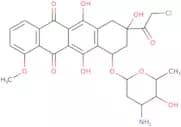
CAS:<p>14-Chloro daunorubicin is a chemotherapeutic agent, which is a synthetic derivative of the naturally occurring anthracycline antibiotic, daunorubicin. This compound is specifically modified to include a chlorine atom at the 14th position, which enhances its pharmacological effectiveness compared to its parent compound. The drug acts primarily by intercalating into DNA, disrupting the function of topoisomerase II, and generating free radicals. These mechanisms collectively inhibit DNA replication and transcription, leading to cell apoptosis, particularly in rapidly dividing cancer cells.</p>Formula:C27H28ClNO10Purezza:Min. 95%Peso molecolare:561.96 g/molClindamycin sulfoxide
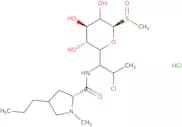
CAS:<p>Clindamycin sulfoxide is a potent metabolite of the lincosamide antibiotic clindamycin, which is derived from the fermentation product of *Streptomyces lincolnensis*. This compound acts by inhibiting bacterial protein synthesis through binding to the 50S ribosomal subunit, thereby interfering with the translocation steps in protein elongation. The mechanism effectively suppresses the growth of a broad range of Gram-positive bacteria, including *Staphylococcus aureus*, *Streptococcus pneumoniae*, and anaerobic microorganisms.</p>Formula:C18H33ClN2O6SPurezza:Min. 95%Peso molecolare:440.98 g/molThiamethoxam-urea
CAS:Thiamethoxam-urea is an advanced agrochemical formulation, which is a synthetic compound derived from the integration of the neonicotinoid insecticide thiamethoxam and the stabilizing agent urea. This product is engineered from laboratory synthesis, where chemical reactions enable the effective combination of these components to ensure optimal stability and efficacy. The mode of action of Thiamethoxam-urea involves neurotoxic interference within the central nervous system of target organisms, primarily acting as an agonist at nicotinic acetylcholine receptors in insects. This disrupts neural transmission, leading to paralysis and eventual death of the pest.Formula:C8H10ClN3O2SPurezza:Min. 95%Peso molecolare:247.7 g/molParvodicin C2
CAS:<p>Parvodicin C2 is a natural antibiotic compound, which is derived from the fermentation of specific actinomycete strains. This antibiotic functions through the inhibition of bacterial protein synthesis, specifically targeting the ribosomal subunits and leading to disruption in the peptide chain elongation process. The targeted mode of action allows it to effectively limit the replication and survival of susceptible bacterial strains.</p>Formula:C83H88Cl2N8O29Purezza:Min. 95%Peso molecolare:1,732.5 g/molColistin A
CAS:Colistin A is an antimicrobial peptide, which is a type of polymyxin antibiotic derived from the bacterium *Paenibacillus polymyxa*. It exerts its bactericidal effect by interacting electrostatically with the lipopolysaccharides and phospholipids in the outer membrane of Gram-negative bacteria. This action disrupts the bacterial cell membrane, leading to increased permeability and cell death.Formula:C53H100N16O13Purezza:Min. 95%Peso molecolare:1,169.5 g/molCefminox Sodium
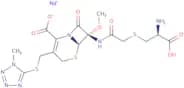
CAS:<p>Cefminox Sodium is a beta-lactam antibiotic, which is synthesized through chemical modification of naturally occurring compounds. This product is classified as a second-generation cephalosporin, derived from cephalosporin C obtained from the fungus Acremonium. It exerts its mode of action by inhibiting bacterial cell wall synthesis. This occurs through the binding to penicillin-binding proteins, ultimately disrupting the cross-linking of peptidoglycan chains which are essential for bacterial cell wall integrity.</p>Formula:C16H20N7O7S3·NaPurezza:Min. 95%Peso molecolare:541.56 g/molFlufenacet-methylsulfone
CAS:<p>Flufenacet-methylsulfone is an herbicidal derivative, which is sourced from the modification of flufenacet metabolites. It operates by inhibiting the biosynthesis of very-long-chain fatty acids, which are crucial components in the formation of cell membranes within target plant species. This biochemical intervention disrupts normal cell division and elongation in weeds, ultimately inhibiting their growth and establishment.</p>Formula:C12H16FNO3SPurezza:Min. 95%Peso molecolare:273.33 g/molCefodizime
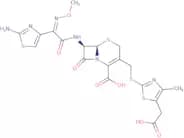
CAS:<p>Cefodizime is a third-generation cephalosporin antibiotic, which is derived from the fungus Acremonium. It exerts its bactericidal effects by inhibiting bacterial cell wall synthesis. This action is achieved through binding to penicillin-binding proteins (PBPs), leading to the interruption of peptidoglycan cross-linking essential for the bacterial cell wall integrity. The breakdown of cell wall synthesis results in the lysis and death of the bacterial cell.</p>Purezza:Min. 95%Amidosulfuron-o-desmethyl
CAS:Amidosulfuron-o-desmethyl is a metabolite derivative, which is studied primarily as a secondary product originating from the breakdown of the herbicide amidosulfuron. Synthesized through microbial and environmental degradation processes, it is part of the sulfonylurea class of compounds. The mode of action involves inhibition of the plant enzyme acetolactate synthase (ALS), leading to disrupted synthesis of essential branched-chain amino acids, ultimately affecting plant growth and survival.Formula:C8H13N5O7S2Purezza:Min. 95%Peso molecolare:355.4 g/molTris(4'-carboxy-1,1'-biphenyl)amine
CAS:<p>Tris(4'-carboxy-1,1'-biphenyl)amine is an organic compound commonly employed as a building block in the development of advanced materials. It is synthesized through a series of chemical reactions involving biphenyl and aniline derivatives, ultimately producing a triphenylamine core with carboxylic acid functional groups. The unique molecular architecture allows this compound to participate in various chemical interactions, including π-π stacking and hydrogen bonding, which are pivotal in its applications.</p>Formula:C39H27NO6Purezza:Min. 95%Peso molecolare:605.6 g/molTropodithietic acid
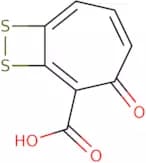
CAS:<p>Tropodithietic acid is a bioactive compound, which is a potent antibacterial agent derived from certain marine bacteria, including the genus Phaeobacter. This antibiotic is characterized by its ability to disrupt quorum sensing, a mechanism that bacteria use for communication and coordination of group behaviors, including virulence. By interfering with this process, tropodithietic acid impedes bacterial colonization and biofilm formation, effectively inhibiting pathogenic activity.</p>Purezza:Min. 95%Porfiromycin
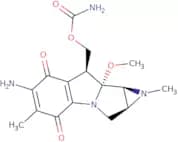
CAS:<p>Porfiromycin is an antineoplastic antibiotic with action on DNA alkylation and cross-linking and is used for research on cancer treatment, particularly for hypoxic tumors.</p>Formula:C16H20N4O5Purezza:Min. 95 Area-%Colore e forma:PowderPeso molecolare:348.35 g/molN4-Methyl-5-(3,4,5-trimethoxybenzyl)-pyrimidine-2,4-diamine
CAS:<p>N4-Methyl-5-(3,4,5-trimethoxybenzyl)-pyrimidine-2,4-diamine is a synthetic organic compound, classified as an antimicrobial agent. This compound is developed through chemical synthesis processes, derived from pyrimidine analogs, and is commonly used in medicinal chemistry and pharmacology research. It operates by inhibiting key enzymes involved in the folic acid pathway, crucial for bacterial growth and proliferation. By targeting this pathway, the compound prevents nucleic acid synthesis, ultimately leading to bacterial cell death.</p>Formula:C15H20N4O3Purezza:Min. 95%Peso molecolare:304.34 g/molBeclabuvir
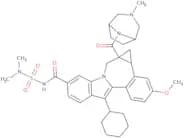
CAS:Beclabuvir is an investigational antiviral agent, which is synthetically derived with the purpose of targeting the hepatitis C virus (HCV). It functions as a non-nucleoside inhibitor, specifically inhibiting the HCV NS5B RNA-dependent RNA polymerase, a crucial enzyme necessary for viral replication. By obstructing the polymerase activity, Beclabuvir effectively impedes the replication cycle of the virus, thereby reducing viral load in infected individuals.Formula:C36H45N5O5SPurezza:Min. 95%Peso molecolare:659.84 g/molFoscarnet sodium
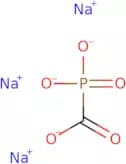
CAS:<p>Foscarnet sodium is a pyrophosphate analog antiviral agent with action on viral DNA polymerase and is used for treating cytomegalovirus and herpes simplex virus infections.</p>Formula:CNa3O5PPurezza:Min. 95%Colore e forma:White PowderPeso molecolare:191.95 g/molDL-chloramphenicol
CAS:<p>DL-chloramphenicol is a broad-spectrum antibiotic, which is a synthetic compound derived from natural chloramphenicol originally isolated from the bacterium Streptomyces venezuelae. This compound exerts its effects by inhibiting bacterial protein synthesis. It binds to the 50S subunit of the bacterial ribosome, preventing peptide bond formation and consequently halting the growth of susceptible bacteria. The optical isomer, DL-chloramphenicol, contains equal parts of both D- and L- isomers, with the L-form being responsible for its antibiotic activity.</p>Formula:C11H12Cl2N2O5Purezza:Min. 95%Peso molecolare:323.13 g/molUrdamycin B
CAS:<p>Urdamycin B is an anthracycline antibiotic, which is derived from the bacterium *Streptomyces fradiae*. This compound acts by intercalating into DNA, disrupting the replication and transcription processes, leading to cell death. Its mode of action involves inhibiting topoisomerase II, an enzyme critical for DNA replication and cell cycle progression. This mechanism impairs cellular proliferation, making it effective against rapidly dividing cells.</p>Formula:C37H44O13Purezza:Min. 95%Peso molecolare:696.70 g/molNeticonazole hydrochloride
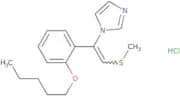
CAS:<p>Neticonazole hydrochloride is an antifungal agent, which is a synthetic imidazole derivative with potent antifungal properties. It is synthesized through a multi-step chemical process in a laboratory setting, designed to enhance its efficacy and stability. Its mode of action involves the inhibition of ergosterol synthesis, a critical component of fungal cell membranes. By hindering this pathway, Neticonazole hydrochloride compromises the integrity and function of the fungal cell membrane, ultimately leading to cell death.</p>Formula:C17H23ClN2OSPurezza:Min. 95%Peso molecolare:338.9 g/mol