Acidi grassi
Gli acidi grassi sono acidi carbossilici con lunghe catene di idrocarburi, che possono essere saturi o insaturi. Sono componenti essenziali dei lipidi, fungendo da building blocks fondamentali per lipidi complessi, fonti di energia e molecole di segnalazione. Gli acidi grassi sono coinvolti in vari processi biologici, tra cui il metabolismo, la struttura delle membrane cellulari e l'infiammazione. Presso CymitQuimica, offriamo una vasta gamma di acidi grassi di alta qualità per supportare la tua ricerca in biochimica lipidica, nutrizione e campi correlati.
Sottocategorie di "Acidi grassi"
- Acilgliceroli/Gliceridi(43 prodotti)
- Eicosanoidi(6 prodotti)
- Esteri di acidi grassi(946 prodotti)
- Acidi grassi alogenati(32 prodotti)
Trovati 2447 prodotti di "Acidi grassi"
Ordinare per
Purezza (%)
0
100
|
0
|
50
|
90
|
95
|
100
16-Mercaptohexadecan-1-ol
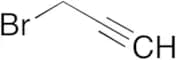
CAS:Prodotto controllatoFormula:C16H34OSColore e forma:NeatPeso molecolare:274.506Propargyl Bromide (Stablized with MgO)
CAS:Prodotto controllato<p>Applications Propargyl Bromide is used in the synthesis of betulonic acid-peptide conjugates with anti-inflammatory activity. Also used in the synthesis of PEG and peptide-grafted polyesters.<br> Not a dangerous good if item is equal to or less than 1g/ml and there is less than 100g/ml in the package<br>References Govdi, A. et al.: Mendel. Comm., 23, 260 (2013); Parrish, B. et al.: J. Am. Chem. Soc., 127, 7404 (2005);<br></p>Formula:C3H3BrColore e forma:NeatPeso molecolare:118.96cis-8,11,14-Eicosatrienoic Acid Ethyl Ester-d5
CAS:Prodotto controllato<p>Applications cis-8,11,14-Eicosatrienoic Acid Ethyl Ester-d5 is the isotope labelled analog of cis-8,11,14-Eicosatrienoic Acid Ethyl Ester (E477920); the ethyl ester derivative of cis-8,11,14-Eicosatrienoic Acid (E477930) which is a fatty acid with selective tumoricidal activity.<br>References Das, U., et al.: Cancer Lett., 56, 235 (1991); Rudra, P., et al.: Anticancer Res., 21, 29 (2001); Menendez, J., et al.: Breast Cancer Res. Treat., 72, 203 (2002)<br></p>Formula:C22H33D5O2Colore e forma:NeatPeso molecolare:339.57Trifluoropyruvic Acid Ethyl Ester
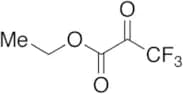
CAS:Prodotto controllato<p>Stability Moisture Sensitive<br>Applications Trifluoropyruvic Acid Ethyl Ester is used as a reagent in the preparation of potential biologically active compounds such as in the highly enantioselective organocatalytic hydroxyalkylation of indoles.<br>References Toeroek, B. et al.: Angew. Chem. Int. Ed., 44, 3086 (2005); Wolf, C. et al.: Adv. Synth. Cat., 353, 760 (2011);<br></p>Formula:C5H5F3O3Colore e forma:NeatPeso molecolare:170.093,3,12,12-Tetramethyl-1,5,10,14-tetraoxadispiro[5.2.5.2]hexadecane
CAS:Prodotto controllatoFormula:C16H28O4Colore e forma:NeatPeso molecolare:284.39Glyceryl-d5 Trihexadecanoate
CAS:Prodotto controllato<p>Applications Glyceryl-d5 Trihexadecanoate (CAS# 60763-98-6) is a useful isotopically labeled research compound.<br></p>Formula:C51H93D5O6Colore e forma:NeatPeso molecolare:812.37Propargyl Alcohol-13C3
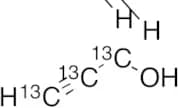
CAS:Prodotto controllato<p>Applications Propargyl Alcohol-13C3 is labelled Propargyl Alcohol (P762550) which is used as a corrosion inhibitor, a metal complex solution, a solvent stabilizer and an electroplating brightener additive. It is also used as an intermediate in organic synthesis.<br> Not a dangerous good if item is equal to or less than 1g/ml and there is less than 100g/ml in the package<br>References Zhang, T., et al.: Res. Chem. Interm. (2013); Choudhary, Y., et al.: SPE Product. Operat., 28, 268 (2013); Hed, Y., et al.: J. Mater. Chem. Mater. Bio. Med., 1, 6015 (2013)<br></p>Formula:C3H4OColore e forma:NeatPeso molecolare:59.04Glyceryl Tri(hexadecanoate-16,16,16-d3)
CAS:Prodotto controllato<p>Applications Glyceryl Tri(hexadecanoate-16,16,16-d3) (CAS# 285979-78-4) is a useful isotopically labeled research compound.<br></p>Formula:C51H89D9O6Colore e forma:NeatPeso molecolare:816.396,7-Dihydro-6-oxo-1H-pyrazolo[3,4-b]pyridine-3-carboxylic Acid Ethyl Ester
CAS:Prodotto controllatoFormula:C9H9N3O3Colore e forma:NeatPeso molecolare:207.19Ethyl palmitate
CAS:<p>Ethyl palmitate is a glycol ether that belongs to the group of esters. It has been shown to have biochemical properties and natural compounds such as caproic acid and ethyl palmitate. The liquid form of ethyl palmitate is clear, colorless, and odorless with a density of 1.065 g/mL at 20°C. Ethyl palmitate is soluble in ethanol, diethylether, benzene, chloroform, carbon tetrachloride, acetic acid ethyl ester, acetone, ethyl acetate, dichloromethane, and methanol. Ethyl palmitate can be used as a model system or analytical method for the identification of other lipids in biological samples.</p>Formula:C18H36O2Purezza:Min. 95%Peso molecolare:284.48 g/mol4-Oxo-1-piperidinecarboxylic acid ethyl ester
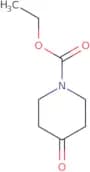
CAS:Prodotto controllato<p>4-Oxo-1-piperidinecarboxylic acid ethyl ester is an antimicrobial agent that belongs to the group of unsaturated ketones. It has been shown to have clinical activity against gram-positive bacteria, including Staphylococcus aureus, Enterococcus faecalis and Streptococcus pneumoniae, as well as Candida albicans. It also exhibits significant antiinflammatory activity in mice with chronic inflammation induced by carrageenan or LPS. 4-Oxo-1-piperidinecarboxylic acid ethyl ester inhibits the enzyme dpp-4, which is involved in the production of amyloid beta peptides and type II diabetes. This compound was also shown to possess anticholinesterase activity in vitro.</p>Formula:C8H13NO3Purezza:Min. 95%Peso molecolare:171.19 g/mol1,3-Dioleoyl-2-palmitoylglycerol
CAS:<p>Dipalmitoylglycerol is a fatty acid that is naturally found in catfish. The optimal conditions for the synthesis of dipalmitoylglycerol from tripalmitin have been determined by surface methodology to be at pH 5 and at 0°C. Dipalmitoylglycerol has been shown to bind to the enzyme acetyl-CoA carboxylase, which is involved in the synthesis of fatty acids, and prevent its activation. As a result, there is no production of malonyl CoA, which is an important precursor in the synthesis of fatty acids. This may be beneficial for infants because it prevents them from developing allergies and asthma.</p>Formula:C55H102O6Purezza:Min. 95%Peso molecolare:859.39 g/mol(2S,3S,5S)-5-[(N-Formyl-L-leucyl)oxy]-2-hexyl-3-hydroxyhexadecanoic acid
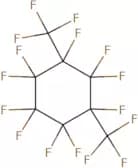
CAS:<p>Please enquire for more information about (2S,3S,5S)-5-[(N-Formyl-L-leucyl)oxy]-2-hexyl-3-hydroxyhexadecanoic acid including the price, delivery time and more detailed product information at the technical inquiry form on this page</p>Formula:C29H55NO6Purezza:Min. 95%Peso molecolare:513.75 g/molHexadecafluoro(1,3-dimethylcyclohexane)
CAS:Prodotto controllato<p>Ternary mixtures of hexadecafluoro(1,3-dimethylcyclohexane) with fluorine and hydrogen fluoride are stable compounds. The proton is a constant, which is the only variable in the equation. The analytical method for determining the amount of hexadecafluoro(1,3-dimethylcyclohexane) in a mixture can be found in reference 1. This reference also discusses the matrix effect on this compound's stability and optical properties. Reference 2 discusses transfer reactions that are present when hexadecafluoro(1,3-dimethylcyclohexane) is heated to temperatures of 400°C or above. Reference 3 discusses how polymer films can be formed by heating hexadecafluoro(1,3-dimethylcyclohexane) with a solvent such as pentane. Reference 4 discusses how covid-19 pandemic has been shown to be effective against the H2 strain of subt</p>Formula:C8F16Purezza:Min. 95%Peso molecolare:400.06 g/mol1,2-Dilinoleoyl-3-palmitoyl-rac-glycerol
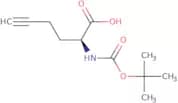
CAS:<p>1,2-Dilinoleoyl-3-palmitoyl-rac-glycerol (DLPG) is a lipid molecule that is structurally similar to the sphingolipid ceramide. It has been shown to be an inhibitor of cellular uptake and growth rate and also has long-term toxicity effects. DLPG has been shown to inhibit the signal transduction pathway by binding to microprocessors in the cell membrane and changing their frequency. DLPG also has a profile that can be used as an analog for dextran sulfate, which is a chemical compound that inhibits the uptake of glucose in mammalian cells. The uptake of DLPG can be decoupled from its signaling activity by using constant magnetic fields, which can be generated with superparamagnetic iron oxides or iron particles.</p>Formula:C55H98O6Purezza:Min. 95%Peso molecolare:855.36 g/molBoc-HomoGly(Propargyl)-OH
CAS:<p>Please enquire for more information about Boc-HomoGly(Propargyl)-OH including the price, delivery time and more detailed product information at the technical inquiry form on this page</p>Formula:C11H17NO4Purezza:Min. 95%Peso molecolare:227.26 g/molPropargylaldehyde diethyl acetal
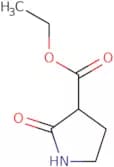
CAS:Propargylaldehyde diethyl acetal is a chemical compound that is used as an intermediate in the synthesis of other compounds. It is a white crystal or crystalline powder that is soluble in organic solvents such as ether, alcohols, and benzene. Propargylaldehyde diethyl acetal has been shown to be potent inhibitors of HSV-1, HSV-2, and HCMV. Furthermore, it has been reported that propargylaldehyde diethyl acetal inhibits the growth of cancer cells in vitro. In addition, propargylaldehyde diethyl acetal has been shown to inhibit the production of autoimmune diseases such as rheumatoid arthritis and multiple sclerosis.Formula:C7H12O2Purezza:Min. 95%Colore e forma:Colorless Clear LiquidPeso molecolare:128.17 g/mol2-Oxopyrrolidine-3-carboxylic acid ethyl ester
CAS:<p>Please enquire for more information about 2-Oxopyrrolidine-3-carboxylic acid ethyl ester including the price, delivery time and more detailed product information at the technical inquiry form on this page</p>Formula:C7H11NO3Purezza:Min. 95%Peso molecolare:157.17 g/molGlycidyl palmitate
CAS:<p>Glycidyl palmitate is a synthetic fatty acid ester that has reactive hydroxyl groups. It is used in the production of polylactic acid, a biodegradable polymer. Glycidyl palmitate can be prepared by reacting a fatty acid with glycerol and an epichlorohydrin. The elimination rate of glycidyl palmitate from the body has been shown to be activated by surface methodology such as chemical ionization mass spectrometry. Glycidyl palmitate can also be analyzed using gas chromatography with flame ionization detection (GC-FID) or gas chromatography-mass spectrometry (GC-MS). A sample preparation technique for glycidyl palmitate is to dissolve it in sodium salts and use filtration as the final step before analysis. The most common fatty acids present in glycidyl palmitate are oleic acid and linoleic acid.</p>Formula:C19H36O3Purezza:Min. 95%Peso molecolare:312.49 g/molMethyl palmitate
CAS:<p>Methyl palmitate is a chemical compound that belongs to the group of esters. It is a colorless liquid with a melting point of -17 °C, boiling point of 113 °C, and density of 0.834 g/mL. Methyl palmitate has shown genotoxic activity in a water vapor-resistant strain of Salmonella typhimurium TA100 and in the Ames assay. This chemical also has metabolic response properties, which may be due to its ability to induce prostaglandin J2 production and inhibit cyclic AMP accumulation in cells. Methyl palmitate is used as an additive for cosmetics, such as skin care products, perfumes, and hair dyes. It can also be found in food products such as margarine and coffee creamer.</p>Formula:C17H34O2Purezza:Min. 95%Peso molecolare:270.45 g/mol



![3,3,12,12-Tetramethyl-1,5,10,14-tetraoxadispiro[5.2.5.2]hexadecane](/_next/image/?url=https%3A%2Fstatic.cymitquimica.com%2Fproducts%2FTR%2Fthumb-webp%2FT305450.webp&w=3840&q=75)


![6,7-Dihydro-6-oxo-1H-pyrazolo[3,4-b]pyridine-3-carboxylic Acid Ethyl Ester](/_next/image/?url=https%3A%2Fstatic.cymitquimica.com%2Fproducts%2FTR%2Fthumb-webp%2FD450380.webp&w=3840&q=75)



![(2S,3S,5S)-5-[(N-Formyl-L-leucyl)oxy]-2-hexyl-3-hydroxyhexadecanoic acid](/_next/image/?url=https%3A%2Fstatic.cymitquimica.com%2Fproducts%2F3D%2Fthumb-webp%2FFF23586.webp&w=3840&q=75)