


Zuccheri e nucleobasi della spina dorsale
Gli zuccheri dello scheletro e le basi azotate sono componenti essenziali degli acidi nucleici come DNA e RNA. Lo scheletro è composto da gruppi zuccheri e fosfati, mentre le basi azotate formano il codice genetico attraverso l'appaiamento delle basi. Questi composti sono fondamentali nello studio della genetica e della biologia molecolare. Presso CymitQuimica, è possibile trovare una varietà di zuccheri dello scheletro e basi azotate per la ricerca e l'uso in laboratorio.
Trovati 1001 prodotti di "Zuccheri e nucleobasi della spina dorsale"
Ordinare per
Purezza (%)
0
100
|
0
|
50
|
90
|
95
|
100
N7-(2-Hydroxyethyl)adenine
CAS:Prodotto controllato<p>Applications A DNA adduct ethylene oxide hydroxyethylnitrosourea. It is also used in the preparation of acyclic nucleosides and nucleotides as antiviral agents.<br>References Snoeck, R., et al.: Antimicrob. Agents Chemother., 32, 1839 (1988), Bronson, J., et al.: J .Med. Chem., 32, 1457 (1989), Balzarini, J., et al.: J. Biol. Chem., 266, 8686 (1991),<br></p>Formula:C7H9N5OColore e forma:NeatPeso molecolare:179.1796-Azauridine
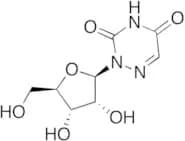
CAS:Prodotto controllato<p>Stability Hygroscopic<br>Applications 6-Azauridine is can be applied in antiviral studies.<br></p>Formula:C8H11N3O6Colore e forma:NeatPeso molecolare:245.19Tris(trimethylsilyl)guanine
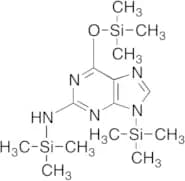
CAS:Prodotto controllato<p>Applications Tris(trimethylsilyl)guanine is an intermediate used in the synthesis of 9-(2-Hydroxyethyl)guanine (H942035), which is an impurity of the antiviral agent Acyclovir (A192400). 9-(2-Hydroxyethyl)guanine is a nucleoside phosphotransferase acceptor.<br>References Kamimura, A. et al.: Agric. Biol. Chem., 37, 2037 (1973);<br></p>Formula:C14H29N5OSi3Colore e forma:NeatPeso molecolare:367.679-(4-Dihydroxyborylbutyl)guanine
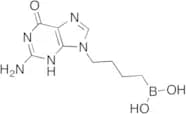
CAS:Prodotto controllatoFormula:C9H14BN5O3Colore e forma:NeatPeso molecolare:251.052-Deoxy-3,5-di-O-p-toluoyl-D-ribofuranosyl Chloride
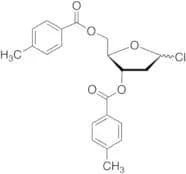
CAS:Prodotto controllatoFormula:C21H21ClO5Colore e forma:NeatPeso molecolare:388.846-Amino-1,3-dimethyl-5-nitrosouracil
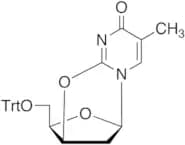
CAS:Prodotto controllato<p>Applications 6-Amino-1,3-dimethyl-5-nitrosouracil (cas# 3346-61-0) is a compound useful in organic synthesis.<br>References Varma, R., et al.: J. Ocular Pharmacol. Ther., 16, 571 (2000),<br></p>Formula:C6H8N4O3Colore e forma:NeatPeso molecolare:184.155-O-Trityl-2,3’-anhydrothymidine
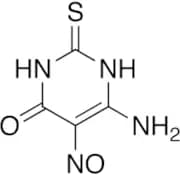
CAS:<p>Applications 5-O-Trityl-2,3’-anhydrothymidine (cas# 25442-42-6) is a compound useful in organic synthesis.<br></p>Formula:C29H26N2O4Colore e forma:NeatPeso molecolare:466.536-Amino-5-nitroso-2-thiouracil
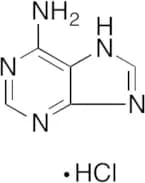
CAS:Prodotto controllato<p>Applications Pyrimidine with the ability to form complexes with heavy metal ions.<br>References Iltzsch, M., et al.: Biochem. Pharmacol., 48, 781 (1994),<br></p>Formula:C4H4N4O2SColore e forma:NeatPeso molecolare:172.17Adenine Hydrochloride
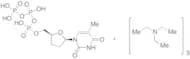
CAS:Prodotto controllato<p>Applications Adenine Hydrochloride can be utilized in uses for enhanced detection of hydrogen peroxide with platinized microelectrode arrays for analyses of mitochondria activities. It can also be used for biological use in method for producing Cordyceps sinesis by fermentation.<br>References Ben-Amor, S., et al.: Electrochim. Acta., 126, 171-178 (2014); Jia, J., et al.: Faming Zhuanli Shenqing, CN 101407767 A 20081117 (2008);<br></p>Formula:C5H5N5·HClColore e forma:NeatPeso molecolare:135.13 + 36.463'-Deoxy-thymidine 5'-(Tetrahydrogen Triphosphate) Triethylammonium Salt
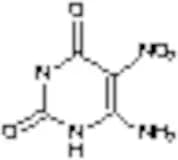
CAS:Prodotto controllatoFormula:C10H17N2O13P3•3(C6H15N)Colore e forma:NeatPeso molecolare:567.11486-Amino-5-nitrouracil
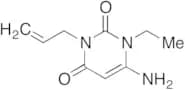
CAS:Prodotto controllato<p>Applications 6-Amino-5-nitrouracil (cas# 3346-22-3) is a compound useful in organic synthesis.<br>References Graves, A., et al.: J. Mol. Biol., 377, 914 (2008),<br></p>Formula:C4H4N4O4Colore e forma:NeatPeso molecolare:172.103-Allyl-6-amino-1-ethyluracil
CAS:Prodotto controllatoFormula:C9H13N3O2Colore e forma:NeatPeso molecolare:195.218(E)-5-(2-Carboxvinyl)uracil
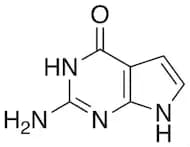
CAS:Prodotto controllato<p>Applications (E)-5-(2-Carboxvinyl)uracil (cas# 57412-59-6) is a compound useful in organic synthesis.<br></p>Formula:C7H6N2O4Colore e forma:NeatPeso molecolare:182.137-Deazaguanine
CAS:Prodotto controllato<p>Applications 7-Deazaguanine (cas# 7355-55-7) is a compound useful in organic synthesis.<br></p>Formula:C6H6N4OColore e forma:NeatPeso molecolare:150.141,3-Dipropyl-7-methylxanthine
CAS:Prodotto controllato<p>1,3-Dipropyl-7-methylxanthine is a xanthine compound that is structurally related to caffeine. It has been shown to have an inhibitory effect on the production of reactive oxygen species and cytosolic calcium levels in primary cells, as well as a nonselective adenosine receptor antagonist activity. It has also been shown to antagonize the effects of adenosine receptors, p2 receptors, and p2y receptors. This drug is used for the treatment of basophilic leukemia.</p>Formula:C12H18N4O2Purezza:Min. 95%Peso molecolare:250.3 g/mol5-Amino-3,7-dimethylxanthine
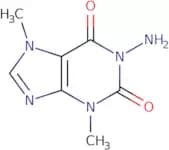
CAS:Prodotto controllatoPlease enquire for more information about 5-Amino-3,7-dimethylxanthine including the price, delivery time and more detailed product information at the technical inquiry form on this pageFormula:C7H9N5O2Purezza:Min. 95%Peso molecolare:195.18 g/mol1-(2,3-Dihydroxypropyl)-3,7-dihydro-3,7-dimethyl-1H-purine-2,6-dione
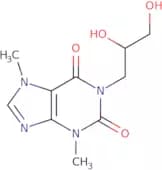
CAS:Prodotto controllato1-(2,3-Dihydroxypropyl)-3,7-dihydro-3,7-dimethyl-1H-purine-2,6-dione (theophylline) is a bronchodilator and anti-inflammatory agent. It is used to treat asthma and other respiratory conditions. Theophylline is structurally similar to caffeine and theobromine and has been shown to have a similar effect on the heart and blood vessels as these stimulants. It also stimulates the central nervous system in a manner similar to that of theobromine. Theophylline has shown some benefit in congestive heart failure patients but has not been proven effective for treating high blood pressure or fibrillation.Formula:C10H14N4O4Purezza:Min. 95%Peso molecolare:254.24 g/mol8-Cyclopentyl-1,3-dimethylxanthine
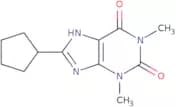
CAS:Prodotto controllato<p>8-Cyclopentyl-1,3-dimethylxanthine (CPT) is a xanthine derivative that binds to the adenosine receptor and inhibits the phosphodiesterase enzyme. CPT is used in vivo as a model for measuring locomotor activity, dopamine receptors, adenosine receptors, and glutamate receptors. The binding of CPT to these receptors can lead to bronchoconstriction by stimulating the release of vasoactive substances from airway cells and increasing the sensitivity of airway cells to bronchoconstrictor stimuli. This drug also has been shown to inhibit calcium ion influx into cytosol and increase intracellular levels of cAMP.</p>Formula:C12H16N4O2Purezza:Min. 95%Colore e forma:PowderPeso molecolare:248.28 g/mol8-[(2-Hydroxyethyl)(methyl)amino]-1,3,9-trimethyl-3,9-dihydro-1H-purine-2,6-dione
CAS:Prodotto controllato<p>Please enquire for more information about 8-[(2-Hydroxyethyl)(methyl)amino]-1,3,9-trimethyl-3,9-dihydro-1H-purine-2,6-dione including the price, delivery time and more detailed product information at the technical inquiry form on this page</p>Formula:C11H17N5O3Purezza:Min. 95%Peso molecolare:267.28 g/mol







![8-[(2-Hydroxyethyl)(methyl)amino]-1,3,9-trimethyl-3,9-dihydro-1H-purine-2,6-dione](/_next/image/?url=https%3A%2Fstatic.cymitquimica.com%2Fproducts%2F3D%2Fthumb-webp%2FFH132897.webp&w=3840&q=75)