Nucleotidi
I nucleotidi sono composti organici che fungono da mattoni per la costruzione degli acidi nucleici, essenziali per la formazione del DNA e dell'RNA. Ogni nucleotide è composto da una base azotata, una molecola di zucchero e uno o più gruppi fosfato. Questi nucleotidi si uniscono per formare lunghe catene, creando il materiale genetico che porta e trasmette informazioni genetiche in tutti gli organismi viventi. In questa sezione, troverai una vasta gamma di nucleotidi cruciali per la ricerca in genetica, biologia molecolare e biochimica. Sono fondamentali per studiare i processi genetici, sintetizzare acidi nucleici e sviluppare strumenti diagnostici e terapeutici. Da CymitQuimica, offriamo nucleotidi di alta qualità per supportare la tua ricerca scientifica e applicazioni, garantendo precisione e affidabilità nei tuoi esperimenti.
Sottocategorie di "Nucleotidi"
Trovati 2634 prodotti di "Nucleotidi"
Ordinare per
Purezza (%)
0
100
|
0
|
50
|
90
|
95
|
100
5-Amino-1-β-D-ribofuranosyl-1H-imidazole-4-carboxamide
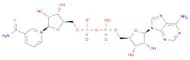
CAS:Formula:C9H14N4O5Purezza:95%Colore e forma:SolidPeso molecolare:258.2313THIONICOTINAMIDE ADENINE DINUCLEOTIDE
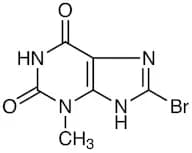
CAS:Formula:C21H33N7O13P2SPurezza:95%Colore e forma:SolidPeso molecolare:685.53838-Bromo-3-methylxanthine
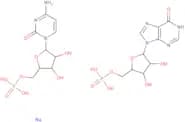
CAS:Formula:C6H5BrN4O2Purezza:>98.0%(T)(HPLC)Colore e forma:White to Almost white powder to crystalPeso molecolare:245.04Polyinosinic-polycytidylic acid sodium salt
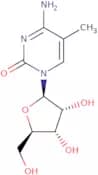
CAS:<p>Polyinosinic acid-polycytidylic acid (Poly I:C), an agonist of TLR3 toll-like receptors, is a synthetic double-stranded RNA analog, consisting of polyinosinic acid (poly I) paired with polycytidylic acid (poly C), forming a stable duplex structure. PolyI:C stimulates the secretion of pro-inflammatory cytokines and type I interferon through its interaction with endosomal Toll-like receptor 3 (TLR-3) and the cytoplasmic receptors melanoma differentiation-associated gene 5 (MDA-5) and retinoic acid-inducible gene I (RIG-I). This immunostimulant activity makes Poly I:C a useful vaccine adjuvant and is used in vaccine formulations. Poly I:C and its stabilized analogs (e.g., poly-ICLC) are also being actively researched for their dual role in oncology: directly targeting tumors and acting as immune potentiators. For example Poly I:C can induce apoptosis in tumor cells and stimulate immunogenic cell death and is therefore being explored alongside chemotherapy, radiotherapy, and checkpoint inhibitors, helping to overcome resistance mechanisms and strengthen treatment outcomes. We can supply PolyI:C to all stages of your project - from R&D and preclinical phases right up to GMP commercial manufacture. Contact our team for custom Poly I:C products.<br>For more on poly I:C read out blog 'Poly I:C: A Vaccine Adjuvant With Oncological Potential.'</p>Formula:(C10H13N4O8P)x•(C9H14N3O8P)x•NaxColore e forma:White Powder5-Methylcytidine
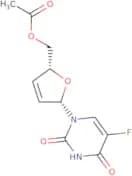
CAS:<p>5-Methylcytidine is a nucleoside that is found in DNA and RNA. It is used in structural biology to probe the structure of DNA. 5-Methylcytidine binds to the enzyme methyl transferase, which catalyzes the transfer of a methyl group from S-adenosylmethionine to produce 5-methyluridine. This reaction occurs in long-term toxicity studies using primary cells, such as lymphocytes and fibroblasts. 5-Methylcytidine has been shown to inhibit tumour growth in mice by binding to nuclear dna polymerase and blocking transcription. The binding site for this drug on the polymerase is located at the same site as that for nucleoside analogues like azidothymidine (AZT) and zidovudine (AZT).</p>Formula:C10H15N3O5Purezza:Min. 95%Colore e forma:White PowderPeso molecolare:257.24 g/mol1-(5-O-Acetyl-2,3-dideoxy-ß-L-glycero-pent-2-enofuranosyl)-5-fluorouracil
CAS:<p>1-(5-O-Acetyl-2,3-dideoxy-ß-L-glycero-pent-2-enofuranosyl)-5-fluorouracil is a modified nucleoside analog with structural alterations that enhance its biological properties and stability. The compound features 5-fluorouracil as the nucleobase, a fluorinated pyrimidine often used in chemotherapy due to its ability to interfere with DNA replication. The sugar component is 2,3-dideoxy-β-L-glycero-pent-2-enofuranose and has a specific glycerol and enol configuration, which alters its interactions with enzymes involved in nucleic acid metabolism. The compound includes a 5-O-acetyl protecting group at the 5'-position, which shields the hydroxyl group during synthesis.</p>Formula:C11H11FN2O5Purezza:Min. 95%Peso molecolare:270.21 g/molRef: 3D-NA182971
Prodotto fuori produzione5-Iodocytidine
CAS:<p>5-Iodocytidine is a nucleoside analogue that has been shown to possess potent antitumor activity. It is also used as a fluorescent probe for detection of uridine in biological samples. 5-Iodocytidine is structurally similar to uridine, which allows it to be taken up by cells and incorporated into RNA. This analog can also be detected with antibody response, as well as with the use of a fluorescence microscope. 5-Iodocytidine may have the potential to treat infectious diseases and autoimmune diseases because it binds to response elements on DNA and activates gene transcription.</p>Formula:C9H12IN3O5Purezza:Min. 98 Area-%Colore e forma:White PowderPeso molecolare:369.11 g/mol7-Cyano-7-deaza-2'-deoxyadenosine
CAS:<p>7-Cyano-7-deaza-2'-deoxyadenosine is a nucleoside analog that inhibits the growth of virus by competing with deoxyadenosine for incorporation into DNA and RNA. 7-Cyano-7-deaza-2'-deoxyadenosine also stabilizes dna duplexes and prevents them from breaking down. It has been shown to be effective against herpes simplex virus, which causes painful blisters on the skin or genitals. This drug has been used in clinical trials as an antiviral agent. 7-Cyano-7-deaza-2'-deoxyadenosine is synthesized from 2',3'-didehydrocytidine under the following conditions:</p>Formula:C12H13N5O3Purezza:Min. 95%Colore e forma:PowderPeso molecolare:275.26 g/molRef: 3D-NC144684
Prodotto fuori produzione3'-O-Methyluridine
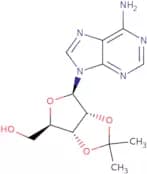
CAS:<p>3'-O-Methyluridine is a nucleoside that is used in the preparation of oligonucleotides and as a substrate for uridine phosphorylase. It is used to study the termination of RNA synthesis, which occurs when there are no more ribose residues in the RNA template strand. When this happens, an adenosine residue is added by polyphosphate kinase to the 3' end of the RNA strand. This addition causes a release of pyrophosphate and leads to end of DNA synthesis. The acid hydrolysis technique can be used to separate 3'-O-methyluridine from other nucleotides. This reaction produces guanosine, which can be detected using polymerase chain reaction (PCR) techniques such as polyacrylamide gel electrophoresis (PAGE).</p>Formula:C10H14N2O6Purezza:Min. 95%Colore e forma:White PowderPeso molecolare:258.23 g/mol2',3'-O-Isopropylideneadenosine
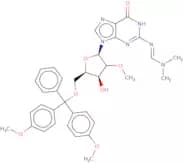
CAS:<p>2',3'-O-Isopropylideneadenosine is a nucleoside that has a possible usage as an organic chemical synthesis intermediate</p>Formula:C13H17N5O4Purezza:Min. 98 Area-%Colore e forma:White PowderPeso molecolare:307.31 g/molN2-DMF-5'-O-DMT-2'-O-methylguanosine
CAS:<p>N2-DMF-5'-O-DMT-2'-O-methylguanosine is a novel nucleoside analog that has antiviral, anticancer and immunomodulating properties. It is synthesized from 2′,3′-dideoxyadenosine 5′-monophosphate by the condensation of 2,6-dimethylaniline with methylguanosine 5′-monophosphate and 5,6-dimethylaniline. The modification of the guanine base in N2-DMF-5'-O-DMT-2'-O-methylguanosine to an O6 -methyl group results in increased affinity for the ribonucleotide reductase enzyme (RNR) and inhibition of DNA synthesis.</p>Formula:C35H38N6O7Purezza:Min. 95%Peso molecolare:654.71 g/molRef: 3D-ND08425
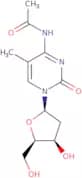
Prodotto fuori produzioneN4-Acetyl-2'-deoxy-5-methylcytidine
<p>N4-Acetyl-2'-deoxy-5-methylcytidine is a novel nucleoside analog of cytidine. It has been shown to be an activator of the immune system, and has antiviral and anticancer properties. This synthetic nucleoside is phosphorylated by kinases in cells to form N4-acetyl-2'-deoxy-5'-methyluridine monophosphate. The phosphate group can be removed by phosphatases in cells to yield N4-acetyl-2'-deoxycytidine, which is a precursor for DNA synthesis.</p>Formula:C12H17N3O5Purezza:Min. 95%Colore e forma:PowderPeso molecolare:283.28 g/molRef: 3D-NA15219
Prodotto fuori produzionePolyinosinic acid tripotassium salt
CAS:<p>Polyinosinic acid is a single stranded RNA analog which is combined with polycytidylic acid (poly C) to form a stable duplex structure known as Polyinosinic acid-polycytidylic acid (Poly I:C). PolyI:C stimulates the secretion of pro-inflammatory cytokines and type I interferon through its interaction with endosomal Toll-like receptor 3 (TLR-3) and the cytoplasmic receptors melanoma differentiation-associated gene 5 (MDA-5) and retinoic acid-inducible gene I (RIG-I). This immunostimulant activity makes Poly I:C a useful vaccine adjuvant and is used in vaccine formulations. Poly I:C and its stabilized analogs (e.g., poly-ICLC) are also being actively researched for their dual role in oncology: directly targeting tumors and acting as immune potentiators. For example Poly I:C can induce apoptosis in tumor cells and stimulate immunogenic cell death and is therefore being explored alongside chemotherapy, radiotherapy, and checkpoint inhibitors, helping to overcome resistance mechanisms and strengthen treatment outcomes. We can supply PolyI:C to all stages of your project - from R&D and preclinical phases right up to GMP commercial manufacture. Contact our team for custom Poly I:C products.<br>For more on poly I:C read out blog 'Poly I:C: A Vaccine Adjuvant With Oncological Potential.'</p>Purezza:Min. 95%