Nucleotidi
I nucleotidi sono composti organici che fungono da mattoni per la costruzione degli acidi nucleici, essenziali per la formazione del DNA e dell'RNA. Ogni nucleotide è composto da una base azotata, una molecola di zucchero e uno o più gruppi fosfato. Questi nucleotidi si uniscono per formare lunghe catene, creando il materiale genetico che porta e trasmette informazioni genetiche in tutti gli organismi viventi. In questa sezione, troverai una vasta gamma di nucleotidi cruciali per la ricerca in genetica, biologia molecolare e biochimica. Sono fondamentali per studiare i processi genetici, sintetizzare acidi nucleici e sviluppare strumenti diagnostici e terapeutici. Da CymitQuimica, offriamo nucleotidi di alta qualità per supportare la tua ricerca scientifica e applicazioni, garantendo precisione e affidabilità nei tuoi esperimenti.
Sottocategorie di "Nucleotidi"
Trovati 2634 prodotti di "Nucleotidi"
Ordinare per
Purezza (%)
0
100
|
0
|
50
|
90
|
95
|
100
2'-Deoxy-5'-O-DMT-2'-fluorocytidine
CAS:<p>2'-Deoxy-5'-O-DMT-2'-fluorocytidine is a novel nucleoside analog. It acts as an activator of the enzyme ribonucleotide reductase, which is essential for DNA synthesis and repair. 2'-Deoxy-5'-O-DMT-2'-fluorocytidine has antiviral activity against herpes simplex virus type 1 (HSV-1) and herpes simplex virus type 2 (HSV-2). This compound also inhibits the growth of various tumor cell lines in culture, including human leukemia cells. In addition, 2'-Deoxy-5'-O-DMT-2'-fluorocytidine has been shown to have antiinflammatory effects in animal studies.</p>Formula:C30H30FN3O6Purezza:Min. 95%Colore e forma:White to off-white solid.Peso molecolare:547.59 g/mol5'-O-DMT-thymidine
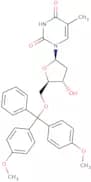
CAS:<p>5’-O-DMT-thymidine is also known as 5’-O-(4,4’-dimethoxytrityl)thymidine. It is a key deoxynucleoside building block that is protected with a dimethoxytrityl group in the 5-O-position of the deoxy-ribose moiety, leaving the 3-hydroxyl free for modification. It is used a convenient starting point for nucleotide synthesis. 5’-O-DMT-thymidine can be converted into 3’-O-phosphoramidite derivatives for oligonucleotide synthesis. Additionally, 5’-O-DMT-thymidine can be converted into more stable 1-N-protected derivatives.</p>Formula:C31H32N2O7Purezza:Min. 98 Area-%Colore e forma:White PowderPeso molecolare:544.6 g/mol2-Chloroinosine
CAS:2-Chloroinosine is a synthetic nucleoside analog derived from inosine, in which a chlorine atom is substituted at the 2-position of the purine base (hypoxanthine). This modifcation causes altered reactivity and can be used in research applicationsFormula:C10H11ClN4O5Purezza:Min. 95%Colore e forma:PowderPeso molecolare:302.67 g/mol2-Thiothymidine
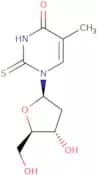
CAS:<p>2-Thiothymidine is a hydrogen bond donor and acceptor that can be used as a substitute for thymine in the synthesis of DNA. 2-Thiothymidine has been shown to have successful in vivo treatment against bladder cancer and skin cells, as well as photochemical properties. It has been shown to inhibit the growth of prostate cancer cells by inhibiting DNA synthesis. 2-Thiothymidine binds to dna duplexes and polymerase chain reactions, which are important for replication of DNA. This drug also inhibits replication by preventing intramolecular hydrogen bonds from forming.<br>2-Thiothymidine is a nucleoside analog that is substituted for thymine during DNA synthesis. It inhibits the growth of prostate cancer cells by inhibiting DNA synthesis. It binds to dna duplexes and polymerase chain reactions, which are important for replication of DNA. This drug also inhibits replication by preventing intramolecular hydrogen bonds from forming.</p>Formula:C10H14N2O4SPurezza:Min. 95%Colore e forma:White PowderPeso molecolare:258.3 g/mol5-Ethynyluridine
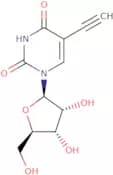
CAS:5-Ethynyluridine (5-EU) is an uracil analogue functionalized with a terminal alkyne group used for nucleotide, and especially RNA, labelling. 5-EU is cell permeable and is incorporated into RNA during its biosynthesis. The terminal alkyne group in 5-EU can react with azide-functionalised fluorophores or biotine, to form a labelled adduct with a triazole linker.Formula:C11H12N2O6Purezza:Min. 98 Area-%Colore e forma:PowderPeso molecolare:268.22 g/mol7-Deaza-2’-C-methylinosine
<p>7-Deaza-2’-C-methylinosine is an antiviral agent that inhibits the replication of DNA or RNA. It is a nucleoside analog that can be phosphorylated to form a diphosphate or monophosphate. 7-Deaza-2’-C-methylinosine has been shown to have anticancer effects in vitro and in vivo, as well as inhibit the proliferation of cancer cells. This agent also has novel properties due to the presence of the methyl group at position 2’ on the deoxyribose ring.</p>Formula:C11H11N3O6Purezza:Min. 95%Colore e forma:PowderPeso molecolare:281.22 g/molN6-Methyladenosine
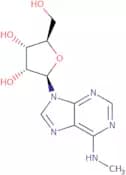
CAS:<p>N6-methyladenosine (m6A) is a modified form of adenosine that contains a methyl group at the N6 position and has a high importance in epigenetics. Among other nucleoside modifications found in mRNA, N6-methyladenosine is the most common and abundant in eukaryotes, and is related to some cancers and viral infections (Huafei, 2020). Moreover, N6-methyladenoside has been reported to regulate RNA abundance in the SARS-CoV-2 infection (Zhang, 2021)</p>Formula:C11H15N5O4Purezza:Min. 98.0 Area-%Colore e forma:White PowderPeso molecolare:281.27 g/mol7-Deaza-2'-C-methyladenosine
CAS:<p>Anti-HCV agent; inhibitor of viral RNA polymerases</p>Formula:C12H16N4O4Purezza:Min. 95 Area-%Colore e forma:Off-White PowderPeso molecolare:280.29 g/molThymidine-5'-O-(1-thiotriphosphate) lithium salt - 100mM aqueous solution
Thymidine-5'-O-(1-thiotriphosphate) lithium salt is a novel nucleoside analogue that has antiviral and anticancer properties. It can also be used as a building block for the synthesis of other nucleosides. Thymidine-5'-O-(1-thiotriphosphate) lithium salt is synthesized by reacting thymidine with lithium diisopropylamide (LDA). This nucleoside analogue has been shown to inhibit the growth of certain types of cancer cells in vitro, which may be due to its ability to inhibit DNA synthesis and induce apoptosis.Formula:C10H17N2O13P3S•(Li)xPurezza:Min. 95%Peso molecolare:498.23 g/molp-Topolin riboside
CAS:<p>p-Topolin riboside is a potent antibacterial agent that binds to the receptor binding site of wild-type mice. This hydrogen bond inhibits the activity of cellular p-topolin riboside, which is required for the synthesis of carotenoids and nitro compounds in mitochondria. p-Topolin riboside has been shown to have anti-aging properties and can inhibit locomotor activity in vivo. It has also been shown to have potent antibacterial effects against bacteria such as MRSA, Pseudomonas aeruginosa, and Enterococcus faecalis.</p>Formula:C17H19N5O5Purezza:Min. 95%Colore e forma:White PowderPeso molecolare:373.36 g/mol2'-O-Propargyluridine
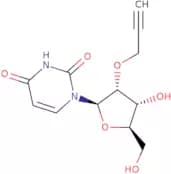
CAS:<p>2'-O-Propargyluridine is a modified nucleoside that is used in anticancer and antiviral drug synthesis. It is also used as an activator for phosphoramidites. 2'-O-Propargyluridine has been shown to have antiviral activity against herpes simplex virus type 1. This compound has also been shown to be active against cancer cells, with the ability to inhibit tumor growth in vitro and in vivo. 2'-O-Propargyluridine has a novel chemical structure and is not found in nature, which makes it difficult for the body's immune system to recognize and attack it.</p>Formula:C12H14N2O6Purezza:Min. 95%Colore e forma:White PowderPeso molecolare:282.25 g/mol5-Chlorocytidine
CAS:<p>5-Chlorocytidine is a reactive oxygen species that can be generated by the hypochlorous acid (HOCl) or by atp, which is a nucleotide. 5-Chlorocytidine has been shown to induce apoptosis in virus-infected mammalian cells and macrophage-like cells. It also induces pro-inflammatory cytokines and has potential as a biomarker for leukemia and inflammatory diseases. 5-Chlorocytidine reacts with proteins and lipids in the atherosclerotic lesion to produce other reactive oxygen species, such as hydrogen peroxide, which may lead to cell death.</p>Formula:C9H12ClN3O5Purezza:Min. 95 Area-%Colore e forma:White PowderPeso molecolare:277.66 g/mol2',3'-Dideoxycytidine
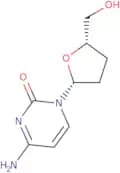
CAS:Anti-viral; reverse transcriptase inhibitorFormula:C9H13N3O3Purezza:Min. 98 Area-%Colore e forma:White PowderPeso molecolare:211.22 g/mol5-Methyl-2-thiouridine
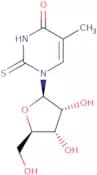
CAS:<p>5-Methyl-2-thiouridine is a nucleotide that is found in the type strain of Escherichia coli. It has been shown to be an effective inhibitor of protein synthesis, with optimum concentration at 0.1 mM. 5-Methyl-2-thiouridine binds to the ribosome and inhibits its activity. 5-Methyl-2-thiouridine also interacts with human mitochondrial RNA and alters its structure, leading to an antibody response that protects against infection by the bacteria in question. This nucleotide has also been shown to inhibit bacterial growth in wastewater treatment plants. The chemical structures of 5-methyluridine are similar to those of uridine except for a methyl group on the second carbon atom (5 position). The presence of this methyl group confers increased water permeability and decreased kinetic energy on the molecule, which can be detected using nuclear magnetic resonance spectroscopy.</p>Formula:C10H14N2O5SPurezza:Min. 95%Colore e forma:White PowderPeso molecolare:274.29 g/mol5-Methyl-2′-O-[2-(methylamino)-2-oxoethyl]-cytidine
5-Methyl-2′-O-[2-(methylamino)-2-oxoethyl]-cytidine is a nucleoside that is synthesized by phosphoramidite chemistry. It is a novel chemical compound with antiviral, anticancer, and deoxyribonucleoside properties. This nucleoside is modified in the 5′ position with a methyl group and has been shown to have cytotoxic effects on cancer cells.Formula:C13H20N4O6Purezza:Min. 95%Peso molecolare:328.33 g/mol2',3',5'-Tri-O-acetylguanosine
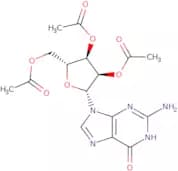
CAS:2',3',5'-Tri-O-acetylguanosine is a protected form of the nucleoside guanosine which has potential application as a synthetic intermediate in nucleic acid and nucleoside chemistry.Formula:C16H19N5O8Purezza:Min. 95%Colore e forma:White PowderPeso molecolare:409.35 g/molN2-Isobutyryl-9-(b-D-arabinofuranosyl)guanine
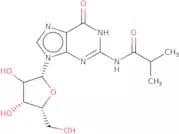
<p>N2-Isobutyryl-9-(b-D-arabinofuranosyl)guanine is a monophosphate analog of guanine. It is a novel antiviral agent that inhibits the DNA polymerase and RNA polymerase activities of human immunodeficiency virus (HIV). The drug has a high purity and is available in large quantities.</p>Formula:C14H19N5O6Purezza:Min. 95%Colore e forma:PowderPeso molecolare:353.33 g/mol9-(b-D-Ribofuranosyl)isoguanine
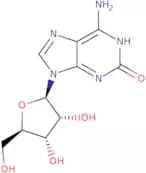
CAS:<p>9-(B-D-Ribofuranosyl)isoguanine is a purine analogue that is an anti-cancer drug. It has low potency and its biological properties are unknown. It has been shown to be an inhibitor of the polymerase chain reaction in vitro, but it is unclear if this activity will translate to in vivo models. 9-(B-D-Ribofuranosyl)isoguanine is structurally similar to pyrazole, which also inhibits the polymerase chain reaction in vitro. A recent study found that 9-(B-D-Ribofuranosyl)isoguanine may act as a toll-like receptor agonist and suppress lipopolysaccharide (LPS)-induced inflammation in mice, which suggests that this drug may have anti-inflammatory properties.</p>Formula:C10H13N5O5Purezza:Min. 95%Colore e forma:PowderPeso molecolare:283.25 g/mol5'-Carboxy-2',3'-O-isopropylideneadenosine
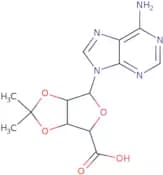
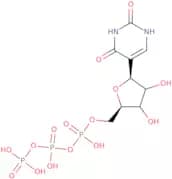
CAS:5'-Carboxy-2',3'-O-isopropylideneadenosine is a novel deoxyribonucleoside. It has high purity and high quality, good stability, and a low price. This product can be used as the raw material for synthesis of DNA, RNA, and phosphoramidites. It is an anticancer drug and antiviral agent that can be used to synthesize new drugs. It also has strong anti-inflammatory properties.Formula:C13H15N5O5Purezza:Min. 95%Colore e forma:PowderPeso molecolare:321.3 g/molPseudouridine-5'-triphosphate trisodium salt - 100mM aqueous solution
CAS:Pseudouridine-5'-triphosphate trisodium salt (PUR) is a nucleoside analogue that inhibits the synthesis of RNA. PUR is also a potent inhibitor of DNA synthesis and can be used to inhibit angiogenesis. PUR has been shown to have an effect on vascular endothelial cells, platelets, and cancer cells in vitro. This drug targets the vessels and other target cells such as those found in cardiovascular diseases, ovary, and cancer. PUR has been shown to be effective in vivo studies using mice models for the treatment of osteogenic sarcoma.Formula:C9H12N2O15P3Na3Purezza:Min. 95 Area-%Colore e forma:Colorless PowderPeso molecolare:550.09 g/mol







![5-Methyl-2′-O-[2-(methylamino)-2-oxoethyl]-cytidine](/_next/image/?url=https%3A%2Fstatic.cymitquimica.com%2Fproducts%2F3D%2Fthumb-webp%2FNM182888.webp&w=3840&q=75)