Nucleosidi
Trovati 3569 prodotti di "Nucleosidi"
L-Guanosine
CAS:L-Guanosine is an enantiomer of adenosine. It has been shown to be effective in the treatment of autoimmune diseases and viruses, such as HIV. L-Guanosine is activated by phosphorylation, which leads to its binding with DNA and inhibition of viral replication. L-Guanosine is also a potent inhibitor of mammalian cell proliferation. It binds to the enzyme adenosyltransferase, thereby inhibiting the production of nucleotides, which are necessary for DNA synthesis. This inhibition causes cell death due to lack of DNA synthesis and protein production.
Formula:C10H13N5O5Purezza:Min. 95%Colore e forma:White PowderPeso molecolare:283.24 g/molN4-Ethenocytidine
CAS:N4-Ethenocytidine is a nucleoside analogue that has been synthesized and shown to be an effective inhibitor of the hepatitis C virus. N4-Ethenocytidine prevents the synthesis of viral RNA by attacking the 3'-hydroxyl group of uridine, which is involved in the formation of ribonucleotides. This compound can also inhibit rat liver microsomes through a hydrated attack on carbonyl groups. The reaction products are trifluoroacetic acid and chloride ions. N4-Ethenocytidine's fluorescence properties have been used to identify its reaction intermediates, which include uridylic acid and 4-etheno-N6-isopentenyladenosine.
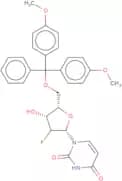
Formula:C11H13N3O5Purezza:Min. 95%Colore e forma:White Off-White PowderPeso molecolare:267.24 g/mol2'-Deoxy-5'-O-DMT-2'-fluoro-L-uridine
2'-Deoxy-5'-O-DMT-2'-fluoro-L-uridine is a nucleoside with anticancer and antiviral properties. It is used in the production of oligonucleotides, which are short chains of nucleic acids that can be synthesized in vitro to serve as probes for specific DNA or RNA sequences. 2'-Deoxy-5'-O-DMT-2'-fluoro-L-uridine is also a substrate for phosphoramidite synthesis, which converts it into 2'-deoxy-5'-O-(4,4',4''-(1,3,2-triazole)-tris(o-tolyl))uronium tetrafluoroborate (TOTU). This product has been shown to inhibit the activity of HIV reverse transcriptase and prevent the infection of cells by HIV.
Formula:C30H29FN2O7Purezza:Min. 95%Peso molecolare:548.57 g/mol5-Ethynyl-2'-O-methyluridine triphosphate
5-Ethynyl-2'-O-methyluridine triphosphate is a novel nucleoside that contains a methyl group at the 5 position of the uracil ring. It is an antiviral agent for use in the treatment of HIV, herpes simplex virus, cytomegalovirus, and influenza virus infections. 5-Ethynyl-2'-O-methyluridine triphosphate is also used as a precursor to synthesize DNA and RNA. This compound has been shown to have anticancer properties against breast cancer cells.
Purezza:Min. 95%2’-Deoxy-2’-fluoro-N3-(2S)-[2-(tert-butoxycarbonyl)-amino-3-carbonyl]propyluridine
2’-Deoxy-2’-fluoro-N3-(2S)-[2-(tert-butoxycarbonyl)-amino-3-carbonyl]propyluridine is a nucleoside, modified with fluorine at the 2’ position. It is an activator of phosphoramidites in the synthesis of DNA and RNA. This product has shown anticancer activity in vitro. 2'DFNAPU has also been shown to inhibit the replication of HIV virus and herpes simplex virus type 1 in cell culture, which may be due to its ability to inhibit viral DNA polymerase.
Purezza:Min. 95%2'-Deoxy-5-methylcytidine
CAS:2'-Deoxy-5-methylcytidine is a nucleoside analogue that inhibits the synthesis of DNA. It prevents methylation of guanine, which disrupts the binding of guanine nucleotide-binding proteins to the dna template and prevents polymerase chain reactions. 2'-Deoxy-5-methylcytidine has been shown to inhibit colon cancer cells in vitro, and may be a potential biomarker for bowel disease. This drug is also a methyltransferase inhibitor, which means it blocks the enzyme responsible for adding methyl groups to cytosine molecules.
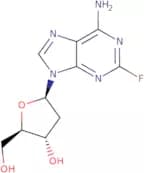
Formula:C10H15N3O4Purezza:Min. 98 Area-%Colore e forma:White PowderPeso molecolare:241.25 g/mol2'-Deoxy-2-fluoroadenosine
CAS:2'-Deoxy-2-fluoroadenosine is an adenosine member and an organofluorine compound
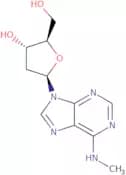
Formula:C10H12FN5O3Purezza:Min. 98 Area-%Colore e forma:White PowderPeso molecolare:269.23 g/mol2'-Deoxy-N6-methyladenosine
CAS:2'-Deoxy-N6-methyladenosine (2DMA) is a nucleoside that has been found to inhibit the phosphorylation of p2y receptors in rat kidney cells. 2DMA inhibits the production of collagen, which may have a matrix effect on cells. Studies have shown that 2DMA can be used as a sample preparation reagent for nuclear DNA. It has also been shown to be effective at inhibiting transcription and replication of human mitochondrial DNA.
Formula:C11H15N5O3Purezza:Min. 95%Colore e forma:White PowderPeso molecolare:265.27 g/mol7-Methyl-6-thioguanosine inner salt
CAS:7-Methyl-6-thioguanosine inner salt is a compound that inhibits the activity of creatine kinase and phosphatase, which are enzymes involved in energy metabolism. It also binds to actin filaments and prevents their depolymerization. The binding mechanism of 7-methyl-6-thioguanosine inner salt is believed to be due to its ability to form disulfide bonds with cysteine residues on the surface of the enzyme. This inhibition has been shown to reduce the ATP production in mammalian cells and has been used as a model system for studying cellular processes.
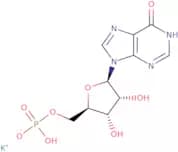
Formula:C11H15N5O4SPurezza:Min. 95 Area-%Colore e forma:White PowderPeso molecolare:313.33 g/molPolyinosinic acid tripotassium salt
CAS:Polyinosinic acid is a single stranded RNA analog which is combined with polycytidylic acid (poly C) to form a stable duplex structure known as Polyinosinic acid-polycytidylic acid (Poly I:C). PolyI:C stimulates the secretion of pro-inflammatory cytokines and type I interferon through its interaction with endosomal Toll-like receptor 3 (TLR-3) and the cytoplasmic receptors melanoma differentiation-associated gene 5 (MDA-5) and retinoic acid-inducible gene I (RIG-I). This immunostimulant activity makes Poly I:C a useful vaccine adjuvant and is used in vaccine formulations. Poly I:C and its stabilized analogs (e.g., poly-ICLC) are also being actively researched for their dual role in oncology: directly targeting tumors and acting as immune potentiators. For example Poly I:C can induce apoptosis in tumor cells and stimulate immunogenic cell death and is therefore being explored alongside chemotherapy, radiotherapy, and checkpoint inhibitors, helping to overcome resistance mechanisms and strengthen treatment outcomes. We can supply PolyI:C to all stages of your project - from R&D and preclinical phases right up to GMP commercial manufacture. Contact our team for custom Poly I:C products.
For more on poly I:C read out blog 'Poly I:C: A Vaccine Adjuvant With Oncological Potential.'Purezza:Min. 95%3'-Azido-3'-deoxythymidine-b-D-glucuronide sodium salt
CAS:3'-Azido-3'-deoxythymidine-b-D-glucuronide sodium salt is an antiviral and anticancer agent that inhibits the synthesis of DNA, RNA, and protein. It has shown to be effective against a variety of viruses including HIV-1, herpes simplex virus type 1, influenza A virus, vaccinia virus, and vesicular stomatitis virus. 3'-Azido-3'-deoxythymidine-b-D-glucuronide sodium salt also inhibits the growth of cancer cells in vitro. This drug is a modified nucleoside with a phosphoramidite backbone and a 3'-azido group at one end. The other end contains a beta D glucuronic acid moiety. The modifications allow for the inhibition of DNA synthesis by blocking the incorporation of deoxyribonucleotides into DNA chains.
Formula:C16H20N5NaO10Purezza:Min. 95%Colore e forma:PowderPeso molecolare:465.35 g/molRef: 3D-NA06316
Prodotto fuori produzione4-[(1Z)-2-(4-Chlorophenyl)vinyl]pyridine
CAS:4-[(1Z)-2-(4-Chlorophenyl)vinyl]pyridine is a modified nucleoside that is used in anticancer drugs. It has shown antiviral and antitumor effects. 4-[(1Z)-2-(4-Chlorophenyl)vinyl]pyridine is synthesized by condensing 4-chlorobenzaldehyde and 2,3-dichloropyridine. The nucleoside has been modified to be phosphorylated at the 5′ position and contains a ribonucleotide moiety and a deoxyribonucleotide moiety. This product is of high purity and quality, with an activator group at the 5′ position.
Formula:C13H10ClNPurezza:Min. 95%Peso molecolare:215.68 g/molRef: 3D-NC65881
Prodotto fuori produzione5-(Aminomethyl)-2-thiouridine
CAS:5-(Aminomethyl)-2-thiouridine is a bifunctional molecule that can be used in chromatography and as a precursor for the epigenetic modifications of DNA. 5-(Aminomethyl)-2-thiouridine has been shown to have an effect on the methyltransferase pathway, which is involved in the epigenome. This molecule has also been shown to affect the growth rate of bacteria in vitro.
Formula:C10H15N3O5SPurezza:Min. 95%Peso molecolare:289.31 g/molCyclic inosine diphosphate ribose
CAS:Cyclic inosine diphosphate ribose is a synthetic, fluorescent compound that can be used as a probe for assays. It has been synthesized by the solid-phase synthesis of a specific antibody and is bioconjugated with an oligo(ethylene glycol) moiety. Cyclic inosine diphosphate ribose can be used to measure lymphocyte activation, which is important for the study of autoimmune diseases and cancer. Cyclic inosine diphosphate ribose has also been shown to bind to the ryanodine receptor, which causes an increase in intracellular calcium concentration.
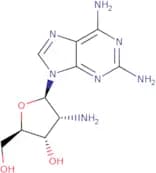
Formula:C15H20N4O14P2Purezza:Min. 95%Peso molecolare:542.29 g/mol2,6-Diamino-9-(2'-amino-2'-deoxy-b-D-ribofuranosyl)purine
CAS:2,6-Diamino-9-(2'-amino-2'-deoxy-b-D-ribofuranosyl)purine (dAraMP) is a novel nucleoside analogue that was synthesized and characterized. It has been shown to inhibit the growth of cancer cells in vitro. dAraMP is a monophosphate analogue of 2,6-diamino-9-(2'-deoxy-b-D-ribofuranosyl)purine (dAraP). The modified phosphoramidite approach used in its synthesis yielded high purity and yields. This product is also available as a diphosphate analogue of 2,6 diamino 9-(2'-amino 2'-deoxy b D ribofuranosyl) purine (dAMP). The diphosphate form of this product has been shown to be an activator for DNA polymerase.Formula:C10H15N7O3Purezza:Min. 95%Colore e forma:White To Off-White SolidPeso molecolare:281.28 g/molRef: 3D-ND06322
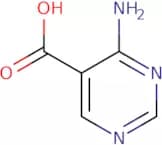
Prodotto fuori produzione4-Aminopyrimidine-5-carboxylic acid
CAS:4-Aminopyrimidine-5-carboxylic acid is an aminopyrimidone that has been synthesized to be used as a new class of antihypertensive agents. It has dose-dependent blood pressure lowering effects, which are likely due to its ability to block angiotensin receptors. 4-Aminopyrimidine-5-carboxylic acid also has antibacterial and antifungal properties. This compound is metabolized in vivo into the pharmacologically active amine 6-aminonicotinamide and excreted in the urine. In vitro studies have shown that 4-aminopyrimidine-5 carboxylic acid inhibits the growth of bacteria by binding to DNA gyrase and topoisomerase IV enzymes required for cell division.
Formula:C5H5N3O2Purezza:Min. 95%Peso molecolare:139.11 g/molRef: 3D-NA57368
Prodotto fuori produzione5-Methyl-2',3'-stannyluridine
5-Methyl-2',3'-stannyluridine is a nucleoside analog that is a potent inhibitor of viral replication and can be used for the treatment of HIV. It has been shown to inhibit the activity of RNA polymerase, thereby preventing transcription and replication. 5-Methyl-2',3'-stannyluridine also inhibits DNA synthesis by inhibiting the activity of DNA polymerase. This drug also acts as an antitumor agent and has been shown to inhibit tumor growth in animal models. The high purity of this drug makes it suitable for use in pharmaceutical applications.
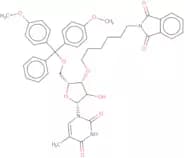
5-Methyl-2',3'-stannyluridine is a modified nucleoside that has been modified with a stannyl group at the 2' position on the sugar moiety and an allyl group at the 3' position on the sugar moiety. The phosphoramidites are synthesized from 5-methyl-2',3'-stannylPurezza:Min. 95%5'-O-DMT-3'-O-hexylphthalimido-5-methyluridine
5'-O-DMT-3'-O-hexylphthalimido-5-methyluridine is an activated nucleoside phosphoramidite for the synthesis of DNA and RNA. It is a building block for various nucleic acid analogues and has been shown to have antiviral and anticancer properties. 5'-O-DMT-3'-O-hexylphthalimido-5-methyluridine is also known as N6 -(2,4,6 trimethoxybenzoyl) adenosine or 5'-O-(2,4,6 triisopropoxybenzoyl)-adenosine (TIBA) and is used in the laboratory to produce oligonucleotides with modified sugar groups. This product has been shown to be effective against a number of cancer cell lines and has potential use in chemotherapy.
Formula:C45H47N3O10Purezza:Min. 95%Peso molecolare:789.89 g/molN6-2-(4-Aminophenyl)ethyladenosine
CAS:N6-2-(4-Aminophenyl)ethyladenosine is a carbamazepine prodrug that is converted to the active form, carbamazepine, by esterases. It has been shown to inhibit the binding of adenosine to adenosine receptor subtypes and to have an antagonistic effect on the activity of endogenous adenosine at these receptors. N6-2-(4-Aminophenyl)ethyladenosine has also been shown to act as an antagonist at the A3 adenosine receptor. This drug has been shown to reduce bronchoconstrictor responses in animal models and may be used for treating asthma.
N6-2-(4-Aminophenyl)ethyladenosine has also been shown in vitro studies using human papillary muscle cells to enhance polymerase chain reactions (PCR).Purezza:Min. 95%Ref: 3D-NA72432
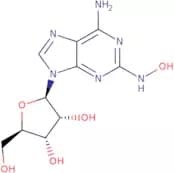
Prodotto fuori produzione2-Hydroxyaminoadenosine
CAS:2-Hydroxyaminoadenosine (2-HAA) is a novel nucleoside that is used as an activator of ribonucleotide reductase. It has been shown to be effective against cancer cells in vitro and in vivo. 2-HAA also inhibits the synthesis of viral DNA, which may be due to its ability to inhibit the ribonuclease activity of the virus. 2-HAA has also been shown to have antiviral activity against herpes simplex virus type 1 (HSV-1).
Formula:C10H14N6O5Purezza:Min. 95%Peso molecolare:298.26 g/mol



![2’-Deoxy-2’-fluoro-N3-(2S)-[2-(tert-butoxycarbonyl)-amino-3-carbonyl]propyluridine](/_next/image/?url=https%3A%2Fstatic.cymitquimica.com%2Fproducts%2F3D%2Fthumb-webp%2FND162843.webp&w=3840&q=75)



![4-[(1Z)-2-(4-Chlorophenyl)vinyl]pyridine](/_next/image/?url=https%3A%2Fstatic.cymitquimica.com%2Fproducts%2F3D%2Fthumb-webp%2FNC65881.webp&w=3840&q=75)