Nucleosidi
Trovati 3569 prodotti di "Nucleosidi"
3'-O-[(Propan-2-ylidene)amino]-thymidine 5'-triphosphate
CAS:3'-O-[(Propan-2-ylidene)amino]-thymidine 5'-triphosphate is an antiviral and anticancer agent that is used for the synthesis of DNA and RNA. It is a novel nucleoside analog that has been modified to be activated by phosphoramidite chemistry. 3'-O-[(Propan-2-ylidene)amino]-thymidine 5'-triphosphate is synthesized from 2,6-diisopropylaniline, methyl 3-(aminomethyl)-1H-pyrrole-2,4-dicarboxylate, and propylamine in cyclohexane at reflux.Formula:C13H22N3O14P3Purezza:Min. 95%Peso molecolare:537.25 g/mol5-Azacytidine
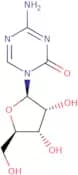
CAS:An azanucleoside and epigenetic modulator that interferes with nucleic acid metabolism. The compound gets incorporated into RNA and inhibits ribonucleotide reductase subunit RRM2 in leukemia cell lines. Intracellularly, 5-azacytidine can get converted into 2′-deoxy-5-azacytidine (decitabine) and subsequently incorporated in DNA, where it irreversibly inhibits DNMT1 methyltransferase. In human epithelial cell lines, this compound decreases Src-activated expression of a histone chaperone CAF1 and inhibits cell motility and invasiveness.
Formula:C8H12N4O5Purezza:Min. 95%Colore e forma:White Off-White PowderPeso molecolare:244.21 g/molN4-Acetyl-5'-O-DMT-cytidine
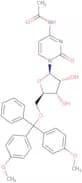
CAS:N4-Acetyl-5'-O-DMT-cytidine is an antiviral drug that inhibits the viral DNA polymerase. It is a modified nucleoside, which is activated by phosphorylation. N4-Acetyl-5'-O-DMT-cytidine is used in research for its anticancer properties and has shown to inhibit the growth of cancer cells in vitro. The compound was found to be more potent than cytidine and other modified nucleosides.Formula:C32H33N3O8Purezza:Min. 98 Area-%Colore e forma:White PowderPeso molecolare:587.63 g/mol3'-Amino-5'-O-benzoyl-3'-deoxy-D3-thymidine
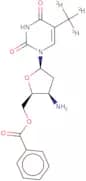
Prodotto controllato3'-Amino-5'-O-benzoyl-3'-deoxy-D3-thymidine is an activator that has been shown to have antiviral and anticancer properties. It is a novel nucleoside that is synthesized by reacting 3'-amino-5'-O-benzoyl-2',3'-dideoxyribose with 2,4,6-trichlorobenzoyl chloride. This product can be used in the synthesis of modified deoxyribonucleosides and phosphoramidites. 3'-Amino-5'-O-benzoyl-3'-deoxy-D3-thymidine has a CAS number of 605834-49-1.
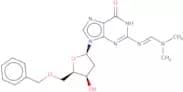
Formula:C17H16N3O5D3Purezza:Min. 95%Peso molecolare:348.37 g/mol5'-O-Benzyl-N2-DMF-2'-deoxyguanosine
5'-O-Benzyl-N2-DMF-2'-deoxyguanosine is a deoxyribonucleoside that is synthesized from 5'-O-benzyl-N2,N4-dimethoxypyridinium chloride and 2'-deoxyguanosine. It is a novel anticancer and antiviral agent that has shown to be more active than other analogues in inhibiting the growth of human cancer cells in culture. The drug has also been shown to inhibit the replication of herpes simplex virus type 1 (HSV1) in animal models. 5'-O-Benzyl-N2,N4-dimethoxypyridinium chloride was used as the precursor for this drug, which can be prepared by reacting benzaldehyde with dimethoxypyrimidine.Formula:C20H24N6O4Purezza:Min. 95%Peso molecolare:412.44 g/mol4-Chloro-7-(2-deoxy-3,5-bis-O-(p-toluoyl)-β-D- ribofuranosyl)-5-iodo-7H-pyrrolo[2,3-d]pyrimidine
4-Chloro-7-(2-deoxy-3,5-bis-O-(p-toluoyl)-beta-D-ribofuranosyl)-5-iodo-7H-pyrrolo[2,3-d]pyrimidine is a synthetic activator that selectively activates the transcription of genes in cells. It has been shown to have anticancer activity and may be useful as a therapeutic agent for the treatment of certain cancers. 4C 7 (2dEB 3,5BT) 5I is also known to be an antiviral agent against HIV and influenza virus. The modification on the 2'-deoxyribose sugar moiety can enhance both activation and antiviral activities.Purezza:Min. 95%L-Uridine
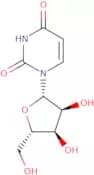
CAS:L-Uridine is a nucleoside that is the major precursor of RNA and DNA. It is also an equilibrative nucleoside, which means that it can act as either an acid or a base. L-Uridine has been shown to have anti-tumor activity in squamous cell carcinoma and human malignancies. It has also been shown to be an active inhibitor of arabinoside, which is a drug used for the treatment of acute myeloid leukemia (AML). L-Uridine may also have antitumor immunity effects by activating natural killer cells.Formula:C9H12N2O6Purezza:Min. 95%Colore e forma:PowderPeso molecolare:244.2 g/mol5-Bromo-2'-deoxyuridine-5'-monophosphate sodium salt
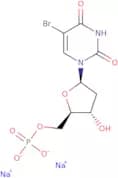
CAS:5-Bromo-2'-deoxyuridine-5'-monophosphate sodium salt (BrdUMP) is an antiviral agent that inhibits the synthesis of DNA. It has shown activity against herpes simplex virus and cytomegalovirus, and has been used in the treatment of Kaposi's sarcoma. BrdUMP is a monophosphate prodrug that is activated by ribonucleoside diphosphates to inhibit the production of viral DNA and RNA. This drug has anticancer properties due to its ability to inhibit cell division. BrdUMP is synthesized from 2'-deoxyuridine-5'-monophosphate, which is obtained from uracil or thymine. The CAS number for this compound is 51432-32-7, and it can be used as a phosphoramidite for the preparation of DNA, RNA, or oligonucleotide analogues.Formula:C9H12BrN2O8PNa2Purezza:Min. 97 Area-%Colore e forma:PowderPeso molecolare:433.06 g/mol2',3'-Dideoxyinosine
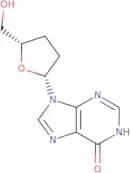
CAS:2',3'-Dideoxyinosine is a purine analog that can suppress human immunodeficiency virus (HIV) replication after intracellular metabolic conversionFormula:C10H12N4O3Purezza:Min. 95 Area-%Colore e forma:White Off-White PowderPeso molecolare:236.23 g/mol3’,5’-Di-O-acetyl-2’-azido-2’-deoxyuridine
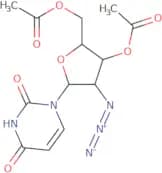
CAS:Please enquire for more information about 3’,5’-Di-O-acetyl-2’-azido-2’-deoxyuridine including the price, delivery time and more detailed product information at the technical inquiry form on this pagePurezza:Min. 95%2'-Deoxy-5'-DMT(2-E-bromoethenyl)uridine 3'-CE phosphoramidite
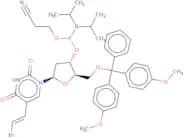
CAS:2'-Deoxy-5'-DMT(2-E-bromoethenyl)uridine 3'-CE phosphoramidite is a synthesized nucleoside used for the preparation of oligonucleotides. It is used in the synthesis of oligonucleotides as an activator, monophosphate, or nucleotide. 2'-Deoxy-5'-DMT(2-E-bromoethenyl)uridine 3'-CE phosphoramidite is a novel and high quality chemical that has not been previously reported. It is typically stored at -20℃. 2'-Deoxy-5'-DMT(2-E-bromoethenyl)uridine 3'-CE phosphoramidite may be incompatible with strong oxidizing agents, strong acids, strong bases, and metal ions.Purezza:Min. 95%N6-Benzoyl-2'-deoxy-5'-O-DMT-adenosine
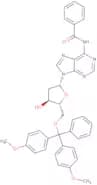
CAS:N6-Benzoyl-2'-deoxy-5'-O-DMT-adenosine is a versatile nucleoside building block.
Formula:C38H35N5O6Purezza:Min. 98 Area-%Colore e forma:White PowderPeso molecolare:657.72 g/molGuanosine 5'-triphosphate sodium salt hydrate
CAS:Guanosine 5'-triphosphate sodium salt hydrate (GTP) is an energy-rich nucleotide that is synthesized from guanosine and inorganic phosphate. GTP acts as a coenzyme in the synthesis of proteins, lipids, and other biological molecules. It also has been shown to inhibit the growth of murine sarcoma virus by regulating intracellular calcium levels. GTP's binding to a receptor on the surface of cells leads to a cascade of reactions that ultimately lead to the production of proteins. This process can be inhibited by pharmacological agents such as thiostrepton, which blocks GTP's incorporation into proteins.Formula:C10H16N5O14P3•Nax•(H2O)xPurezza:Min. 95%Colore e forma:White PowderPeso molecolare:523.18 g/molAdenosine
CAS:Endogenous adenosine receptor ligand; regulator of innate immunityFormula:C10H13N5O4Purezza:(Titration) 99.0 To 101.0%Colore e forma:White PowderPeso molecolare:267.25 g/molAcetyl hypoxanthine
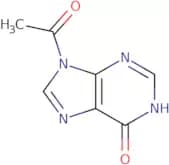
CAS:Acetyl hypoxanthine is an inorganic compound that has a cyclophosphate group. It can be synthesized from the reaction of acetic acid and 6-chloropurine, which is activated with trifluoroacetic acid and irradiated with ultraviolet light. Acetyl hypoxanthine can then be synthesized by ammonolysis of chloroacetone using ammonia or by chlorinating acetylene with chlorine. The advantages of this compound are its high yield and low cost.Formula:C7H6N4O2Purezza:Min. 95 Area-%Colore e forma:PowderPeso molecolare:178.15 g/mol8-Hydroxyadenosine
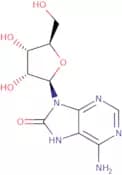
CAS:8-Hydroxyadenosine (8-OHdG) is a purine nucleoside that is formed as a result of oxidative DNA damage. It is not an essential metabolite because it can be synthesized de novo. 8-OHdG has been shown to have potent anti-tumor activity in vitro and in vivo, which may be due to its ability to inhibit DNA replication. The biological effects of 8-OHdG are attributed to its ability to form hydrogen bonds with guanine residues in the double helix, and electrochemical detectors have been developed for its detection.Formula:C10H13N5O5Purezza:Min. 98 Area-%Colore e forma:PowderPeso molecolare:283.25 g/mol5'-O-p-Anisoyl-2'-deoxyuridine
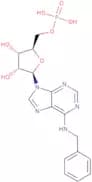
5'-O-p-Anisoyl-2'-deoxyuridine is a novel activator that is an analogue of pyrimidine and has been synthesized for the first time. It belongs to the group of nucleosides and has been modified chemically. This compound can be used as a pharmaceutical drug for the treatment of cancer or viral infections.Formula:C17H18N2O7Purezza:Min. 95%Peso molecolare:362.33 g/molN6-Benzyladenosine 5'-monophosphate sodium salt monohydrate
CAS:N6-Benzyladenosine 5'-monophosphate sodium salt is a nucleoside that is not identified. It has been shown to be metabolized by adenosine deaminase and may have antitumor activity. N6-Benzyladenosine 5'-monophosphate sodium salt is also a radioactively labeled adenine analog that has been used in the study of metabolic pathways.
Formula:C17H18N5Na2O7P·H2OPurezza:Min. 97 Area-%Colore e forma:PowderPeso molecolare:499.32 g/mol5'-O-Acetyl-2',3'-dideoxy-2',3'-didehydro-5-fluorouridine
CAS:5'-O-Acetyl-2',3'-dideoxy-2',3'-didehydro-5-fluorouridine is a nucleoside analog. It is synthesized by substituting the hydroxyl group of uridine with a fluorine atom and the 2' position of ribose with a 5'-O-acetyl group. This modification prevents the incorporation of this nucleoside into DNA or RNA, making it an effective antiviral and anticancer agent. 5'-O-Acetyl-2',3'-dideoxy-2',3'-didehydro-5-fluorouridine has been shown to be highly active against tumor cells but not normal cells in vitro.Formula:C11H11N2O5Purezza:Min. 95%Peso molecolare:251.22 g/mol2’C-Methyl-5-methoxyuridine
CAS:2’-C-Methyl-5-methoxyuridine is a nucleoside analog that inhibits viral replication by inhibiting DNA synthesis. It is also used in the treatment of cancer, as it inhibits the growth of tumor cells by altering their genetic material. This drug is a phosphorothioate and can be activated with an activator to form its active form, which is incorporated into DNA during replication. 2’-C-Methyl-5-methoxyuridine has been shown to be effective against many viruses, including human immunodeficiency virus (HIV), herpes simplex virus type 1 (HSV1), and herpes simplex virus type 2 (HSV2). This drug has been shown to cause death of tumor cells via apoptosis or cell cycle arrest at the G0/G1 phase.
Purezza:Min. 95%
![3'-O-[(Propan-2-ylidene)amino]-thymidine 5'-triphosphate](/_next/image/?url=https%3A%2Fstatic.cymitquimica.com%2Fproducts%2F3D%2Fthumb-webp%2FNP145591.webp&w=3840&q=75)

![4-Chloro-7-(2-deoxy-3,5-bis-O-(p-toluoyl)-β-D- ribofuranosyl)-5-iodo-7H-pyrrolo[2,3-d]pyrimidine](/_next/image/?url=https%3A%2Fstatic.cymitquimica.com%2Fproducts%2F3D%2Fthumb-webp%2FNC162932.webp&w=3840&q=75)