Monosaccaridi
Sottocategorie di "Monosaccaridi"
- Alloses(11 prodotti)
- Arabinosi(21 prodotti)
- Eritrosio(11 prodotti)
- Fruttosio(9 prodotti)
- Fucosio(36 prodotti)
- Galactosamina(41 prodotti)
- Galattosio(261 prodotti)
- Glucosio(365 prodotti)
- Acidi glucuronici(52 prodotti)
- Glicosubstrati per enzima(78 prodotti)
- Gulosio(6 prodotti)
- Idosio(4 prodotti)
- Inositoli(15 prodotti)
- Lixosio(4 prodotti)
- Mannosio(65 prodotti)
- O-Glicani(48 prodotti)
- Psicosi(3 prodotti)
- Rhamnosio(10 prodotti)
- Ribosi(61 prodotti)
- Acidi Sialici(100 prodotti)
- Sorbosio(4 prodotti)
- Zuccheri(173 prodotti)
- Tagatosio(4 prodotti)
- Talosio(8 prodotti)
- Xyloses(20 prodotti)
Trovati 6088 prodotti di "Monosaccaridi"
D-Glucuronic acid, free acid
CAS:D-Glucuronic acid (GlcA) is D-glucose with position six oxidised to a carboxyl group (Collins, 2006). It is a common component of a number of gums and mucilages structurally related to pectins, where it is can be present as a terminal non reducing end residue (Renard, 1999). Glucuronic acid is also found in bacterial polysaccharides, such as, xanthan gum produced by Xanthomonas campestris (Faria, 2011), and in glycosaminoglycans, such as, heparan sulfate (Casale, 2020).
Formula:C6H10O7Peso molecolare:194.14 g/mol6-Deoxy-3,5-O-benzylidene-D-gulonolactone
6-Deoxy-3,5-O-benzylidene-D-gulonolactone is a Methylated Oligosaccharide that is custom synthesized for your needs. It has CAS No. and is available in high purity with a Click modification to the sugar as well as Fluorination. This product is also a Carbohydrate, which is a Polysaccharide and Saccharide that can be used in many applications such as medical research, food production, or industrial processes. 6-Deoxy-3,5-O-benzylidene-D-gulonolactone is made from Monosaccharides and Sugars and can be modified to meet your needs.Purezza:Min. 95%α-D-Mannopyranosyl azide
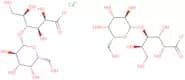
CAS:a-D-Mannopyranosyl azide is a custom synthesis, modification, fluorination, methylation, monosaccharide, synthetic and glycosylation agent. It can be used as a monosaccharide or oligosaccharide for the synthesis of complex carbohydrates.Formula:C6H11N3O5Purezza:Min. 95%Colore e forma:White PowderPeso molecolare:205.17 g/molCalcium lactobionate dihydrate
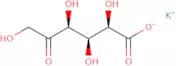
CAS:Food additive; stabilizerFormula:C12H22O12•Ca0•H2OPurezza:Min. 96.0%Colore e forma:White PowderPeso molecolare:754.66 g/mol5-Keto-D-gluconic acid potassium salt
CAS:Intermediate in L-idonate degradation and ketogluconate metabolismFormula:C6H9KO7Purezza:Min. 99.0%Colore e forma:White PowderPeso molecolare:232.23 g/molN-(2,4-Dinitrophenyl-deoxynojirimycin
N-2,4-Dinitrophenyl-deoxynojirimycin (DNPDNJ) is a methylated derivative of deoxynojirimycin. It is an inhibitor of glycosylation that can be used to study the structure and function of carbohydrates. DNPDNJ is a synthetic saccharide that can be custom synthesized. Click modification and modification with Oligosaccharides are common modifications for DNPDNJ. DNPDNJ is available in high purity and has been fluorinated for use in fluorescence studies.
Purezza:Min. 95%Furaneol beta-D-glucopyranoside
CAS:Furaneol beta-D-glucopyranoside is a synthetic sugar that is used as an intermediate in the synthesis of complex carbohydrates. Furaneol beta-D-glucopyranoside has been modified by methylation and fluorination, which allows it to be used in click chemistry. Furaneol beta-D-glucopyranoside is also a high purity compound with a custom synthesis available for purchase.Formula:C12H18O8Purezza:Min. 97 Area-%Colore e forma:PowderPeso molecolare:290.27 g/mol(3S, 5S) -1-Benzyl-3, 4, 5- piperidinetriol
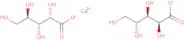
(3S, 5S) -1-Benzyl-3, 4, 5- piperidinetriol is a custom synthesis that belongs to the group of methylated and fluorinated triols. It is a high purity compound with a monosaccharide sugar. This product can be used as an intermediate for the synthesis of complex carbohydrate compounds such as oligosaccharides and polysaccharides.Purezza:Min. 95%Calcium-D-arabonate
CAS:Calcium-D-arabonate is a fatty acid that is used as a functional ingredient in the food industry. It has been shown to increase the rate of reactions, such as glycosidic bond cleavage and polymerization, by acting as an oxidation catalyst. This product also has a high molecular weight and can be used to modify the structure of polymers. Calcium-D-arabonate is often used in model systems because it reacts with other substances at a pH optimum of 6.0-7.5.
Formula:C5H9O6CaPurezza:Min. 98%Colore e forma:White PowderPeso molecolare:185.16 g/molMethyl 2-deoxy-D-ribofuranoside
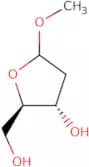
CAS:Methyl 2-deoxy-D-ribofuranoside is a methylglucoside that is synthesized by the reaction of thiourea with chloroacetic acid. The anomers of this compound are atypical and the product can be obtained in high yield (70%) by the use of chromatographic purification. This chemical has been used to produce a variety of compounds including carbamates, chloroacetamides, sulfonamides and others. Methyl 2-deoxy-D-ribofuranoside is also an intermediate for asymmetric synthesis. It can act as a catalyst for reactions involving alkali metals and nucleophiles such as chloride, hydantoin and dimethylformamide. The structure of this molecule has been determined by nmr spectroscopy and its 1H NMR spectrum is consistent with that predicted from its molecular formula.
Formula:C6H12O4Purezza:Min. 95%Colore e forma:Slightly Yellow Clear LiquidPeso molecolare:148.16 g/molMonogalactosyldiacylglycerol
Monogalactosyldiacylglycerol (MGDG) is a polyunsaturated fatty acid, specifically a galactolipid. MGDG is synthesized by plants and plays an important role in plant physiology. MGDG is involved in the regulation of transcription and translation and also has anti-cancer properties. It has been shown that MGDG can inhibit the proliferation of breast cancer cells such as MDA-MB-231 cells through its interactions with miR-205, a microRNA that regulates cellular growth, differentiation, and apoptosis. The biochemical properties of MGDG are similar to those of diacylglycerol (DAG), which is also involved in transcriptional regulation. It has also been shown that MGDG inhibits the growth of MDA-MB-231 cells when exposed to high salt concentrations.
Formula:C45H74O10Purezza:Min. 95%Peso molecolare:775.06 g/molD-myo-Inositol-1,3,5-triphosphate sodium salt
D-myo-Inositol-1,3,5-triphosphate sodium salt is a Glycosylation, complex carbohydrate. It can be Methylated, Click modified, Polysaccharide, Fluorinated and Saccharide. D-myo-Inositol-1,3,5-triphosphate sodium salt can be Modified by Modification and Sugar. D-myo-Inositol-1,3,5-triphosphate sodium salt is Synthetic. It has CAS No. and Monosaccharide Custom synthesis. D-myo-Inositol-1,3,5-triphosphate sodium salt is High purity.Formula:C6H12O15P3·xNaPurezza:Min. 95%Peso molecolare:417.07 g/mol(Piperidine-2,6-dione-4-yl) b-D-ribofuranoside
Methylation of a saccharide is the covalent addition of a methyl group to one of the hydroxyl groups. This process may be achieved through an electrophilic substitution reaction with a methylating agent such as dimethyl sulfate. In the case of polysaccharides, this process can be carried out in vitro using enzymes called glycosyltransferases. The mechanism for glycosyltransferase-mediated methylation was elucidated by Michaelis and Menten in 1913.Purezza:Min. 95%Allyl 4,6-O-benzylidene-L-glucopyranoside
Allyl 4,6-O-benzylidene-L-glucopyranoside is a modification of the carbohydrate allyl 4,6-O-benzylidene-D-glucopyranoside. This modification can be synthesized from benzyl alcohol and sodium hydroxide in the presence of sodium borohydride. Allyl 4,6-O-benzylidene-L-glucopyranoside is a monosaccharide with a CAS number of 159430-38-3. It is an important component of many polysaccharides and glycosides. This compound has been fluorinated to produce allyl 4,6-(difluoroacetoxy)-L glucopyranoside (CAS No. 160105).
Allyl 4,6 - O - benzyldene - L - glucopyranoside has high purity and is available for customFormula:C16H20O6Purezza:Min. 95%Colore e forma:White to off-white solid.Peso molecolare:308.33 g/molN-Acetylneuraminic acid
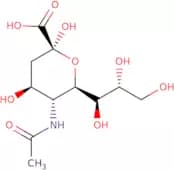
CAS:N-Acetylneuraminic acid (NANA or Neu5Ac), as the most common sialic acid, is a nine-carbon monosaccharide whose amino group is acetylated (Collins, 2006). Sialic acid is found across the animal kingdom and some prokaryotes. Sialic acid occurs as a component of oligosaccharides (N- and O-linked glycoproteins, glycolipids, human milk, blood groups), bacterial polysaccharides and glycoconjugates. Sialic acid is also found in free form in body fluids (Schauer, 1997).Formula:C11H19NO9Purezza:Min. 98 Area-%Colore e forma:White PowderPeso molecolare:309.27 g/molMethyl 6-deoxy-β-D-glucopyranoside
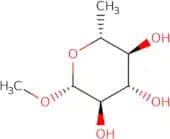
CAS:Methyl 6-deoxy-b-D-glucopyranoside is a custom synthesis that produces methylated sugars. It is a high purity, complex carbohydrate with a molecular weight of 312.06 g/mol and CAS No. 6340-52-9. Methyl 6-deoxy-b-D-glucopyranoside is produced by the click modification of glucose, which is an oligosaccharide composed of six molecules of glucose linked together. This product has been used in the synthesis of polysaccharides and saccharides.Formula:C7H14O5Purezza:Min. 95%Colore e forma:PowderPeso molecolare:178.18 g/molα-D-Galactopyranosyl phenylisothiocyanate
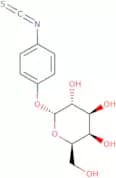
CAS:a-D-Galactopyranosyl phenylisothiocyanate is a compound that is used in the synthesis of saccharides and oligosaccharides. It reacts with a variety of sugars, including glucose, sucrose, maltose and lactose, to produce methylated derivatives. This reagent is also useful for the synthesis of glycosides. The product can be used in custom synthesis or as a fluorinated carbohydrate.
Formula:C13H15NO6SPurezza:Min. 95%Colore e forma:Off-White SolidPeso molecolare:313.33 g/mol1,2,3,4-Tetra-O-acetyl-L-rhamnopyranose
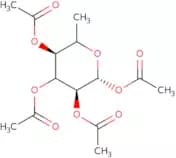
CAS:1,2,3,4-Tetra-O-acetyl-L-rhamnopyranose is an acetylated disaccharide that is glycosylated with mercuric triflate and glycoalkaloid acceptors. It has been shown to be a glycosylation coupling agent for theophylline in solanum species. 1,2,3,4-Tetra-O-acetyl-L-rhamnopyranose can also act as a steroidal glycoalkaloid acceptor and has been identified in Solanum species.
Formula:C14H20O9Purezza:Min. 95%Colore e forma:Colorless PowderPeso molecolare:332.3 g/molL-Fucose - non animal origin
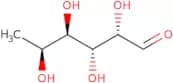
CAS:L-Fucose is an aldohexose that is used as the building block for various glycoproteins and glycolipids. It is found in human serum and human pathogens. L-Fucose can be isolated from the hybridoma cell line by apical chromatography. The analytical method of L-fucose includes body formation, oligosaccharides, and glycan titration calorimetry. Structural analysis of L-fucose includes glycosylation, sugar analysis, and carbohydrate analysis. Fucose can also be used to produce oligosaccharides through enzymatic reactions with other sugars including glucose and galactose. This reaction produces a linkage between fucose and other sugars that are called glycosidic bonds.Formula:C6H12O5Purezza:Min. 98 Area-%Colore e forma:PowderPeso molecolare:164.16 g/mol1-Deoxygalactonojirimycin hydrochloride salt
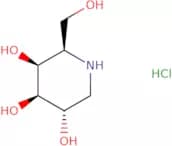
CAS:Specific and potent inhibitor of lysosomal α-galactosidase with IC50 in nanomolar range. It acts as pharmacological chaperone and assists folding of the wild type and mutant versions of the enzyme. It places itself in the instable active site and prevents the damage to the enzyme during the passage through Golgi apparatus, endoplasmatic reticulum and lysosome axis. The exposure to this compound leads to increased levels of functional α-galactosidase in models for lysosomal storage disorders and brings therapeutic benefits to patients with Fabry disease.Formula:C6H13NO4·HClPurezza:Min. 95 Area-%Colore e forma:White PowderPeso molecolare:199.63 g/mol