Substrati enzimatici
Sottocategorie di "Substrati enzimatici"
Trovati 1528 prodotti di "Substrati enzimatici"
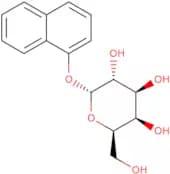
1-Naphthyl a-D-galactopyranoside
CAS:1-Naphthyl a-D-galactopyranoside is a chromogenic substrate use to detect alpha-galactosidase activity.Formula:C16H18O6Purezza:Min. 95%Colore e forma:PowderPeso molecolare:306.31 g/mol4-Methylumbelliferyl a-L-idopyranosiduronic acid sodium salt
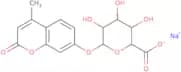
CAS:PAIRED PRODUCT AVAILABLE: alpha-L-iduronidase Enzyme, FI179383.
4MU-alpha-L-idopyranosiduronic acid is a fluorogenic substrate for alpha-L-iduronidase. Active alpha-L-iduronidase cleaves the MU moiety from the synthetic substrate, which results in release of a fluorescent signal (Ex 360 nm / Em 455 nm). The reaction is stopped by the addition of sodium carbonate. 4MU-alpha-L-idopyranosiduronic acid is used in alpha-L-iduronidase assays in the context of biochemical characterisation of samples from patients affected by lysosomal storage disease mucopolysaccharidosis I (MPS I).Formula:C16H15NaO9Purezza:Min. 98 Area-%Colore e forma:White PowderPeso molecolare:374.27 g/mol(+)-Biotin 4-amidobenzoic acid sodium salt
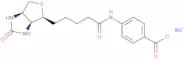
CAS:(+)-Biotin 4-amidobenzoic acid sodium salt, often referred as (+)-biotin PABA, is a fluorogenic substrate used to measure biotinidase activity, especially in newborn screening programs.
Formula:C17H20N3NaO4SPurezza:Min. 95%Colore e forma:White Slightly Yellow PowderPeso molecolare:385.41 g/mol2-Nitrophenyl-1-thio-β-D-galactopyranoside
CAS:2-Nitrophenyl-1-thio-beta-D-galactopyranoside is a nitroaryl compound that can be synthesized from beta-D-galactopyranosides and nitric acid. It has a molecular conformation that is stabilized by hydrogen bonds, which allows it to form supramolecular assemblies with other molecules. The nitro group in this molecule is responsible for the formation of the nitro group in 1,2,4,5,-tetranitrobenzene.
Formula:C12H15NO7SPeso molecolare:317.32 g/molRef: 3D-N-5100
-Unit-ggPrezzo su richiesta1gPrezzo su richiesta5gPrezzo su richiesta10gPrezzo su richiesta500mgPrezzo su richiesta2500mgPrezzo su richiesta6-Chloro-3-indolyl β-D-cellobioside
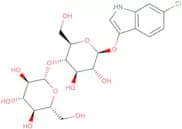
CAS:6-Chloro-3-indolyl b-D-cellobioside is a chromogenic substrate that produces a salmon-pink color after enzymatic cleavage. It is used for detecting the activity of beta-D-cellobiosidase in enzyme assays.
Purezza:Min. 95%Colore e forma:White To Off-White SolidPeso molecolare:491.87 g/molN-α-CBZ-L-citrulline-p-nitroanilide
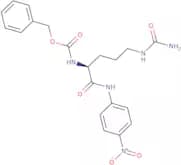
CAS:Nalpha-CBZ-L-Citrulline-p-nitroanilide is a synthetic chromogenic enzyme substrate used in protease enzymatic stutides. After hydrolysis, p-nitroaniline is released, which produces a yellow color detectable spectrophotometrically at 405 nm.
Formula:C20H23N5O6Purezza:Min. 95%Peso molecolare:429.43 g/mol4-Methylumbelliferyl palmitate
CAS:4-Methylumbelliferyl palmitate, commonly names as 4-MUP, is a fluorescent probe that binds to lipases, enzymes responsible to assist on the hydrolysis of fats. In diagnosis, 4-MUP is used for screening of lysosomal storage diseases (LSD) caused by a deficiency of a single enzyme involved in the metabolism of glycoproteins, lipids or mucopolysaccharides.
Formula:C26H38O4Purezza:Min. 95%Colore e forma:White PowderPeso molecolare:414.58 g/mol4-Methylumbelliferyl sulfate, potassium salt
CAS:4-Methylumbelliferyl sulfate, potassium salt is a metabolite of 4-methylumbelliferone and has been used as a human serum marker. This molecule is conjugated with glucuronide and p-hydroxybenzoic acid to form the sulfate, glucuronide conjugate. The reaction mechanism of this compound is not known, but it is thought that the metabolism may involve oxidation at the methyl group. The analytical method for this compound can be performed using liquid chromatography coupled with tandem mass spectrometry (LC-MS/MS). This method can also be used in vitro to test antimicrobial activity against bacteria such as Escherichia coli, Staphylococcus aureus and Pseudomonas aeruginosa.Formula:C10H7KO6SPurezza:Min. 99.0 Area-%Peso molecolare:294.33 g/molRef: 3D-M-6200
-Unit-ggPrezzo su richiesta5gPrezzo su richiesta10gPrezzo su richiesta25gPrezzo su richiesta50gPrezzo su richiesta100gPrezzo su richiesta4-Nitrophenyl 4,6-benzylidene-α-D-maltoheptaoside
CAS:4-Nitrophenyl 4,6-benzylidene-alpha-D-maltoheptaoside is a chromogenic substrate for alpha-amylase. Upon hydrolysis, para-nitrophenol is released yielding a yellowish colour. 4-Nitrophenyl 4,6-benzylidene-alpha-D-maltoheptaoside is used in different applications such as the Starch digestion studies, industrial enzyme optimizationFormula:C55H79NO38Purezza:Min. 95%Colore e forma:PowderPeso molecolare:1,362.2 g/mol4-Methylumbelliferyl caprylate
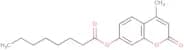
CAS:Used for identification of Salmonella spp. by detection of caprylate esteraseFormula:C18H22O4Purezza:Min. 95%Colore e forma:White PowderPeso molecolare:302.36 g/molAldol® 470 acetate, Biosynth Patent: EP 2427431 and US 8940909
CAS:Prodotto controllatoAldol® 470 acetate is a Fluorogenic substrate that is used in enzymatic reactions to produce a fluorescent product. Aldol® 470 acetate can be used as a ligand or a chromogenic substrate. This product is also used in diagnostic tests, such as conjugates and chemiluminescence, to detect the presence of certain enzymes or microorganisms. It can be used in culture media to measure the amount of certain enzymes, such as phosphatases or proteases, and has been shown to have high purity and quality. This product has CAS No. 1318785-37-3, 1318785-38-4, 1318785-39-5, 1318785-40-6 and 1318785-41-7.
Formula:C25H21NO5Purezza:Min. 95%Colore e forma:PowderPeso molecolare:415.44 g/mol4-Chloro-3-indolyl β-D-galactopyranoside
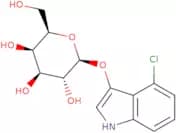
CAS:2-Chloro-4-nitrophenyl b-D-lactoside is a chromogenic enzyme substrate used to study the activity of enzymes. It produces a color when hydrolyzed, which makes it a valuable tool in screening for enzyme activity and studying enzyme kinetics.Formula:C14H16ClNO6Purezza:Min. 95%Colore e forma:SolidPeso molecolare:329.73 g/mol2-(N-Hexadecanoylamino)-4-nitrophenylphosphocholine hydroxide
CAS:2-(N-Hexadecanoylamino)-4-nitrophenylphosphocholine hydroxide, often abbreviated as HDA-PC, is a chromogenic substrate for acid sphingomyelinase enzyme. HDA-PC is used as a key substrate for measuring the activity of this enzyme, responsible for catalyzing the hydrolysis of sphingomyelin to ceramide. The activity assay for this measuring this enzyme's acitivy is to detect a deficiency (or lack) of the enzyme which is directly related to the Niemann-Pick disease.Formula:C27H50N3O8PPurezza:Min. 95%Colore e forma:Off-White PowderPeso molecolare:575.68 g/mol4-Nitrophenyl 2-acetamido-2-deoxy-a-D-glucopyranoside
CAS:4-Nitrophenyl 2-acetamido-2-deoxy-a-D-glucopyranoside is a chromogenic pNP substrate specifically designed for the analysis of N-acetylglucosaminidase activity. Upon enzyme action, the substrate releases 4-nitrophenol, a yellow compound that can be detected by spectrophotometric methods, providing a reliable and sensitive means of quantifying enzyme activity. This versatile substrate is widely used in biochemical studies, disease diagnostics, and the enzyme production industry.Formula:C14H18N2O8Colore e forma:White Off-White PowderPeso molecolare:342.3 g/mol4-Methylumbelliferyl 2-deoxy-2-sulfamino-a-D-glucopyranoside sodium salt - Moscerdam™ biochemical purity
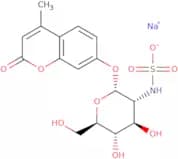
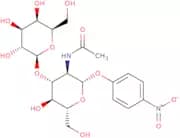
CAS:4-Methylumbelliferyl 2-deoxy-2-sulfamino-a-D-glucopyranoside sodium salt (M3A or MU-GlcNS) is a fluorogenic substrate of heparin sulfamidase, used in the diagnosis of Mucopolysaccharidosis III type A (MPS III A). MPS III A, also known as Sanfilippo syndrome type A, is caused by the deficiency of heparan N-sulfatase. Heparin sulfamidase in the assay desulfates MU-GlcNS to 4-methylumbelliferyl 2-amino-2-deoxy-α-D-glucopyranoside (MU-GlcNH2). To release fluorometrically measurable 4-methylumbelliferone (MU) and by-product glucosamine, MU-GlcNH2 is further hydrolysed by an enzyme such as yeast α-glucosidase during a second incubation.Formula:C16H18NO10SNaPurezza:Min. 95 Area-%Colore e forma:White PowderPeso molecolare:439.37 g/mol4-Nitrophenyl 2-acetamido-2-deoxy-3-O-(b-D-galactopyranosyl)-b-D-glucopyranoside
CAS:Chromogenic substrate for fucosyltransferasesFormula:C20H28N2O13Purezza:Min. 98 Area-%Colore e forma:White PowderPeso molecolare:504.44 g/mol5-Bromo-6-chloro-3-indolyl acetate
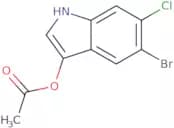
CAS:5-Bromo-6-chloro-3-indolyl acetate is a chromogenic substrate that yields a magenta-colored product after cleavage. The chromophore 5-bromo-6-chloro-indoxyl is released, generating the observable color. It is used in bacterial esterase detection (e.g. Staphylococcus spp.).
Formula:C10H7BrClNO2Purezza:Min. 98 Area-%Colore e forma:PowderPeso molecolare:288.52 g/mol4-Nitrophenyl-β-L-fucopyranoside
CAS:4-Nitrophenyl-beta-L-fucopyranoside is a chromogenic substrate used in the determination of alpha-glucosidase activity. The formation of phenol from 4-nitrophenyl leads to the production of a yellow color that can be quantified by measuring its absorbance at 490 nm. This assay is based on the principle that alpha-glucosidase hydrolyzes sucrose into glucose and fructose, which are then oxidized to form 4-nitrophenol and 4-nitroanomeric acid, respectively. The reaction product is detected by measuring the absorption at 490 nm.Formula:C12H15NO7Peso molecolare:285.26 g/molRef: 3D-N-4160
-Unit-ggPrezzo su richiesta5gPrezzo su richiesta10gPrezzo su richiesta25gPrezzo su richiesta50gPrezzo su richiesta2500mgPrezzo su richiestaLuciferin-α-D-galactoside, sodium salt
Luciferin-alpha-D-galactoside, sodium salt (LDA) is a bioluminescence substrate. It is used in diagnostic tests for the detection of bacteria and fungi. LDA is also used to measure the effectiveness of biocides and disinfectants. This product has been shown to be a potent fluorogenic substrate in chemiluminescent assays that can be used effectively with firefly luciferase.
Formula:C17H17NaN2O8S2Purezza:Min. 94 Area-%Peso molecolare:464.44 g/molRef: 3D-L-8126
-Unit-mgmgPrezzo su richiesta5mgPrezzo su richiesta10mgPrezzo su richiesta25mgPrezzo su richiesta50mgPrezzo su richiesta100mgPrezzo su richiesta4-Methylumbelliferyl palmitate
CAS:Fluorogenic substrate for esterase yielding a blue fluorescent solution upon cleavage.Formula:C26H38O4Purezza:Min. 99 Area-%Peso molecolare:414.59 g/molRef: 3D-M-5750
-Unit-ggPrezzo su richiesta1gPrezzo su richiesta5gPrezzo su richiesta250mgPrezzo su richiesta500mgPrezzo su richiesta2500mgPrezzo su richiesta