Substrati enzimatici
I substrati enzimatici sono molecole su cui agiscono gli enzimi per catalizzare reazioni chimiche. Il substrato si lega al sito attivo dell'enzima, dove subisce una trasformazione specifica per formare il prodotto della reazione. I substrati enzimatici sono strumenti essenziali nella ricerca per studiare la cinetica enzimatica, la specificità e il meccanismo d'azione. Sono utilizzati anche in saggi diagnostici e studi biochimici. Presso CymitQuimica, offriamo una selezione diversificata di substrati enzimatici di alta qualità per supportare le vostre ricerche in enzimologia e biochimica.
Sottocategorie di "Substrati enzimatici"
Trovati 1526 prodotti di "Substrati enzimatici"
Ordinare per
Purezza (%)
0
100
|
0
|
50
|
90
|
95
|
100
AquaSpark® alpha-D-galactoside, 10 mM in DMSO, Ramot at Tel-Aviv University Ltd. Patent family WO 2017/130191
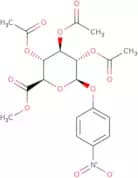
CAS:Substrate for alpha-galactosidaseFormula:C34H39ClO12Purezza:Min. 95%Colore e forma:Clear LiquidPeso molecolare:675.12 g/mol4-Nitrophenyl 2,3,4-tri-O-acetyl-b-D-glucuronide methyl ester
CAS:4-Nitrophenyl 2,3,4-tri-O-acetyl-b-D-glucuronide methyl ester is a fluorescent substrate for the beta-glucuronidase enzyme. It can be used to detect the presence of this enzyme in bacteria and other microorganisms by means of fluorometric or colorimetric assays. It has been shown to have an excellent stability in a variety of culture media and food testing applications. This product is available in high purity and quality, with a CAS number of 18472-49-6.Purezza:Min. 95%Peso molecolare:455.37 g/molAldol® 457 β-D-galactopyranoside, Biosynth Patent: EP 2427431 and US 8940909
CAS:Aldol 457 Beta-D-galactopyranoside is a chromogenic substrate for beta-galactosidase, which is an enzyme that catalyzes the hydrolysis of the terminal galactose residue in D-galactose to form D-galactitol and D-glucose. Aldol 457 Beta-D-galactopyranoside is used as a reagent for the detection of beta-galactosidase activity in biological samples, such as cultured cells or tissues, and has been shown to be a ligand in binding studies with Galectin 1. This product is also used in diagnostic applications such as food testing, culture media, fluorogenic substrates, environmental testing and more.Formula:C24H28N2O8Purezza:Min. 95.0 Area-%Peso molecolare:472.49 g/molRef: 3D-A-4726_P00
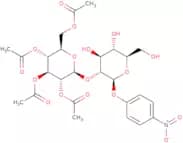
1gPrezzo su richiesta5gPrezzo su richiesta10gPrezzo su richiesta2500mgPrezzo su richiesta-Unit-ggPrezzo su richiesta4-Nitrophenyl 2-O-(2,3,4,6-tetra-O-acetyl-b-D-glucopyranosyl)-b-D-glucopyranoside
CAS:4-Nitrophenyl 2-O-(2,3,4,6-tetra-O-acetyl-b-D-glucopyranosyl)-b-D-glucopyranoside is a state-of-the-art chromogenic substrate designed for rapid and sensitive enzyme activity detection. As a versatile pNP substrate, it produces a noticeable color change upon enzyme-catalyzed hydrolysis, facilitating easy monitoring and quantification of enzyme levels in research and diagnostic applications. The substrate's acetylated glucose moiety ensures specificity and stability, allowing for precise and reliable results across a range of experimental conditions.Purezza:Min. 95%Peso molecolare:631.54 g/mol2-Nitrophenyl caprylate
CAS:2-Nitrophenyl caprylate is a potent inhibitor of gram-negative bacteria. It has been shown to inhibit the enzymatic activity of certain bacterial enzymes, such as the modification of cellular fatty acids. 2-Nitrophenyl caprylate has also been shown to inhibit in vitro growth of various gram-negative bacteria, including E. coli and Salmonella enterica serovar Typhimurium, through detergent compositions and enzymatic reactions (e.g., aminopeptidases). 2-Nitrophenyl caprylate may be useful for the treatment of pancreatitis due to its inhibition of pancreatic secretions and inhibition of pancreatic lipase activity. Transposable sequences have been found in the 2-nitrophenyl caprylate gene cluster, which may be related to its regulatory properties.Purezza:Min. 95%Colore e forma:PowderPeso molecolare:265.31 g/mol6-Chloro-4-trifluoromethylumbelliferyl b-D-galactopyranoside
6-Chloro-4-trifluoromethylumbelliferyl b-D-galactopyranoside is a chromogenic substrate that can be used in enzyme assays to measure the activity of beta-glucuronidase. This compound is sold as a conjugate with an enzyme, which will not interfere with the assay. The compound has been tested to have high purity and quality.Purezza:Min. 95%6-Bromo-2-naphthalenyl-b-D-mannopyranoside
CAS:6-Bromo-2-naphthalenyl-b-D-mannopyranoside is a boronic acid that is used as a universal substrate for the detection of peroxidase activity. This product has been shown to be stable in most culture media and can be used to detect peroxidase activity in food, environmental, and other biological samples. 6-Bromo-2-naphthalenyl-b-D-mannopyranoside also has high purity and is conjugated with various fluorophores for use in chemiluminescence and bioluminescence assays.Formula:C16H17BrO6Purezza:Min. 95%Peso molecolare:385.21 g/mol4-Nitrophenyl b-D-cellopentaoside hexadecaacetate
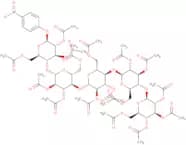
CAS:4-Nitrophenyl b-D-cellopentaoside hexadecaacetate is a fluorogenic substrate that is used to study the activity of various enzymes. It reacts with hydrolytic enzymes in the presence of hydrogen peroxide to produce light, and it can be used for food testing, environmental testing, and diagnostics. 4-Nitrophenyl b-D-cellopentaoside hexadecaacetate is a conjugate of 4-nitrophenol and cellobiose pentaacetate that has a high purity and high quality. The CAS number for this compound is 129411-66-1.Purezza:Min. 95%Peso molecolare:1,622.4 g/molN-Acetyl-L-glutamine p-nitroanilide
CAS:N-Acetyl-L-glutamine p-nitroanilide is a fluorogenic substrate that can be used in the diagnosis of bacterial infections. It is a ligand that can bind to enzymes involved in the production of bioluminescence, such as luciferase, and can be used for the detection of bacteria. It is also used for food testing, environmental testing, and diagnostics. N-Acetyl-L-glutamine p-nitroanilide has high purity and high quality, which makes it suitable for conjugation with other molecules.
Formula:C13H15N3O6Purezza:Min. 95%Colore e forma:PowderPeso molecolare:309.27 g/mol2-Chloro-4-nitrophenyl b-D-lactoside
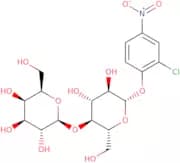
CAS:2-Chloro-4-nitrophenyl b-D-galactopyranoside is a chromogenic enzyme substrate used to study the activity of beta-lactoside. It produces a yellow color when cleaved by the enzyme, making it a useful tool in enzyme assays and screening experiments.Purezza:Min. 95%Colore e forma:PowderPeso molecolare:497.83 g/mol2,4-Dinitrophenyl b-D-cellobioside
CAS:2,4-Dinitrophenyl b-D-cellobioside is a chemiluminescent substrate that is used to detect the activity of enzymes and other proteins. It can be conjugated with an antibody or other ligand for use in diagnostic purposes. 2,4-DNPBC is a pure compound with a high quality that does not contain any other impurities. Its CAS number is 157956-96-2.Purezza:Min. 95%2-Chloro-4-nitrophenyl 2-acetamido-2-deoxy-a-D-glucopyranoside
L-2-Chloro-4-nitrophenyl 2-acetamido-2-deoxy-a-D-glucopyranoside is a chemiluminescent substrate for the detection of aminoglycoside antibiotics. It can be used to determine the concentration of aminoglycosides in blood, urine, and serum. The chemiluminescence reaction is dependent on the presence of oxygen. This product has been shown to have a high quality and purity with environmental testing and staining properties. L-2-Chloro-4-nitrophenyl 2-acetamido-2-deoxy--a--D--glucopyranoside has also been shown to bind ligands such as porphyrins, bilirubin, or hemin with bioluminescence or chromogenic substrates in diagnostics or culture media for food testing. L--2--Chloro--4--Purezza:Min. 95%4-Nitrophenyl 3,4,6-tri-O-acetyl-b-D-galactopyranoside
CAS:4-Nitrophenyl 3,4,6-tri-O-acetyl-b-D-galactopyranoside is a nucleic acid molecule that has been synthesized by recombinant expression in Corynebacterium glutamicum. It is a photosynthetic molecule and can be used to study the molecular basis of photosynthesis. The 4-nitrophenyl group on the sugar moiety confers resistance to degradation by nucleases. 4NP3,4,6GalAc has been shown to be capable of binding to proteins and polypeptides that are important for photosynthesis. This compound also has marginalizing effects on C. glutamicum strains that are used as expression vectors for recombinant protein production.Purezza:Min. 95%Peso molecolare:427.36 g/mol4-Methylumbelliferyl-b-D-glucose-6-phosphoethanolamine
4-Methylumbelliferyl-b-D-glucose-6-phosphoethanolamine is a fluorescent substrate that can be used to identify the presence of beta-glucosidase in biological samples, such as wine or cheese. It has been shown to offer high purity and quality, with a CAS number of 70750-68-6. This product is often used for diagnosing bacterial infections, as it will fluoresce when hydrolyzed by beta-glucosidase enzymes. 4MMUFBE can also be used for food testing, environmental testing, and chromogenic substrate reactions in the laboratory.Purezza:Min. 95%4-Nitrophenyl 3,6-di-O-(a-D-mannopyranosyl)-b-D-mannopyranoside
4-Nitrophenyl 3,6-di-O-(a-D-mannopyranosyl)-b-D-mannopyranoside is a chemiluminescent substrate that is used in the detection of enzymes. It is also used to measure the activity of beta-glucosidase, alpha-galactosidase, and alkaline phosphatase. The product has been tested for environmental sensitivity and has not shown any effects on bacterial growth. 4-Nitrophenyl 3,6-di-O-(a-D-mannopyranosyl)-b-D-mannopyranoside can be used as a high quality stain for histological sections and immunohistochemical studies. This product has been tested for staining properties with different dyes and has shown no interference with the staining process.Purezza:Min. 95%Peso molecolare:625.53 g/molLuciferin-caprylate
Luciferin-caprylate is a substrate for chemiluminescence, which is the light produced by a chemical reaction. It has been shown to have high quality and environmental testing as well as being a ligand for bioluminescence. Luciferin-caprylate can be used for diagnostics in the areas of culture media, food testing, and enzyme substrate. This compound can also be used as a fluorogenic substrate or conjugate.Purezza:Min. 95%5-Bromo-4-chloro-3-indoxyl phosphate, p-toluidine salt - micronized
CAS:5-Bromo-4-chloro-3-indoxyl phosphate, p-toluidine salt - micronized is a chemiluminescent substrate used in diagnostic assays. It is an enzyme substrate that is commonly used to detect peroxidase activity and has been shown to be effective in detecting various types of bacteria. This product is a high quality chemical with a purity of at least 98% and has been tested for environmental safety. 5-Bromo-4-chloro-3-indoxyl phosphate, p-toluidine salt - micronized can be used as a fluorogenic substrate for the detection of proteases and aminopeptidases.Purezza:Min. 95%2-Nitrophenyl b-D-glucuronide
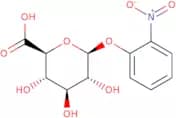
CAS:2-Nitrophenyl-b-D-glucuronide is a chromogenic substrate used to detect the activity of beta-glucuronidase in various biological samples. Upon hydrolysis by the enzyme, the substrate releases 2-nitrophenol, which can be spectrophotometrically measured at 405 nm. The substrate is commonly used in clinical assays to evaluate liver and kidney function, as well as in drug metabolism studies. It is also used in environmental monitoring to assess the presence of microbial activity in soil and water samples. Overall, 2-Nitrophenyl-b-D-glucuronide is a widely used substrate with excellent sensitivity and specificity, making it a valuable tool in enzymology research and diagnostic testing.Purezza:Min. 95%Colore e forma:Off-white solid.Peso molecolare:315.23 g/molResorufin maltotriose
Resorufin maltotriose is an alpha-amylase substrate that releases the dye resorufin with red emission (lmax=585 nm) after enzyme reaction.Formula:C30H47NO18Purezza:Min. 95%Peso molecolare:709.69 g/mol4-Nitrophenyl 2-O-(α-L-fucopyranosyl)-β-D-galactopyranoside
CAS:4-Nitrophenyl 2-O-(α-L-fucopyranosyl)-β-D-galactopyranoside is a chromogenic enzymatic substrate for the detection and quantification of glycosidases, such as fucosidases and galactosidases. Upon enzymatic cleavage, the substrate releases the p-nitrophenol chromophore, which can be quantified via colorimetric analysis. This pNP-conjugated compound enables the rapid, sensitive, and high-throughput detection of enzyme activity in various applications, including enzymatic assays, inhibitor screening, and mechanistic studies. Its precise specificity for α-L-fucopyranosyl and β-D-galactopyranoside moieties makes it an excellent tool for advancing research in glycobiology and related fields.Formula:C18H25NO12Purezza:Min. 95%Colore e forma:White Off-White PowderPeso molecolare:447.39 g/mol