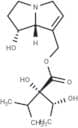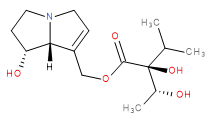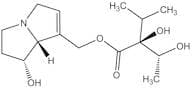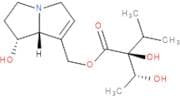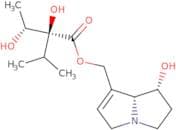
CAS 10285-06-0
:intermediário
- 3′-epi-Lycopsamine
- Butanoic acid, 2,3-dihydroxy-2-(1-methylethyl)-, (2,3,5,7a-tetrahydro-1-hydroxy-1H-pyrrolizin-7-yl)methyl ester, [1R-[1α,7(2S*,3R*),7aβ]]-
- Butanoic acid, 2,3-dihydroxy-2-(1-methylethyl)-, [(1R,7aR)-2,3,5,7a-tetrahydro-1-hydroxy-1H-pyrrolizin-7-yl]methyl ester, (2S,3R)-
- Intermidine
- [(1R,7aR)-1-hydroxy-2,3,5,7a-tetrahydro-1H-pyrrolizin-7-yl]methyl (2S,3R)-2,3-dihydroxy-2-(propan-2-yl)butanoate
- Intermedine
- (+)-Intermedine
(+)-Intermedine
CAS:(+)-Intermedine, a pyrrolizidine alkaloid (PA), shows remarkable cytotoxic activity against neural progenitor cells (NPCs).Fórmula:C15H25NO5Cor e Forma:SolidPeso molecular:299.36Intermedine 100 µg/mL in Water
CAS:Produto ControladoFórmula:C15H25NO5Cor e Forma:Single SolutionPeso molecular:299.36Intermedine
CAS:Natural alkaloidFórmula:C15H25NO5Pureza:≥ 98.0 % (HPLC)Cor e Forma:PowderPeso molecular:299.37Intermedine
CAS:Stability Hygroscopic
Applications Intermedine is an unsaturated monoester pyrrolizidine alkaloid that is extracted from the seeds of Amsinckia intermedia, a tarweed that causes enzootic hepatic cirrhosis in horses and hard liver disease in cattle. Intermedine is also a diastereomer of Lycopsamine (L487525), a pyrrolizidine alkaloid that is found in honey and in comfrey (a topical anti-inflammatory agent used to treat patients with arthritis and gout).
Not a dangerous good if item is equal to or less than 1g/ml and there is less than 100g/ml in the package
References Culvenor, C., et al.: J. Agr. Food Chem., 29 958 (1981); Janes, D., et al.: Nat. Prod. Comm., 7, 861 (2012); Li, Y. & Stermitz, F.: J. Nat. Prod., 51, 1289 (1988); McCulloch, E.: Am. Vet. Med. Assoc., 96, 5 (1940); Pawar, R., et al.: J. Sep. Sci., 33, 200 (2010)Fórmula:C15H25NO5Cor e Forma:NeatPeso molecular:299.36Intermedine
CAS:Intermedine is a pyrrolizidine alkaloid, which is a secondary metabolite derived from certain plant species, particularly within the Boraginaceae family. These alkaloids are primarily isolated from the aerial parts of plants such as comfrey and other herbal species. The mode of action of Intermedine involves its bioactivation in the liver, leading to the formation of reactive metabolites that can bind to cellular macromolecules. This property underlies its cytotoxic and potentially genotoxic effects.
Fórmula:C15H25NO5Pureza:Min. 95%Cor e Forma:PowderPeso molecular:299.36 g/mol