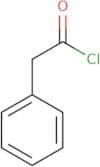
CAS 103-80-0
:Cloreto de fenilacetilo
Descrição:
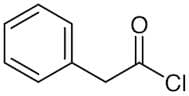
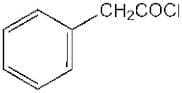
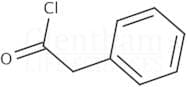
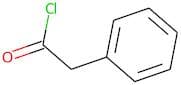
Cloreto de fenilacetilo, com o número CAS 103-80-0, é um composto orgânico caracterizado pelo seu grupo funcional cloreto de acila. Aparece como um líquido incolor a amarelo pálido com um odor pungente, típico dos cloretos de acila. Este composto é conhecido por sua reatividade, particularmente em reações de substituição acilo nucleofílica, onde pode reagir com álcoois, aminas e outros nucleófilos para formar ésteres, amidas e outros derivados. Cloreto de fenilacetilo é solúvel em solventes orgânicos como diclorometano e éter, mas não é solúvel em água devido à sua natureza hidrofóbica. É utilizado principalmente na síntese orgânica, particularmente na preparação de derivados de fenilacetila e como intermediário na produção de produtos farmacêuticos e agroquímicos. Devido à sua natureza reativa, deve ser manuseado com cuidado, pois pode causar irritação severa na pele, olhos e sistema respiratório. Precauções de segurança adequadas, incluindo o uso de equipamentos de proteção individual e trabalho em uma área bem ventilada ou capela de exaustão, são essenciais ao trabalhar com este composto.
Fórmula:C8H7ClO
InChI:InChI=1/C8H7ClO/c9-8(10)6-7-4-2-1-3-5-7/h1-5H,6H2
Chave InChI:InChIKey=VMZCDNSFRSVYKQ-UHFFFAOYSA-N
SMILES:C(C(Cl)=O)C1=CC=CC=C1
Sinónimos:- 2-Phenylacetic acid chloride
- 2-Phenylacetyl chloride
- 2-Phenylethanoyl chloride
- Acetyl chloride, phenyl-
- Chlorure De Phenylacetyle
- Cloruro De Fenilacetilo
- Phenacetyl chloride
- Phenylacetic acid chloride
- Phenylacetic chloride
- Phenylacetyl Chloride
- Phenylacetylchlorid
- α-Phenylacetyl chloride
- Benzeneacetyl chloride
- Phenylacethylchloride
- Phenyl acetyl chloride
- PHENYL ACETY1[E] CHLORIDE
- phenylacetyl
- alpha-Phenylacetyl chloride
- -Toluylchloride
- A-TOLUYL CHLORIDE
- alpha-Toluyl chloride
- AKOS BBS-00003909
- Ver mais sinónimos
Ordenar por
Pureza (%)
0
100
|
0
|
50
|
90
|
95
|
100
6 produtos.
Phenylacetyl Chloride
CAS:Fórmula:C8H7ClOPureza:>98.0%(GC)(T)Cor e Forma:Colorless to Light yellow clear liquidPeso molecular:154.59Phenylacetyl chloride, 98%
CAS:Phenylacetyl chloride is used in the preparation of 1,2-diphenyl-ethanone by reaction with iodobenzene using tetrabutylammonium tetrafluoroborate as a phase transfer catalyst. It is widely used in the chemical industry for manufacturing dyes and pharmaceutical products. It plays an important role in
Fórmula:C8H7ClOPureza:98%Cor e Forma:Liquid, Clear colorless to yellow or pink-redPeso molecular:154.59Phenylacetyl chloride
CAS:Fórmula:C8H7ClOPureza:≥ 99.0%Cor e Forma:Light yellow liquidPeso molecular:154.60Phenylacetyl Chloride(Benzeneacetyl Chloride)
CAS:Produto ControladoStability Moisture Sensitive
Applications Benzeneacetyl Chloride is used in the synthesis of aromatic inhibitors of HIV-1 integrase. Also used in the preparation of napthalenic ligands with high affinity for melatonin receptor.
Not a dangerous good if item is equal to or less than 1g/ml and there is less than 100g/ml in the package
References Burke, T. et al.: J. Med. Chem., 38, 4171 (1995); Yous, S. et al.: J. Med. Chem., 35, 1484 (1992);Fórmula:C8H7ClOCor e Forma:NeatPeso molecular:154.59Phenyl acetyl chloride
CAS:Produto ControladoPhenyl acetyl chloride (PA) is an antibiotic-resistant agent that inhibits the enzyme matrix metalloproteinase. It has been shown to be effective against bowel disease, such as inflammatory bowel disease, and also has potent antitumor activity. PA binds to a protein called p-hydroxybenzoic acid (PHBA), which is a receptor for PA in the stomach lining. The PHBA receptor is responsible for the matrix effect, which destroys bacteria by breaking down the connective tissue in the mucosal lining of the gut. PA also inhibits tumor growth by preventing cell proliferation and inducing apoptosis.Fórmula:C8H7ClOPureza:Min. 95%Peso molecular:154.59 g/mol