CAS 10399-13-0
:Metil α-cicloexil-α-hidroxibenzenoacetato
Descrição:
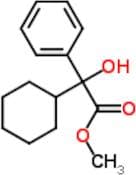
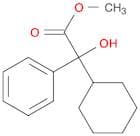
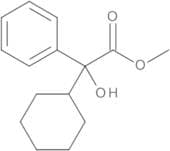
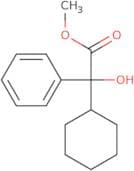
Metil α-cicloexil-α-hidroxibenzenoacetato, identificado pelo seu número CAS 10399-13-0, é um composto orgânico caracterizado pelo seu grupo funcional éster. Esta substância apresenta um grupo ciclohexila e um fragmento de hidroxi-benzeno, que contribuem para suas propriedades químicas únicas. Tipicamente, ésteres como este composto exibem polaridade moderada devido à presença de cadeias hidrocarburadas hidrofóbicas e grupos funcionais polares. Este composto pode ter aplicações na indústria de fragrâncias e sabores, uma vez que os ésteres são frequentemente usados por seus aromas agradáveis. Além disso, a presença do grupo hidroxila sugere potencial para ligações de hidrogênio, o que pode influenciar sua solubilidade em vários solventes. A estrutura molecular indica que pode possuir um grau de estabilidade em condições padrão, embora a reatividade específica dependa de fatores ambientais como temperatura e pH. No geral, Metil α-cicloexil-α-hidroxibenzenoacetato é um composto de interesse na química orgânica, particularmente em estudos relacionados a ésteres e seus derivados.
Fórmula:C15H20O3
InChI:InChI=1S/C15H20O3/c1-18-14(16)15(17,12-8-4-2-5-9-12)13-10-6-3-7-11-13/h2,4-5,8-9,13,17H,3,6-7,10-11H2,1H3
Chave InChI:InChIKey=SPTZOODMHSABLY-UHFFFAOYSA-N
SMILES:C(C(OC)=O)(O)(C1CCCCC1)C2=CC=CC=C2
Sinónimos:- Benzeneacetic acid, α-cyclohexyl-α-hydroxy-, methyl ester
- Cyclohexaneglycolic acid, α-phenyl-, methyl ester
- Methyl 2-Cyclohenyl-2-hydroxy-2-phenylacetate
- Methyl 2-hydroxy-2-cyclohexyl-2-phenylacetate
- Methyl Cyclohexyl(Hydroxy)Phenylacetate
- Methyl alpha-cyclohexylmandelate
- Methyl cyclohexylphenylglycolate
- Methyl α-cyclohexyl-α-hydroxybenzeneacetate
- Methyl α-cyclohexyl-α-phenylglycolate
- Methylcyclohexylphenylglycolate
Ordenar por
Pureza (%)
0
100
|
0
|
50
|
90
|
95
|
100
Foram encontrados 10 produtos.
Oxybutynin Related Compound B (Cyclohexyl Mandelic Acid Methyl Ester)
CAS:Carboxylic acids w/ alcohol function but w/o other oxygen function and their derivatives, nesoiFórmula:C15H20O3Cor e Forma:White Pale Yellow PowderPeso molecular:248.14124methyl 2-(6-cyclohexyl-6-hydroxycyclohexa-2,4-dien-1-yl)acetate
CAS:Fórmula:C15H20O3Pureza:98%Cor e Forma:SolidPeso molecular:248.3175Oxybutynin Related Compound B
CAS:Oxybutynin Related Compound BFórmula:C15H20O3Pureza:98%Peso molecular:248.32Oxybutynin EP Impurity F (Oxybutynin USP Related Compound B)
CAS:Fórmula:C15H20O3Cor e Forma:White To Off-White SolidPeso molecular:248.32Methyl 2-Cyclohexyl-2-hydroxyphenylacetate
CAS:Applications Methyl 2-Cyclohexyl-2-hydroxyphenylacetate is an impurity of Oxybutynin (O868525).
References Bitar, Y., et al.: J. Pharm. Biomed. Anal., 44, 623 (2007), Wen, T., et al.: Talanta, 71, 854 (2007),Fórmula:C15H20O3Cor e Forma:NeatPeso molecular:248.32Methyl cyclohexylphenylglycolate
CAS:Methyl 2-cyclohexyl-2-hydroxy-2-phenylacetateFórmula:C15H20O3Pureza:98%Peso molecular:248.32Methyl 2-cyclohexyl-2-hydroxy-2-phenylacetate
CAS:Fórmula:C15H20O3Pureza:98%+(GC-MS);RGPeso molecular:248.322Methyl 2-cyclohexyl-2-hydroxyphenylacetate
CAS:Methyl 2-cyclohexyl-2-hydroxyphenylacetate is a c6 alkyl and diode. It is an orally active hormone with potential use in catalysis of additives, as well as in the treatment of metabolic disorders. Methyl 2-cyclohexyl-2-hydroxyphenylacetate has been shown to have anticholinergic properties, which may be due to its ability to inhibit acetylcholine release from nerve endings. Lectins are proteins found on the surface of cells that bind to specific sugars and play a role in many biological processes. A lectin that binds to erythrocytes can be used as a marker for damaged red blood cells. Methyl 2-cyclohexyl-2-hydroxyphenylacetate has been shown to react with this lectin in plasma samples from humans, indicating that it is metabolized by enzymes present in red blood cells.Fórmula:C15H20O3Pureza:Min. 95%Peso molecular:248.32 g/mol