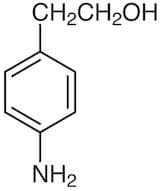
CAS 104-10-9
:2-(4-Aminofenil)etanol
Descrição:
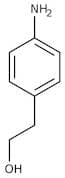
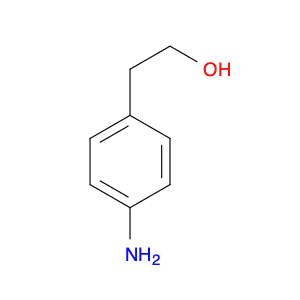
2-(4-Aminofenil)etanol, também conhecido como para-aminofeniletilanol, é um composto orgânico caracterizado pela presença de um grupo amino (-NH2) e um grupo hidroxila (-OH) ligados a um anel fenílico. Este composto apresenta uma cadeia etílica de dois carbonos ligando o grupo fenílico substituído por amino ao grupo hidroxila. Normalmente, é um sólido branco a off-white à temperatura ambiente e é solúvel em água e solventes orgânicos devido aos seus grupos funcionais polares. A presença do grupo amino confere propriedades básicas, permitindo que participe de várias reações químicas, incluindo acilação e alquilação. 2-(4-Aminofenil)etanol é de interesse na química medicinal e pode servir como precursor na síntese de fármacos, particularmente no desenvolvimento de analgésicos e agentes anti-inflamatórios. Além disso, pode ser utilizado na fabricação de corantes e como reagente na síntese orgânica. Precauções de segurança devem ser observadas ao manusear este composto, pois pode representar riscos à saúde em caso de exposição.
Fórmula:C8H11NO
InChI:InChI=1S/C8H11NO/c9-8-3-1-7(2-4-8)5-6-10/h1-4,10H,5-6,9H2
Chave InChI:InChIKey=QXHDYMUPPXAMPQ-UHFFFAOYSA-N
SMILES:C(CO)C1=CC=C(N)C=C1
Sinónimos:- 2-(4-Amino-phenyl)ethanol
- 2-(4-Aminophenyl) ethanol
- 2-(4-Aminophenyl)-1-ethanol
- 2-(4-Aminophenyl)ethyl alcohol
- 2-(p-Aminophenyl)ethanol
- 4-(2-Hydroxyethyl)aniline
- 4-(2-Hydroxyethyl)phenylamine
- 4-Amino Phenethyl Alcohol
- 4-Aminobenzeneethanol
- 4-Aminophenethyl alcohol
- Benzeneethanol, 4-amino-
- NSC 409780
- P-Amino Phenethyl Alcohol
- P-Aminophenethyl Alcohol
- Phenethyl alcohol, p-amino-
- Ver mais sinónimos
Ordenar por
Pureza (%)
0
100
|
0
|
50
|
90
|
95
|
100
10 produtos.
2-(4-Aminophenyl)ethanol, 97%
CAS:2-(4-Aminophenyl)ethanol is used as nonsymmetric monomer in the preparation of ordered [head-to-head (H-H) or tail-to-tail (T-T)] poly(amide-ester), in the synthesis of 4-aminostyrene and in functionalization of graphene nanoplatelets. This Thermo Scientific Chemicals brand product was originallyFórmula:C8H11NOPureza:97%Cor e Forma:Pale cream to cream to yellow to brown, Crystals or powder or crystalline powder or lumps or granulesPeso molecular:137.184-Aminophenethyl alcohol
CAS:4-Aminophenethyl alcoholFórmula:C8H11NOPureza:≥95%Cor e Forma: brown crystalline powderPeso molecular:137.17903g/mol2-(4-Aminophenyl)ethanol
CAS:Fórmula:C8H11NOPureza:>98.0%(GC)(T)Cor e Forma:White to Light yellow to Light orange powder to crystalPeso molecular:137.184-Aminophenethyl alcohol
CAS:Fórmula:C8H11NOPureza:95%Cor e Forma:Solid, Chunks or Crystalline PowderPeso molecular:137.1824-Aminophenethyl Alcohol
CAS:Produto ControladoApplications 4-Aminophenethyl Alcohol, is a building block that can be used in the synthesis of various compounds, such as in synthesis of 4-aminostyrene, and in functionalization of graphene nanoplatelets.
References Li L, et al.Polymer Journal 33(4), 364-370; Hagiwara T, et al. Macromolecules 24(26), 6856-6858, (1991);Fórmula:C8H11NOCor e Forma:NeatPeso molecular:137.184-Aminophenethyl alcohol
CAS:4-Aminophenethyl alcohol is a monosubstituted, basic compound that is used in the laboratory as a cell culture medium supplement to promote growth of fibroblasts. This compound has been shown to stimulate human intestinal cells and human peripheral blood mononuclear cells. 4-Aminophenethyl alcohol acts as a hydroxyl group donor, which may be due to its ability to form hydrogen ions when reacted with sodium hydroxide solution. The reaction of this compound with diazonium salt produces an intermediate, which can be hydrolyzed by the addition of sodium hydroxide solution. The resultant chloride ion reacts with the aminophenethyldihydroxylamine (APDA) moiety to produce APDCl. This product has been shown to increase the population growth rate of fibroblasts in culture by causing DNA synthesis and protein synthesis. Linear regression analysis revealed that there was no statistically significant difference between the control and experimental groups for either DNAFórmula:C8H11NOPureza:Min. 95%Peso molecular:137.18 g/mol