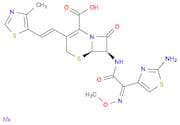
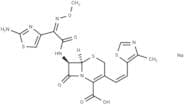
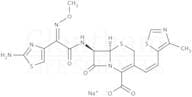
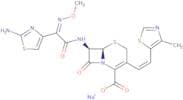
![5-Thia-1-azabicyclo[4.2.0]oct-2-ene-2-carboxylic acid, 7-[[(2Z)-2-(2-amino-4-thiazolyl)-2-(methoxy…](/_next/image/?url=https%3A%2Fstatic.cymitquimica.com%2Fcas-image%2Fthumb-webp%2F313410-5-thia-1-azabicyclo-4-2-0-oct-2-ene-2-carboxylic-acid-7-2z-2-2-amino-4-thiazolyl-2-methoxyimino-acetyl-amino-3-1z-2-4-methyl-5-thiazolyl-ethenyl-8-oxo-sodium-salt-1-1-6r-7r.webp&w=3840&q=75)
CAS 104146-53-4
:Ácido 5-tia-1-azabiciclo[4.2.0]oct-2-eno-2-carboxílico, 7-[[(2Z)-2-(2-amino-4-tiazolil)-2-(metoximino)acetil]amino]-3-[(1Z)-2-(4-metil-5-tiazolil)etenil]-8-oxo-, sal de sódio (1:1), (6R,7R)-
Descrição:
Ácido 5-tia-1-azabiciclo[4.2.0]oct-2-eno-2-carboxílico, 7-[[(2Z)-2-(2-amino-4-tiazolil)-2-(metoximino)acetil]amino]-3-[(1Z)-2-(4-metil-5-tiazolil)etenil]-8-oxo-, sal de sódio (1:1), (6R,7R)- é um composto químico complexo caracterizado por sua estrutura bicíclica, que inclui tanto moieties de tiazol quanto de tiazolidina. Este composto é notável por suas potenciais aplicações farmacológicas, particularmente como antibiótico, devido à sua semelhança estrutural com outros agentes antimicrobianos conhecidos. A presença de múltiplos grupos funcionais, incluindo ácidos carboxílicos e funcionalidades de amina, contribui para sua reatividade e solubilidade em ambientes aquosos. A forma de sal de sódio melhora sua estabilidade e biodisponibilidade. Sua estereoquímica, indicada pela configuração (6R,7R), é crucial para sua atividade biológica, influenciando como interage com enzimas ou receptores-alvo. No geral, este composto exemplifica a intrincada relação entre a estrutura molecular e a função biológica, tornando-se um assunto de interesse em química medicinal e desenvolvimento de medicamentos.
Fórmula:C19H18N6O5S3·Na
InChI:InChI=1S/C19H18N6O5S3.Na/c1-8-11(33-7-21-8)4-3-9-5-31-17-13(16(27)25(17)14(9)18(28)29)23-15(26)12(24-30-2)10-6-32-19(20)22-10;/h3-4,6-7,13,17H,5H2,1-2H3,(H2,20,22)(H,23,26)(H,28,29);/b4-3-,24-12-;/t13-,17-;/m1./s1
Chave InChI:InChIKey=YZHABJAZXAOLGE-WSWQWPGSSA-N
SMILES:C(O)(=O)C=1N2[C@@]([C@H](NC(/C(=N\OC)/C3=CSC(N)=N3)=O)C2=O)(SCC1/C=C\C4=C(C)N=CS4)[H].[Na]
Sinónimos:- 5-Thia-1-azabicyclo(4.2.0)oct-2-ene-2-carboxylic acid, 7-(((2-amino-4-thiazolyl)(methoxyimino)acetyl)amino)-3-(2-(4-methyl-5-thiazolyl)ethenyl)-8-oxo-, monosodium salt, (6R-(3(Z),6-alpha,7-beta(Z)))-
- 5-Thia-1-azabicyclo[4.2.0]oct-2-ene-2-carboxylic acid, 7-[[(2-amino-4-thiazolyl)(methoxyimino)acetyl]amino]-3-[2-(4-methyl-5-thiazolyl)ethenyl]-8-oxo-, monosodium salt, [6R-[3(Z),6α,7β(Z)]]-
- 5-Thia-1-azabicyclo[4.2.0]oct-2-ene-2-carboxylic acid, 7-[[(2Z)-(2-amino-4-thiazolyl)(methoxyimino)acetyl]amino]-3-[(1Z)-2-(4-methyl-5-thiazolyl)ethenyl]-8-oxo-, monosodium salt, (6R,7R)-
- 5-Thia-1-azabicyclo[4.2.0]oct-2-ene-2-carboxylic acid, 7-[[(2Z)-2-(2-amino-4-thiazolyl)-2-(methoxyimino)acetyl]amino]-3-[(1Z)-2-(4-methyl-5-thiazolyl)ethenyl]-8-oxo-, sodium salt (1:1), (6R,7R)-
- 5-thia-1-azabicyclo[4.2.0]oct-2-ene-2-carboxylic acid, 7-[[(2E)-2-(2-amino-4-thiazolyl)-2-(methoxyimino)-1-oxoethyl]amino]-3-[(E)-2-(4-methyl-5-thiazolyl)ethenyl]-8-oxo-, sodium salt, (6R,7R)- (1:1)
- Cefditoren sodium
- Me 1206
Ordenar por
Pureza (%)
0
100
|
0
|
50
|
90
|
95
|
100
5 produtos.
Cefditoren Sodium Salt
CAS:Fórmula:C19H17N6O5S3·NaCor e Forma:Yellow SolidPeso molecular:505.56 22.99Cefditoren sodium
CAS:Cefditoren sodium: cephalosporin antibiotic for bacterial infections; alters Mrp2, Bcrp, Oat2, P-gp, Oct1 mRNA levels.Fórmula:C19H18N6NaO5S3Cor e Forma:SolidPeso molecular:529.57Cefditoren acid sodium
CAS:Cefditoren acid sodium is an antibacterial agent that belongs to the class of third-generation cephalosporins, which is derived from Acremonium fungus and produced through chemical synthesis. This compound acts by inhibiting bacterial cell wall synthesis, leading to cell lysis and death. It achieves this by binding to specific penicillin-binding proteins (PBPs) located inside the bacterial cell wall. The interruption of peptidoglycan synthesis in the cell wall is crucial for maintaining bacterial cell integrity, and its inhibition results in the bactericidal activity of cefditoren acid sodium. It is effective against a range of Gram-positive and Gram-negative bacteria. The key applications of this compound include the treatment of bacterial infections such as respiratory tract infections, skin infections, and other conditions caused by susceptible bacteria. Its spectrum of activity and pharmacokinetic properties make it suitable for situations where third-generation cephalosporins are indicated. Understanding the specific interaction with PBPs and the resistance mechanisms is crucial for optimizing its clinical use and managing antibiotic resistance.Fórmula:C19H17N6NaO5S3Pureza:94%MinPeso molecular:528.56 g/mol