CAS 106-30-9
:Heptanoato de etilo
Descrição:
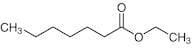
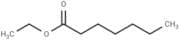
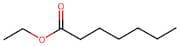
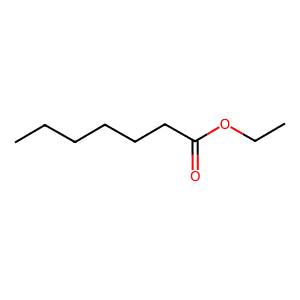
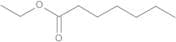
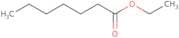
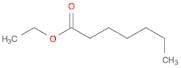
Heptanoato de etilo, com o número CAS 106-30-9, é um éster formado a partir da reação do ácido heptanoico e do etanol. É caracterizado por seu aroma frutado, muitas vezes reminiscentes de maçãs ou peras, tornando-se um agente aromatizante comum na indústria alimentícia. Heptanoato de etilo é um líquido incolor à temperatura ambiente e é ligeiramente solúvel em água, mas mais solúvel em solventes orgânicos como etanol e éter. Sua fórmula molecular é C9H18O2, e possui um ponto de ebulição relativamente baixo, o que contribui para sua volatilidade e propriedades de fragrância. A substância é utilizada não apenas em aromatizantes alimentares, mas também em perfumaria e como solvente em várias aplicações químicas. Heptanoato de etilo é geralmente considerado seguro para uso em produtos alimentícios, embora deva ser manuseado com cuidado devido à sua natureza inflamável. Sua estrutura química inclui uma longa cadeia de hidrocarbonetos, que contribui para suas características hidrofóbicas e influencia seu comportamento em diferentes ambientes.
Fórmula:C9H18O2
InChI:InChI=1/C38H72N2O12/c1-15-27-38(10,46)31(42)24(6)40(13)19-20(2)17-36(8,45)33(52-35-29(41)26(39(11)12)16-21(3)48-35)22(4)30(23(5)34(44)50-27)51-28-18-37(9,47-14)32(43)25(7)49-28/h20-33,35,41-43,45-46H,15-19H2,1-14H3/t20-,21-,22+,23-,24-,25+,26+,27-,28+,29-,30+,31-,32+,33-,35+,36-,37-,38-/m1/s1
Chave InChI:InChIKey=TVQGDYNRXLTQAP-UHFFFAOYSA-N
SMILES:C(CCCCCC)(OCC)=O
Sinónimos:- (2R,3S,4R,5R,8R,10R,11R,12S,13S,14R)-2-ethyl-3,4,10-trihydroxy-3,5,6,8,10,12,14-heptamethyl-15-oxo-11-{[3,4,6-trideoxy-3-(dimethylamino)-beta-D-xylo-hexopyranosyl]oxy}-1-oxa-6-azacyclopentadecan-13-yl 2,6-dideoxy-3-C-methyl-3-O-methyl-alpha-L-ribo-hexopyranoside
- Aether oenanthicus
- Ai3-24251
- Brn 1752311
- Ccris 1344
- Cognac oil
- Enanthic acid, ethyl ester
- Enanthylic ether
- Ethyl enantate
- Ethyl enanthate
- Ethyl heptanoate (natural)
- Ethyl heptoate
- Ethyl heptylate
- Ethyl n-heptanoate
- Ethyl oenanthate
- Ethyl oenanthylate
- FEMA No. 2437
- Grape oil
- Heptanoic acid, ethyl ester
- Nsc 8891
- Oenanthic ether
- Oleum vitis viniferae
- Wine oil
- 4-02-00-00960 (Beilstein Handbook Reference)
- RARECHEM AL BI 0165
- ethylenantate
- enanthylicether
- Ethyl ester of heptanoic acid
- N-HEPTANOIC ACID ETHYL ESTER
- OENANTHIC ACID ETHYL ESTER
- FEMA 2441
- FEMA 2437
- Ver mais sinónimos
Ordenar por
Pureza (%)
0
100
|
0
|
50
|
90
|
95
|
100
14 produtos.
Ethyl Heptanoate
CAS:Fórmula:C9H18O2Pureza:>98.0%(GC)Cor e Forma:Colorless to Almost colorless clear liquidPeso molecular:158.24Ethyl heptanoate, 98+%
CAS:This Thermo Scientific Chemicals brand product was originally part of the Alfa Aesar product portfolio. Some documentation and label information may refer to the legacy brand. The original Alfa Aesar product / item code or SKU reference has not changed as a part of the brand transition to Thermo SciFórmula:CH3(CH2)5CO2CH2CH3Pureza:98+%Cor e Forma:Liquid, Clear colorlessPeso molecular:158.24Ethyl heptanoate
CAS:Ethyl heptanoate is a RIFM spice that is produced and volatilized by the fermentation of eight packets of tempeh.Fórmula:C9H18O2Cor e Forma:SoildPeso molecular:158.24Ethyl Heptanoate(Heptanoic Acid Ethyl Ester)
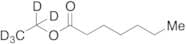
CAS:Produto ControladoFórmula:C9H18O2Cor e Forma:NeatPeso molecular:158.24Heptanoic Acid Ethyl-d5 Ester
CAS:Produto ControladoFórmula:C9H13D5O2Cor e Forma:NeatPeso molecular:163.27Ethyl Heptanoate(Heptanoic Acid Ethyl Ester)
CAS:Ethyl Heptanoate is a colorless liquid that has a strong odor. It is used as a chemical intermediate in the production of ethyl decanoate, which is an ester. Ethyl Heptanoate is soluble in glycol ether and insoluble in water. It has been shown to be chemically stable under normal conditions, but can decompose at temperatures above 300°C. Ethyl Heptanoate has been used in studies to identify signal pathways that are involved in the regulation of cell growth and proliferation by inhibiting the activity of dibutyltin oxide (DBTO). This study was conducted on K562 cells, which were grown in microcapsules with ethyl heptanoate as the only source of oxygen. The results showed that DBTO inhibited cell proliferation by decreasing the activity of sodium carbonate (NaCO) and inhibiting the formation of ethyl decanoate from ethyl heptanoate and caproic acid (C6Fórmula:C9H18O2Pureza:Min. 95%Peso molecular:158.24 g/mol