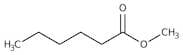
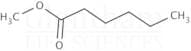
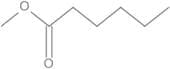
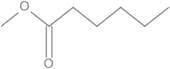
CAS 106-70-7
:Ácido hexanoico, éster metílico
Descrição:
Ácido hexanoico, éster metílico, também conhecido como hexanoato de metila, é um éster derivado do ácido hexanoico e do metanol. É um líquido incolor com um odor frutado, comumente associado ao aroma de maçãs ou abacaxis, tornando-o útil em aplicações de sabor e fragrância. O composto tem um ponto de ebulição relativamente baixo e é solúvel em solventes orgânicos, mas apenas ligeiramente solúvel em água devido à sua cadeia alquílica hidrofóbica. Ácido hexanoico, éster metílico é caracterizado pela sua fórmula química C7H14O2, que indica a presença de uma longa cadeia de hidrocarbonetos e um grupo funcional carboxilato. É frequentemente utilizado na produção de surfactantes, bem como na síntese de outros produtos químicos. Além disso, pode ser encontrado em várias fontes naturais, incluindo certas frutas e produtos lácteos. Os dados de segurança indicam que deve ser manuseado com cuidado, pois pode causar irritação ao entrar em contato com a pele ou os olhos. No geral, Ácido hexanoico, éster metílico é um composto versátil com aplicações em produtos industriais e de consumo.
Fórmula:C7H14O2
InChI:InChI=1/C7H14O2/c1-3-4-5-6-7(8)9-2/h3-6H2,1-2H3
Chave InChI:InChIKey=NUKZAGXMHTUAFE-UHFFFAOYSA-N
SMILES:C(CCCCC)(OC)=O
Sinónimos:- Agnique 610G
- Caproic acid methyl ester
- Hexanoate de methyle
- Hexanoate, Methyl
- Hexanoato De Metilo
- Methyl Hexanoate
- Methyl caproate
- Methyl capronate
- Methyl hexoate
- Methyl n-hexanoate
- Methylhexanoat
- Nsc 5023
- Pastell M 6
- Hexanoic acid, methyl ester
- methyl hexylate
- C6:0 METHYL ESTER
- RARECHEM AL BF 0164
- N-CAPROIC ACID METHYL ESTER
- METHYL HEXANOATE 99+%
- methylhexylate
- FEMA 2708
- METHYL N-CAPROATE
- METHYL HEXANOATE 99+% NATURAL
- Methyl ester of hexanoic acid
- METHYL CAPROATE, STANDARD FOR GC
- Methyl n-hexoate
- METHYL AMYL ACETATE
- Ver mais sinónimos
Ordenar por
Pureza (%)
0
100
|
0
|
50
|
90
|
95
|
100
11 produtos.
Methyl Hexanoate
CAS:Fórmula:C7H14O2Pureza:>98.0%(GC)Cor e Forma:Colorless clear liquidPeso molecular:130.19Methyl Hexanoate [Standard Material for GC]
CAS:Fórmula:C7H14O2Pureza:>99.5%(GC)Cor e Forma:Colorless clear liquidPeso molecular:130.19Methyl hexanoate, 99%
CAS:This Thermo Scientific Chemicals brand product was originally part of the Alfa Aesar product portfolio. Some documentation and label information may refer to the legacy brand. The original Alfa Aesar product / item code or SKU reference has not changed as a part of the brand transition to Thermo SciFórmula:C7H14O2Pureza:99%Cor e Forma:Clear colorless to pale yellow, LiquidPeso molecular:130.19Methyl Caproate
CAS:Saturated acyclic monocarboxylic acids and their anhydrides, halides, peroxides etc, nesoiFórmula:C7H14O2Cor e Forma:Colorless LiquidPeso molecular:130.09938Methyl hexanoate
CAS:Fórmula:CH3(CH2)4CO2CH3Pureza:≥ 99.0%Cor e Forma:Colourless liquidPeso molecular:130.19Hexanoic acid-methyl ester
CAS:Produto ControladoFórmula:C7H14O2Cor e Forma:NeatPeso molecular:130.18Hexanoic acid-methyl ester 1000 µg/mL in n-Hexane
CAS:Fórmula:C7H14O2Cor e Forma:Single SolutionPeso molecular:130.18Methyl Hexanoate
CAS:Produto ControladoApplications Methyl Hexanoate is a short chain flavor ester synthesised through a whole-cell lipase from Aspergillus oryzae WZ007. Also used in the preparation of carbaldehyde hydrazones.
Not a dangerous good if item is equal to or less than 1g/ml and there is less than 100g/ml in the package
References Yan, H. et al.: Cat. Comm., 45, 59 (2014); Neumann, D. et al.: Bioorg. Med. Chem., 22, 813 (2014);Fórmula:C7H14O2Cor e Forma:ColourlessPeso molecular:130.18Methyl Hexanoate
CAS:Methyl hexanoate is a fatty acid that is found in natural oils and fats, such as olive oil. It has a chemical structure of C6H12O2. Methyl hexanoate is used as a model system to study the reactions of organic compounds with hydroxyl groups. The kinetic data obtained from receptor cells show that methyl hexanoate reacts with acyl chains to form methyl myristate, which is an alkane with the molecular formula CH3(CH2)4CO2H. The reaction mechanism for this process includes the following steps: 1) deprotonation of methyl hexanoate by an acid catalyst; 2) elimination of water from the deprotonated molecule; 3) reaction of the resulting carboxylic acid with an acyl chain to produce an ester product; 4) elimination of water from the ester product to form a fatty acid.Fórmula:C7H14O2Pureza:Min. 95%Peso molecular:130.19 g/mol


![Methyl Hexanoate [Standard Material for GC]](/_next/image/?url=https%3A%2Fstatic.cymitquimica.com%2Fproducts%2F3B%2Fthumb%2FS0304.jpg&w=3840&q=75)