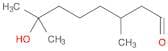
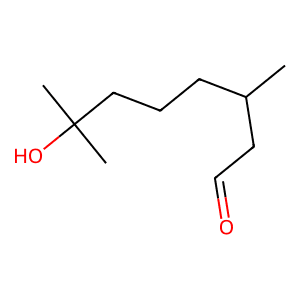
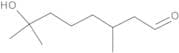
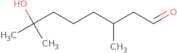
CAS 107-75-5
:Hidroxicitronelal
Descrição:
Hidroxicitronelal, com o número CAS 107-75-5, é um composto orgânico classificado como um monoterpenoide e um aldeído. É um líquido incolor a amarelo pálido com um odor floral e cítrico, tornando-se um ingrediente popular em perfumes e cosméticos. Hidroxicitronelal é solúvel em álcool e óleos, mas tem solubilidade limitada em água. Sua fórmula molecular é C10H18O, e apresenta um grupo hidroxila (-OH) e um grupo aldeído (-CHO), contribuindo para sua reatividade e propriedades de fragrância. Este composto é frequentemente utilizado como um realçador de fragrâncias e também é notado por suas potenciais propriedades alergênicas, o que levou a um escrutínio regulatório nas formulações cosméticas. Além disso, Hidroxicitronelal pode ser sintetizado a partir de citronelal, um componente natural derivado de óleos essenciais. Suas aplicações se estendem além da perfumaria, incluindo o uso em agentes aromatizantes e como um potencial intermediário na síntese orgânica. Os dados de segurança indicam que deve ser manuseado com cuidado, pois pode causar irritação na pele em indivíduos sensíveis.
Fórmula:C10H20O2
InChI:InChI=1S/C10H20O2/c1-9(6-8-11)5-4-7-10(2,3)12/h8-9,12H,4-7H2,1-3H3
Chave InChI:InChIKey=WPFVBOQKRVRMJB-UHFFFAOYSA-N
SMILES:C(C(C)(C)O)CCC(CC=O)C
Sinónimos:- (±)-Hydroxycitronellal
- 3,7-Dimethyl-7-Hydroxyoctanal
- 3,7-Dimethyl-7-hydroxyoctan-1-al
- 7-Hydroxy-3,7-dimethyloctanal
- Citronellal hydrate
- Citronellal, hydroxy-
- Cyclalia
- Cyclosia
- Cyclosia base
- Fixol
- Laurine
- Lilyl aldehyde
- Muguet synthetic
- Muguettine principle
- NSC 406740
- Octanal, 7-hydroxy-3,7-dimethyl-
- Ver mais sinónimos
Ordenar por
Pureza (%)
0
100
|
0
|
50
|
90
|
95
|
100
7 produtos.
7-Hydroxy-3,7-dimethyloctanal
CAS:Fórmula:C10H20O2Pureza:95%Cor e Forma:LiquidPeso molecular:172.26467-Hydroxycitronellal
CAS:7-HydroxycitronellalFórmula:C10H20O2Pureza:95%Cor e Forma: clear. colourless liquidPeso molecular:172.26g/mol7-Hydroxy-3,7-dimethyloctanal
CAS:7-Hydroxy-3,7-dimethyloctanal has extremely weak agonist activity against TRPM8 (EC50 = 1960 µM) and can be used in related research in the field of life sciences.
Fórmula:C10H20O2Cor e Forma:SolidPeso molecular:172.267-Hydroxycitronellal
CAS:Produto ControladoStability Air Sensitive
Applications 7-Hydroxycitronellal shows fungicide activity the strains of Candida tropicalis.
References Filho, O., et al.: Bioscience Journal, 33, 204 (2017)Fórmula:C10H20O2Cor e Forma:NeatPeso molecular:172.267-Hydroxy-3,7-dimethyloctanal
CAS:Fórmula:C10H20O2Pureza:95%Cor e Forma:Liquid, No data available.Peso molecular:172.268Citronellal hydrate
CAS:Citronellal hydrate is a chemical substance that is found in many essential oils, such as citronella, lemon grass, and citronella. It has been shown to have significant effects on the human metabolism and urine samples. Citronellal hydrate can be used as a preservative due to its ability to inhibit bacterial growth, including bacteria that are resistant to benzalkonium chloride. Citronellal hydrate also has been shown to have an effect on cell maturation, which may be predictive for the development of cancer cells. Citronellal hydrate is present in many natural products that are used in cosmetics and personal care products. It is a good analytical method for identifying the presence of other chemicals in a sample because it has been shown to react with molecules such as alcohols, amines, ketones, esters, and ethers. Citronellal hydrate reacts with these molecules by altering their mass through an electron-transfer process called triple-Fórmula:C10H20O2Pureza:Min. 95%Peso molecular:172.26 g/mol