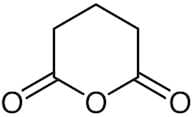
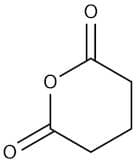
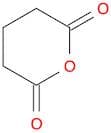
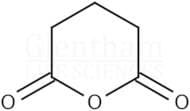
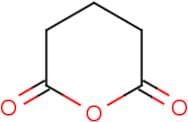
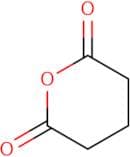
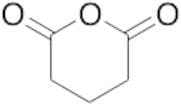
CAS 108-55-4
:Anidrido glutárico
- 2,6-Dioxo-dihydropyrane
- Anhidrido Glutarico
- Anhydride glutarique
- Dihydro-2H-pyran-2,6(3H)-dione
- Dihydro-3H-pyran-2,6-dione
- Dihydropyran-2,6-dione
- Glutaric Anhydride
- Glutaric acid anhydride
- Glutarsaeureanhydrid
- Glutarsaureanhydrid
- Nsc 16640
- Oxacyclohexane-2,6-dione
- Pentahydropyran-2,6-dione
- Pentanedioic acid anhydride
- Pentanedioic anhydride
- Pyroglutaric acid
- 2H-Pyran-2,6(3H)-dione, dihydro-
- 1,5-Glutaric anhydride
- Ver mais sinónimos
Glutaric Anhydride
CAS:Fórmula:C5H6O3Pureza:>98.0%(T)Cor e Forma:White to Light yellow powder to crystalPeso molecular:114.10Glutaric anhydride, 98%
CAS:Glutaric anhydride is used in the production of glutaric acid family pharmaceuticals. Its derivatives are also used in certain corrosion inhibitors, some surfactants and metal finishing compounds. It is also used in the production of polymers, particularly modified unsaturated linear (epoxy) polyestFórmula:C5H6O3Pureza:98%Cor e Forma:White to pale yellow, Crystals or crystalline powder or powderPeso molecular:114.10Glutaric anhydride
CAS:Fórmula:C5H6O3Pureza:≥ 98.0%Cor e Forma:White to off-white or pale yellow crystalline powderPeso molecular:114.10Glutaric Anhydride
CAS:Fórmula:C5H6O3Pureza:98.0%Cor e Forma:Chunks,Crystalline PowderPeso molecular:114.1Glutaric anhydride
CAS:Glutaric anhydride
Fórmula:C5H6O3Pureza:0.98Cor e Forma: white solidPeso molecular:114.10g/molGlutaric anhydride
CAS:Glutaric anhydride is a reactive anhydride that can be used to synthesize esters. It is chemically stable and has good thermal stability, so it can be used at elevated temperatures. Glutaric anhydride reacts with the carboxylic acid group of organic compounds to form an ester linkage. This reaction has been shown to take place in biological systems, such as glutaric acid in the human body. Glutaric anhydride is also used for the synthesis of pharmaceuticals and other organic compounds, as well as eye drops for treating eye disorders. The reaction mechanism of glutaric anhydride is not fully understood, but it is believed that it takes place through a radical-based mechanism.
Fórmula:C5H6O3Pureza:Min. 98 Area-%Cor e Forma:White PowderPeso molecular:114.1 g/molGlutaric Anhydride
CAS:Produto ControladoApplications Glutaric anhydride is an industrial chemical that causes gastrointestinal irritancy, erythema, edema, necrosis and ulcerations in humans. Glutaric anhydride is also used as a reagent to synthesize 4-(4-hydroxy-phenylcarbamoyl)-butyric acid, an analog of p-hydroxyaniline that displays analgesic and antipyretic effects in rats and mice.
References Ballantyne, B., et al.: Vet. Hum. Toxicol., 34, 493 (1992); Kumar, R., et al.: Acta Pharm. Sci., 50, 183 (2008)Fórmula:C5H6O3Cor e Forma:Off-WhitePeso molecular:114.1Glutaric Anhydride pure, 98%
CAS:Fórmula:C5H6O3Pureza:min.98%Cor e Forma:White to off-white, Crystalline compound / flakesPeso molecular:114.10