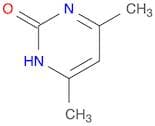
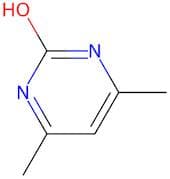
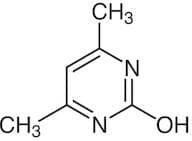
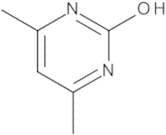
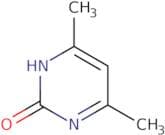
CAS 108-79-2
:2-Hidroxi-4,6-dimetilpirimidina
- 2(1H)-Pyrimidinone, 4,6-dimethyl-
- 2(1H)-Pyrimidone, 4,6-dimethyl-
- 2-Hydroxy-4,6-dimethylpyrimidine
- 2-Pyrimidinol, 4,6-dimethyl-
- 4,6-Dimethyl-1,2-dihydro-2-pyrimidone
- 4,6-Dimethyl-1,2-dihydropyrimidin-2-one
- 4,6-Dimethyl-2(1H)-Pyrimidinon
- 4,6-Dimethyl-2(1H)-pyrimidinone
- 4,6-Dimethyl-2(1H)-pyrimidone
- 4,6-Dimethyl-2(3H)-pyrimidinone
- 4,6-Dimethyl-2-pyrimidone
- 4,6-dimethyl-2-PYRIMIDINOL
- 4,6-dimethylpyrimidin-2(1H)-one
- Ver mais sinónimos
Ambrisentan Related Compound E (4,6-Dimethylpyrimidin-2-ol)
CAS:Compounds containing a pyrimidine ring, whether or not hydrogenated, or piperazine ring in the structure, nesoiFórmula:C6H8N2OCor e Forma:White Off-White Pale Yellow Crystalline PowderPeso molecular:124.063664,6-Dimethylpyrimidin-2(1H)-one
CAS:Fórmula:C6H8N2OPureza:97%Cor e Forma:SolidPeso molecular:124.14054,6-Dimethyl-2-hydroxypyrimidine
CAS:4,6-Dimethyl-2-hydroxypyrimidine
Fórmula:C6H8N2OPureza:97+%Cor e Forma: faint yellow crystalline solidPeso molecular:124.14g/mol4,6-Dimethyl-2-hydroxypyrimidine
CAS:Fórmula:C6H8N2OPureza:>98.0%(T)(HPLC)Cor e Forma:White to Light yellow to Light orange powder to crystalPeso molecular:124.144,6-Dimethyl-2-hydroxypyrimidine
CAS:Produto ControladoApplications 4,6-Dimethyl-2-hydroxypyrimidine is a component of Nicarbazine (N394530), a coccidiostat, which is an antiprotozoal agent that acts upon Coccidia parasites.
References Ksenija Sinigoj, G., et al.: Slovenski Kemijski Dnevi, (2012); Kyung-Woo, L., et al.: Han'guk Kagum Hakhoechi, 39, 17 (2012);Fórmula:C6H8N2OCor e Forma:NeatPeso molecular:124.144,6-Dimethyl-2-hydroxypyrimidine
CAS:4,6-Dimethyl-2-hydroxypyrimidine (DMHP) is an antibiotic drug that inhibits the activity of lipoprotein lipase. DMHP is a broad-spectrum antibiotic that has been shown to have inhibitory effects on bacterial growth in vitro assays. The chemical ionization method was used to measure the amount of DMHP in plasma samples. Results showed that DMHP levels were below the limit of detection in all samples. This suggests that DMHP does not accumulate in the body and may be metabolized quickly. Liquid chromatography with ultra violet light detection was used to analyze the chemical structure of DMHP and found it to be a mixture of two compounds: 4,6-dimethylpyrimidin-2(1H)-one and 2,4,6-trimethoxypyrimidine. The surface methodology was used to identify target tissues for toxicity studies, showing that this compound preferentially binds to liver tissue.
Fórmula:C6H8N2OPureza:Min. 95%Cor e Forma:PowderPeso molecular:124.14 g/mol2-Hydroxy-4,6-dimethylpyrimidine
CAS:Fórmula:C6H8N2OPureza:98%Cor e Forma:SolidPeso molecular:124.143