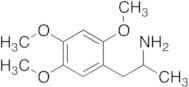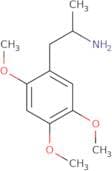
CAS 1083-09-6
:2,4,5-Trimetoxianfetamina
- (±)-1-(2,4,5-Trimethoxyphenyl)-2-aminopropane
- 1-(2,4,5-Trimethoxyphenyl)Propan-2-Amine
- 1-(2,4,5-Trimethoxyphenyl)Propan-2-Amine Hydrochloride (1:1)
- 2,4,5-Tma
- 2,4,5-Trimethoxy-α-methylbenzeneethanamine
- 2,4,5-Trimethoxyamphetamin, >99% (Hplc)
- 2,4,5-Trimethoxyamphetamine
- 2,4,5-Trimethoxyphenylisopropylamine
- 2,4,5-trimethoxy-N-(propan-2-yl)aniline
- Benzeneethanamine, 2,4,5-trimethoxy-α-methyl-
- Phenethylamine, 2,4,5-trimethoxy-α-methyl-
- Tma 2
- Ver mais sinónimos
2,4,5-Trimethoxyamphetamine
CAS:Produto ControladoApplications 2,4,5-Trimethoxyamphetamine is a derivative of Amphetamine (A634240), CNS stimulant; anorexic.Controlled substance (stimulant).
References Warren, M.R., et al.: J. Pharmacol. Exp. Ther., 85, 119 (1945); Behrendt, W.A, et al.: Arzneim.-Forsch., 13, 711 (1963); Seiden, L.S., Annu. Rev. Pharmacol. Toxicol., 32, 639 (1993)Fórmula:C12H19NO3Cor e Forma:NeatPeso molecular:225.282,4,5-Trimethoxyamphetamine
CAS:Produto Controlado2,4,5-Trimethoxyamphetamine (TMA) is a psychoactive drug and psychedelic that belongs to the class of substituted amphetamines. It has high affinity for serotonergic 5-HT 1A receptors and moderate affinity for dopaminergic D 2 receptors. TMA also interacts with 5-HT 1A and 5-HT 2C serotonin receptors. TMA is used in humans as an adjunct to psychotherapy. It has a low potential for abuse, but can produce adverse reactions such as skin irritation or neurotoxicity.
Fórmula:C12H19NO3Pureza:Min. 95%Peso molecular:225.28 g/molRef: 3D-BAA08309
Produto descontinuado