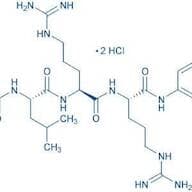
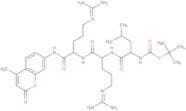
CAS 109358-46-5
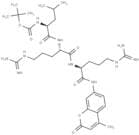
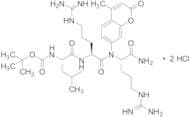
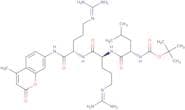
:Boc-Leu-Arg-Arg-AMC . 2 HCl
Descrição:
Boc-Leu-Arg-Arg-AMC·2 HCl, também conhecido como um substrato peptídico, é um composto sintético comumente utilizado em pesquisa bioquímica, particularmente em estudos envolvendo proteases e atividade enzimática. O grupo "Boc" (tert-butiloxicarbonila) serve como um grupo protetor para o aminoácido leucina (Leu), enquanto "Arg" denota resíduos de arginina, que são conhecidos por suas propriedades básicas e envolvimento em vários processos biológicos. A parte "AMC" (7-amino-4-metilcumarina) atua como um repórter fluorescente, permitindo a detecção da clivagem enzimática. A presença de dois sais de cloridrato (HCl) indica que o composto está em forma de sal, o que pode aumentar sua solubilidade em soluções aquosas. Este composto é tipicamente utilizado em ensaios para monitorar a atividade proteolítica, pois a clivagem da ligação peptídica libera o AMC fluorescente, permitindo uma análise quantitativa. Sua estabilidade, solubilidade e propriedades fluorescentes fazem dele uma ferramenta valiosa em biologia molecular e bioquímica para estudar a cinética enzimática e a especificidade do substrato.
Ordenar por
Pureza (%)
0
100
|
0
|
50
|
90
|
95
|
100
Foram encontrados 6 produtos.
Boc-Leu-Arg-Arg-AMC · 2 HCl
CAS:Boc-LLR-AMC is a good substrate for the Kex2 endoprotease (kexin, previously known as proteinase yscF), a membrane-bound, calcium-dependent serine protease from yeast α-cells. Boc-LRR-AMC is also used for determining the trypsin-like activity of the proteasome.Fórmula:C33H52N10O7·2HClPureza:> 99%Cor e Forma:White PowderPeso molecular:773.76Boc-LRR-AMC
CAS:Boc-LRR-AMC is a fluorogenic 26S/20S proteasome substrate that releases fluorescent AMC upon cleavage, aiding activity quantification.Fórmula:C33H52N10O7Cor e Forma:SolidPeso molecular:700.83Boc-Leu-Arg-Arg-AMC
CAS:Fórmula:C33H52N10O7·C2H4O2Pureza:≥ 98.0%Cor e Forma:White lyophilised powderPeso molecular:760.9Boc-Leu-Arg-Arg-AMC·2 HCl
CAS:Produto ControladoFórmula:C33H52N10O7Cor e Forma:NeatPeso molecular:700.829Boc-Leu-Arg-Arg-AMC dihydrochloride
CAS:Boc-Leu-Arg-Arg-AMC·2 HCl is a soybean trypsin inhibitor that has been used in the study of basic protein synthesis and cellular physiology. This inhibitor binds to the active site of soybean trypsin, preventing it from cleaving peptide bonds. The kinetic of this reaction was studied using Boc-Leu-Arg-Arg-AMC·2 HCl as a substrate and its inhibition by various concentrations of inhibitors. The inhibitory effect on the enzyme activity was measured by following the release of AMC fluorogenic substrate in vitro. Boc-Leu-Arg-Arg-AMC·2 HCl was found to be an effective inhibitor of melanoma antigen formation in vivo when injected into mice with melanoma xenografts. It also decreased tumor growth and increased survival rates in leukemic mice treated with platinum chemotherapy drugs or other pharmacological agents.Fórmula:C33H52N10O7·2HClPureza:Min. 95%Peso molecular:773.75 g/molBoc-Leu-Arg-Arg-AMC
CAS:Boc-Leu-Arg-Arg-AMC is a synthetic, nonpeptide antagonist of the CGRP receptor. It has been shown to inhibit the binding of peptides to the CGRP receptor and is used as a research tool for studying the pharmacology and protein interactions of this receptor. Boc-Leu-Arg-Arg-AMC has been shown to stimulate ion channel activity in vitro. This compound also has an affinity for antibodies that are specific for CGRP receptors, which can be used as a ligand in immunoassays.Fórmula:C33H52N10O7Pureza:Min. 95%Peso molecular:700.83 g/mol