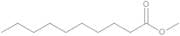
CAS 110-42-9
:Metil decanoato
Descrição:
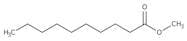
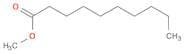
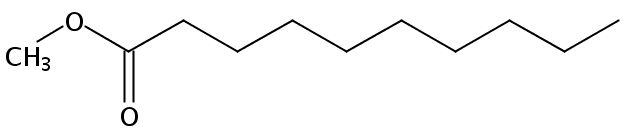
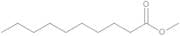
Metil decanoato, com o número CAS 110-42-9, é um éster formado a partir da reação de metanol e ácido decanoico. É caracterizado por seu agradável odor frutado, o que o torna útil nas indústrias de sabores e fragrâncias. Este composto é um líquido incolor a amarelo pálido à temperatura ambiente e possui um ponto de ebulição relativamente baixo, indicando que é volátil. Metil decanoato é solúvel em solventes orgânicos como etanol e éter, mas tem solubilidade limitada em água devido à sua cadeia decanoato hidrofóbica. É comumente utilizado como solvente e na síntese de outros compostos químicos. Além disso, exibe propriedades típicas de ésteres, incluindo ser menos denso que a água e ter uma viscosidade mais baixa. Metil decanoato também é reconhecido por suas potenciais aplicações na produção de biodiesel e como composto modelo em estudos de metabolismo lipídico. Os dados de segurança indicam que deve ser manuseado com cuidado, pois pode ser um irritante para a pele e os olhos.
Fórmula:C11H22O2
InChI:InChI=1S/C11H22O2/c1-3-4-5-6-7-8-9-10-11(12)13-2/h3-10H2,1-2H3
Chave InChI:InChIKey=YRHYCMZPEVDGFQ-UHFFFAOYSA-N
SMILES:C(CCCCCCCC)C(OC)=O
Sinónimos:- C 1098
- Capric acid methyl ester
- Capric acid methyl ester~Decanoic acid methyl ester~Methyl decanoate
- Ce 1095
- Decanoate de methyle
- Decanoate, Methyl
- Decanoato De Metilo
- Decanoic acid methyl ester
- Estasol MD 10
- Metholene 2095
- Methyl caprinate
- Methyl decanoate
- Methyl n-caprate
- Methyl n-decanoate
- Methyldecanoat
- Methyle N-Caprinate
- Nsc 3713
- Pastell M 10
- Uniphat A 30
- Ver mais sinónimos
Ordenar por
Pureza (%)
0
100
|
0
|
50
|
90
|
95
|
100
14 produtos.
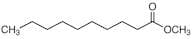
Methyl Decanoate
CAS:Fórmula:C11H22O2Pureza:>98.0%(GC)Cor e Forma:Colorless to Almost colorless clear liquidPeso molecular:186.30Methyl Decanoate [Standard Material for GC]
CAS:Fórmula:C11H22O2Pureza:>99.5%(GC)Cor e Forma:Colorless clear liquidPeso molecular:186.30Methyl decanoate, 98+%
CAS:It is employed as an intermediate for caproic acid, detergents, emulsifiers, wetting agents, stabilizers, resins, lubricants, plasticizers and flavoring. As a chemical intermediate for alkanolamides, fatty alcohols acids.This Thermo Scientific Chemicals brand product was originally part of the Alfa
Fórmula:C11H22O2Pureza:98+%Cor e Forma:Liquid, Clear colorless to pale yellowPeso molecular:186.30Methyl Caprate
CAS:Saturated acyclic monocarboxylic acids and their anhydrides, halides, peroxides etc, nesoiFórmula:C11H22O2Cor e Forma:Clear Colorless LiquidPeso molecular:186.3Methyl decanoate
CAS:Methyl decanoate (capric acid methyl ester) is an ester compound commonly used as an intermediate in organic synthesisFórmula:C11H22O2Pureza:99.43%Cor e Forma:SolidPeso molecular:186.29Methyl Decanoate(Methyl Caprate)
CAS:Applications Methyl Caprate, is an unsaturated biodiesel fuel surrogate. It can also be used as flavor and fragrance ingredients.
References Wang, W., et al.: Energy & Fuels, 27, 5527 (2013);Fórmula:C11H22O2Cor e Forma:ColourlessPeso molecular:186.29Capric Acid Methyl Ester (Methyl Decanoate) extrapure, 99%
CAS:Fórmula:C11H22O2Pureza:min. 99%Cor e Forma:Clear, Colourless, LiquidPeso molecular:186.29Methyl Decanoate
CAS:Methyl decanoate is a fatty acid that is used in the production of glycol ethers. It is produced by combining anhydrous sodium decanoate in a laminar flow reactor with methyl alcohol and water vapor. The mixture is heated to 180 °C, which causes the release of methyl alcohol and water vapor. The reaction mechanism for this process involves the oxidation of methyl alcohol, which creates a reactive intermediate. In the presence of oxygen and light, this intermediate reacts with the methyl decanoate to form methyl myristate and caproic acid. This process can also be carried out under constant pressure without using any solvent or catalyst. Methyl decanoate has been shown to react with fluorescence probes such as 8-hydroxyquinoline (8HQ). This reaction leads to changes in the fluorescence intensity, which can be detected using a spectrophotometer at wavelengths between 420 nm and 500 nm.Fórmula:C11H22O2Pureza:95%Min GcPeso molecular:186.3 g/mol

![Methyl Decanoate [Standard Material for GC]](/_next/image/?url=https%3A%2Fstatic.cymitquimica.com%2Fproducts%2F3B%2Fthumb%2FS0308.jpg&w=3840&q=75)