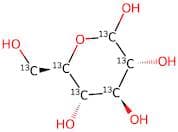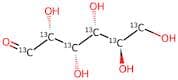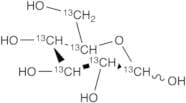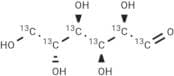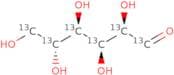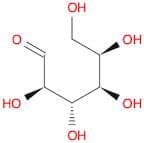
CAS 110187-42-3
:D-Glicose-13C6
- (U-13C6)-D-Glucose
- (~13~C_6_)hexose
- <span class="text-smallcaps">D</span>-Glucose-1,2,3,4,5,6-<sup>13</sup>C<sub>6</sub>
- <span class="text-smallcaps">D</span>-Glucose-<sup>13</sup>C<sub>6</sub>
- <sup>13</sup>C<sub>6</sub>-<span class="text-smallcaps">D</span>-Glucose
- D-Glucose-1,2,3,4,5,6-13C6
- 13C6-D-Glucose
- D-Glucose-13C6
D-Glucose-1,2,3,4,5,6-13C6 min. Chem. 99% min. Isot. 99%
CAS:D-Glucose-1,2,3,4,5,6-13C6 min. Chem. 99% min. Isot. 99%Fórmula:CH12O6Pureza:>99%Cor e Forma: white solidPeso molecular:186.11g/molD-Glucose-1,2,3,4,5,6-13C6
CAS:Pureza:≥ 98.0%Cor e Forma:White powder to crystalline powderPeso molecular:186.11D-Glucose-13C6
CAS:Produto ControladoApplications Labelled D-Glucose is a simple sugar that is present in plants. A monosaccharide that may exist in open chain or cyclic conformation if in solution. It plays a vital role in photosynthesis and fuels the energy required for cellular respiration. D-Glucose is used in various metabolic processes including enzymic synthesis of cyclohexyl-α and β-D-glucosides. Can also be used as a diagnostic tool in detection of type 2 diabetes mellitus and potentially Huntington's disease through analysis of blood-glucose in type 1 diabetes mellitus.
References Wang, R., et al.: J. Mol. Catal. B. Enz., 56, 131 (2009); Springhorn, C. et al.: J. Clin. Endocrinol. Metab., 97, 4640 (2012); Hashimoto, K. et al.: J. Clin. Endocrinol. Metab., 97, 3016 (2012); Avelange, M. et al.: Plant. Phys., 94, 1157 (1990); Cramer, C. et al.: J. Chem. Soc., 115, 5745 (1993);Fórmula:C6H12O6Cor e Forma:NeatPeso molecular:186.11D-Glucose-13C6
CAS:D-Glucose-13C6 (Dextrose-13C6), a C13 marker, serves as a metabolic tracer and can be used to study metabolism-related diseases in the body.Fórmula:C6H12O6Pureza:99.55% - >99.99%Cor e Forma:SolidPeso molecular:186.11D-Glucose-13C6
CAS:D-Glucose-13C6 is a complex carbohydrate, which is composed of a glucose molecule with one carbon atom labeled as C6. It is used to study the structure of carbohydrates and their interactions with proteins. D-Glucose-13C6 also has applications in the study of diseases such as Alzheimer's disease, Parkinson's disease, diabetes mellitus type 2, and cancer. In addition, this molecule can be used to measure plasma glucose concentrations in humans or animals. D-Glucose-13C6 is not active against bacteria such as Pseudomonas aeruginosa or Escherichia coli. The synthesis of D-glucose-13C6 requires anhydrous dextrose and unlabeled glucose.Fórmula:C6H12O6Pureza:Min. 98 Area-%Cor e Forma:White PowderPeso molecular:186.11 g/molRef: IN-DA008SMR
Produto descontinuado