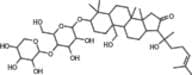
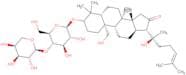
CAS 11028-00-5
:Bacosídeo A
Descrição:
Bacosídeo A é um composto natural derivado principalmente da planta Bacopa monnieri, comumente conhecido por seu uso na medicina tradicional e como nootrópico. É classificado como uma saponina triterpenoide e é conhecido por suas potenciais propriedades neuroprotetoras e de melhoria cognitiva. Acredita-se que Bacosídeo A facilite a transmissão sináptica e promova o crescimento das terminações nervosas, o que pode contribuir para a melhoria da memória e das capacidades de aprendizado. O composto exibe propriedades antioxidantes, ajudando a mitigar o estresse oxidativo nos tecidos neurais. Além disso, Bacosídeo A tem sido estudado por seus potenciais efeitos sobre a ansiedade e a depressão, mostrando seu papel na promoção do bem-estar mental. Sua solubilidade em água é limitada, o que pode afetar sua biodisponibilidade, mas várias formulações estão sendo exploradas para melhorar sua absorção. No geral, Bacosídeo A é reconhecido por seu potencial terapêutico, particularmente no contexto da saúde cognitiva e neuroproteção, tornando-se um assunto de interesse tanto na pesquisa farmacológica quanto na medicina herbal.
Fórmula:C41H68O13
InChI:InChI=1/C41H68O13/c1-21(2)9-8-14-40(7,50)29-22-10-11-27-38(5,39(22,6)17-23(29)44)15-12-26-37(3,4)28(13-16-41(26,27)20-43)53-36-33(49)31(47)34(25(18-42)52-36)54-35-32(48)30(46)24(45)19-51-35/h9,22,24-36,42-43,45-50H,8,10-20H2,1-7H3/t22-,24+,25-,26+,27+,28?,29-,30+,31-,32-,33-,34-,35+,36+,38-,39-,40+,41-/m1/s1
Sinónimos:- (5R,8R,9S,10S,13R,14R,17S)-3-[(2R,3R,4R,5S,6R)-3,4-dihydroxy-6-(hydroxymethyl)-5-[(2S,3R,4S,5S)-3,4,5-trihydroxytetrahydropyran-2-yl]oxy-tetrahydropyran-2-yl]oxy-17-[(1S)-1-hydroxy-1,5-dimethyl-hex-4-enyl]-10-(hydroxymethyl)-4,4,8,14-tetramethyl-1,2,3,5,6,7,9,11,12,13,15,17-dodecahydrocyclopenta[a]phenanthren-16-one
- 3-[(O-α-<span class="text-smallcaps">L</smallcap>-Arabinopyranosyl-β-<smallcap>D</span>-glucopyranosyl)oxy]-19,20-dihydroxydammar-24-en-16-one
- Dammar-24-en-16-one, 3-[(O-α-<span class="text-smallcaps">L</smallcap>-arabinopyranosyl-β-<smallcap>D</span>-glucopyranosyl)oxy]-19,20-dihydroxy-
- Dammar-24-en-16-one, 3-[(α-<span class="text-smallcaps">L</smallcap>-arabinopyranosyl-O-β-<smallcap>D</span>-glucopyranosyl)oxy]-19,20-dihydroxy-
- 3-[(O-α-L-Arabinopyranosyl-β-D-glucopyranosyl)oxy]-19,20-dihydroxydammar-24-en-16-one
- Dammar-24-en-16-one, 3-[(O-α-L-arabinopyranosyl-β-D-glucopyranosyl)oxy]-19,20-dihydroxy-
- Bacoside A
- Dammar-24-en-16-one, 3-[(α-L-arabinopyranosyl-O-β-D-glucopyranosyl)oxy]-19,20-dihydroxy-
- -D-glucopyranosyl)oxy]-19,- 20-dihydroxy-
- Dammar-24-en-16-one,3-[(O-R-Larabinopyranosyl- â
- 3-[(O-alpha-L-Arabinopyranosyl-beta-D-glucopyranosyl)oxy]-19,20-dihydroxydammar-24-en-16-one
- Ver mais sinónimos
Ordenar por
Pureza (%)
0
100
|
0
|
50
|
90
|
95
|
100
4 produtos.
Bacoside A
CAS:Bacoside A shows potential anti-cancer effects, cytoprotection, EAE inhibition, and vasorelaxation abilities.Fórmula:C41H68O13Pureza:98%Cor e Forma:SolidPeso molecular:768.98Stevenleaf
CAS:Stevenleaf is a natural compound that has been shown to have antioxidant, anti-inflammatory and neuroprotective properties. It has been found to reduce neuronal death in an experimental model of malignant brain tumor. Stevenleaf also has the ability to inhibit mitochondrial membrane potential and mitochondrial functions, which may be due to its ability to inhibit the activity of cytochrome c oxidase. It is unclear how this compound works in humans, but it may be due to its ability to alter nuclear DNA transcription or by binding with human serum proteins. Stevenleaf may have therapeutic effects against neurodegenerative diseases such as Parkinson's disease and Alzheimer's disease due to its ability to increase the efficiency of mitochondria and prevent cellular damage caused by oxidative stress. The optimum concentration for this compound is not yet known, but it has been shown that at high concentrations it can cause cytotoxicity.Pureza:90%Min