CAS 111119-28-9
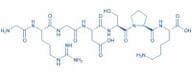
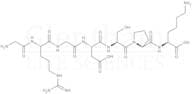
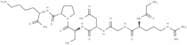
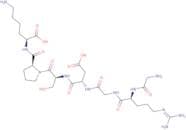
:glicina-arginina-glicina-ácido aspártico-serina-prolina-lisina
Descrição:
A substância química conhecida como "glicina-arginina-glicina-ácido aspártico-serina-prolina-lisina" é um peptídeo composto por seis aminoácidos: glicina (Gly), arginina (Arg), ácido aspártico (Asp), serina (Ser), prolina (Pro) e lisina (Lys). Este peptídeo é frequentemente estudado por sua atividade biológica e potenciais aplicações em campos como bioquímica e farmacologia. Sua sequência sugere que pode desempenhar um papel na sinalização celular, particularmente em interações com moléculas de adesão celular e receptores. A presença de aminoácidos carregados positivamente, como arginina e lisina, pode contribuir à sua capacidade de interagir com componentes celulares carregados negativamente. Além disso, a estrutura do peptídeo pode influenciar sua solubilidade, estabilidade e função biológica geral. O número CAS 111119-28-9 identifica exclusivamente este peptídeo específico, facilitando seu reconhecimento na literatura científica e em bancos de dados. No geral, glicina-arginina-glicina-ácido aspártico-serina-prolina-lisina exemplifica a complexidade das interações de peptídeos em sistemas biológicos e destaca a importância das sequências de aminoácidos na determinação da função.
Fórmula:C28H49N11O11
InChI:InChI=1/C28H49N11O11/c29-8-2-1-5-16(27(49)50)37-25(47)19-7-4-10-39(19)26(48)18(14-40)38-24(46)17(11-22(43)44)36-21(42)13-34-23(45)15(35-20(41)12-30)6-3-9-33-28(31)32/h15-19,40H,1-14,29-30H2,(H,34,45)(H,35,41)(H,36,42)(H,37,47)(H,38,46)(H,43,44)(H,49,50)(H4,31,32,33)/t15-,16-,17-,18-,19-/m0/s1
SMILES:C(CCN)C[C@@H](C(=O)O)N=C([C@@H]1CCCN1C(=O)[C@H](CO)N=C([C@H](CC(=O)O)N=C(CN=C([C@H](CCCNC(=N)N)N=C(CN)O)O)O)O)O
Sinónimos:- H-Gly-Arg-Gly-Asp-Ser-Pro-Lys-OH
- glycyl-N~5~-(diaminomethylidene)-L-ornithylglycyl-L-alpha-aspartyl-L-seryl-L-prolyl-L-lysine
- GRGDSPK
- GLY-ARG-GLY-ASP-SER-PRO-LYS
- EMD 56574
- Gly-Arg-Gly-Asp-Ser-Pro-Lys >=97% (HPLC)
- L-Lysine, glycyl-L-arginylglycyl-L-α-aspartyl-L-seryl-L-prolyl-
- GRGDSPK, FIBRONECTIN ATTACHMENT PEPTIDE
- GLY-ARG-GLY-ASP-SER-PRO-LYS ACETATE
- glycyl- arginyl-glycyl-aspartyl-seryl-prolyl-lysine
Ordenar por
Pureza (%)
0
100
|
0
|
50
|
90
|
95
|
100
6 produtos.
H-Gly-Arg-Gly-Asp-Ser-Pro-Lys-OH
CAS:GRGDSPK, fibronectin analog.Fórmula:C28H49N11O11Pureza:98.6%Peso molecular:715.77GRGDSPK
CAS:GRGDSPK (EMD 56574) is an inhibitory peptide for RGD-mediated adhesion between integrin and extracellular matrix molecules.Fórmula:C28H49N11O11Pureza:98%Cor e Forma:SolidPeso molecular:715.76RGD Peptide GRGDSPK
CAS:GRGDSPK is the sequence found in cell binding region of fibronectin and many other proteins. The sequence, referred to as RGD, is critical for facilitating cell adhesion.-RGD peptide is an adhesive peptide which can be used in a biomaterial context to attach cells to a range of materials. RGD has many applications including as an antigen for integrin adhesion of thymocytes to thymic epithelial cells. RGD can be used as a blocking peptide to study bacteria and fibronectin. RGD can also be used on collagen-coated plates for study of integrins' role in progenitor cell differentiation. Delivery of RGD peptide inhibits bone mineralization in a dose-dependent manner so GRGDSPK is used to study the role of integrins in bone formation. The presence of RGD peptide dramatically alters bone morphology, with a disruption of osteoblast and mineralized matrix organisation. RGD is a vital research tool in bone formation and integrin.Fórmula:C28H49N11O11Pureza:Min. 95%Cor e Forma:PowderPeso molecular:715.4 g/molH-Gly-Arg-Gly-Asp-Ser-Pro-Lys-OH
CAS:H-Gly-Arg-Gly-Asp-Ser-Pro-Lys-OH is a peptide that has been shown to have chemotactic activity for monocytes and polymorphonuclear leucocytes, which are cells that participate in the inflammatory response. It also has biological properties that are reactive with hydroxyl groups and can be used to generate monoclonal antibodies. H-Gly-Arg-Gly-Asp-Ser-Pro-Lys-OH has been shown to stimulate the migration of galleria mellonella larvae, suggesting it may have potential as an antiinflammatory agent.Fórmula:C28H49N11O11Pureza:Min. 95%Peso molecular:715.76 g/molH-Gly-Arg-Gly-Asp-Ser-Pro-Lys-OH
CAS:GRGDSPK, fibronectin analog.
Fórmula:C28H49N11O11Pureza:98.7%Peso molecular:715.77