CAS 11121-48-5
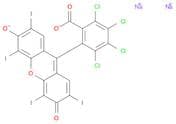
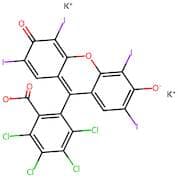
:Rosa de Bengala
Descrição:
Rosa de Bengala é um corante sintético pertencente à classe dos corantes xantênicos, caracterizado por sua vibrante cor rosa a vermelha. É comumente utilizado em várias aplicações, incluindo como um corante biológico em microscopia, um fotossensibilizador em terapia fotodinâmica e como um traçador em estudos ambientais. A estrutura química de Rosa de Bengala apresenta um derivado dibromado da fluoresceína, que contribui para sua forte absorção no espectro visível. É solúvel em água e solventes orgânicos, tornando-o versátil para diferentes condições experimentais. Rosa de Bengala exibe propriedades fototóxicas, que podem ser aproveitadas em aplicações médicas para atacar e destruir células cancerosas quando ativadas pela luz. Além disso, foi estudado por suas propriedades antioxidantes e potencial uso nas indústrias alimentícia e cosmética. No entanto, considerações de segurança são importantes, pois pode causar irritação na pele e reações alérgicas em alguns indivíduos. No geral, Rosa de Bengala é um composto valioso tanto na pesquisa científica quanto em aplicações práticas, com uma variedade de características que o tornam adequado para diversos usos.
Fórmula:Unspecified
InChI:InChI=1/C20H4Cl4I4O5/c21-10-8(9(20(31)32)11(22)13(24)12(10)23)7-3-1-5(25)16(29)14(27)18(3)33-19-4(7)2-6(26)17(30)15(19)28/h1-2,29H,(H,31,32)
Sinónimos:- Bengal Rose
- HFinCl<sub>4</sub>I<sub>4</sub>
- Rb 1017
- Rose Bengale
- SODIUM TETRAIODODICHLOROFLUORESCEIN
- C.I. Acid Red 94
- redno.105
- Rose Bengal
- TETRACHLOROTETRAIODOFLUORESCEIN SODIUM SALT
- RB
- rose
- C.I.AcidRed94(45440)
- TETRAIODOTETRACHLOROFLUORESCEIN DISODIUM SALT
- 2,3,4,5-tetrachloro-6-(6-hydroxy-2,4,5,7-tetraiodo-3-oxo-3H-xanthen-9-yl)benzoic acid
- Ver mais sinónimos
Ordenar por
Pureza (%)
0
100
|
0
|
50
|
90
|
95
|
100
5 produtos.
Rose Bengal
CAS:Rose Bengal is a photosensitizer effective against microbial cells. In the presence of light and oxygen, it inhibits the growth of yeast cells and other microorganisms, sometimes leading to their death. Rose Bengal can also limit bacterial growth, restrict the colony size of filamentous fungi, and suppress the growth of "spreading fungi" such as Rhizopus and Trichoderma.Cor e Forma:Solid(3-Oxo-6-Oxido-2,4,5,7-Tetraiodo-3H-Xanthen-9-Yl)-3,4,5,6-Tetrachlorobenzoate Sodium Salt
CAS:(3-Oxo-6-Oxido-2,4,5,7-Tetraiodo-3H-Xanthen-9-Yl)-3,4,5,6-Tetrachlorobenzoate Sodium SaltPureza:95%Sodium 2,3,4,5-tetrachloro-6-(2,4,5,7-tetraiodo-6-oxido-3-oxo-3H-xanthen-9-yl)benzoate
CAS:Pureza:98%Peso molecular:1017.63PV-10
CAS:PV-10 is a peptide that activates ion channels. It is an agonist for the nicotinic acetylcholine receptor (nAChR) and a low-affinity antagonist for the N-methyl-D-aspartate receptor (NMDAR). PV-10 binds to specific sites on the nAChR, which causes the channel to open and allow ions to flow into the cell. This leads to depolarization of the membrane, which triggers an action potential in neurons. PV-10 is also able to bind to other proteins such as NR1 subunits of NMDARs and alpha 7 subunits of nAChRs. These interactions inhibit the function of these receptors and prevent them from opening their channels. This prevents calcium influx into cells, blocking neurotransmitter release and preventing the activation of downstream pathways that lead to neuronal death. PV-10 has been shown to be selective for certain types of ion channels over othersFórmula:C20H4Cl4I4O5Pureza:Min. 95%Peso molecular:973.7 g/mol