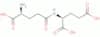
CAS 1116-22-9
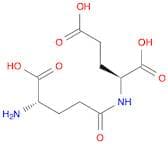
:Ácido L-γ-glutamil-L-glutâmico
Descrição:
Ácido L-γ-glutamil-L-glutâmico, também conhecido como um dipeptídeo, é um composto formado por dois resíduos de ácido glutâmico ligados por uma ligação peptídica. É caracterizado por sua estrutura, que inclui um grupo funcional ácido carboxílico e um grupo amino, típico dos aminoácidos. Esta substância é solúvel em água, refletindo a natureza polar de seus grupos funcionais, e exibe propriedades associadas aos aminoácidos, como a capacidade de participar de várias reações bioquímicas. Ácido L-γ-glutamil-L-glutâmico é frequentemente estudado no contexto de seu papel nas vias metabólicas e suas potenciais aplicações em nutrição e farmacêuticos. Também pode exibir atividade biológica, influenciando a neurotransmissão e a sinalização celular devido à sua participação na síntese de neurotransmissores. A estabilidade e reatividade do composto podem ser influenciadas por fatores como pH e temperatura, tornando importante considerar essas condições em ambientes experimentais. No geral, Ácido L-γ-glutamil-L-glutâmico é uma molécula significativa na bioquímica com várias implicações na saúde e na doença.
Fórmula:C10H16N2O7
InChI:InChI=1S/C10H16N2O7/c11-5(9(16)17)1-3-7(13)12-6(10(18)19)2-4-8(14)15/h5-6H,1-4,11H2,(H,12,13)(H,14,15)(H,16,17)(H,18,19)/t5-,6-/m0/s1
Chave InChI:InChIKey=OWQDWQKWSLFFFR-WDSKDSINSA-N
SMILES:[C@H](NC(CC[C@@H](C(O)=O)N)=O)(CCC(O)=O)C(O)=O
Sinónimos:- (2S)-2-{[(4S)-4-ammonio-4-carboxylatobutanoyl]amino}pentanedioate
- <span class="text-smallcaps">L</smallcap>-Glutamic acid, <smallcap>L</span>-γ-glutamyl-
- <span class="text-smallcaps">L</smallcap>-Glutamic acid, N-<smallcap>L</span>-γ-glutamyl-
- <span class="text-smallcaps">L</smallcap>-γ-Glutamyl-<smallcap>L</span>-glutamic acid
- Gamma-Glutamylglutamic Acid
- Glutamic acid, N-<span class="text-smallcaps">L</smallcap>-γ-glutamyl-, <smallcap>L</span>-
- Glutamic acid, N-<span class="text-smallcaps">L</span>-γ-glutamyl-
- H-Gamma-Glu-Glu-Oh
- L-gamma-glutamyl-L-glutamic acid
- N-gamma-L-Glutamyl-L-glutamic acid
- gamma-Glutamylglutamate
- γ-<span class="text-smallcaps">L</smallcap>-Glutamyl-<smallcap>L</span>-glutamic acid
- γ-Glutamylglutamic acid
- L-Glutamic acid, N-L-γ-glutamyl-
- L-Glutamic acid, L-γ-glutamyl-
- Glutamic acid, N-L-γ-glutamyl-
- Glutamic acid, N-L-γ-glutamyl-, L-
- Ver mais sinónimos
Ordenar por
Pureza (%)
0
100
|
0
|
50
|
90
|
95
|
100
6 produtos.
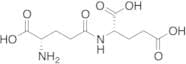
H-Glu(Glu-OH)-OH
CAS:Bachem ID: 4000639.
Fórmula:C10H16N2O7Cor e Forma:White PowderPeso molecular:276.25γ-L-Glutamyl L-Glutamic Acid
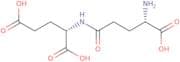
CAS:Produto ControladoApplications H-GAMMA-GLU-GLU-OH (cas# 1116-22-9) is a useful research chemical.
Fórmula:C10H16N2O7Cor e Forma:NeatPeso molecular:276.24H-Glu(Glu-OH)-OH
CAS:H-Glu(Glu-OH)-OH is a synthetic amino acid that is currently being investigated as a diagnostic agent for the detection of intracellular protein degradation by matrix metalloproteinase-9 (MMP-9). H-Glu(Glu-OH)-OH is taken up by cells in a concentration and time dependent manner, with an uptake rate of approximately 1.6 x 10^6 molecules per cell per hour. The uptake mechanism is not yet known, but has been hypothesized to be due to receptor binding. H-Glu(Glu-OH)-OH binds to cerebellar granule cells and alters mitochondrial metabolism, which may be related to its effects on the ubiquitin proteasome pathway. This compound also has diagnostic potential for atherosclerosis and glutamate transport disorders.Fórmula:C10H16N2O7Pureza:Min. 95%Peso molecular:276.24 g/mol