CAS 1118-71-4
:2,2,6,6-Tetrametil-3,5-heptanodiona
Descrição:
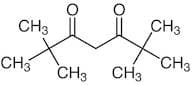
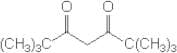
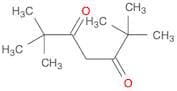
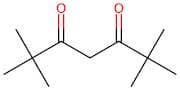
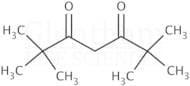
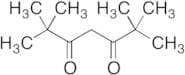
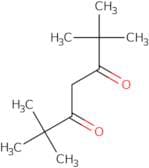
2,2,6,6-Tetrametil-3,5-heptanodiona, com o número CAS 1118-71-4, é um composto orgânico caracterizado por sua estrutura de diketona, apresentando dois grupos carbonila (C=O). Este composto é um líquido incolor a amarelo pálido à temperatura ambiente e é conhecido por seu distinto odor doce e frutado. É solúvel em solventes orgânicos como etanol e éter, mas tem solubilidade limitada em água devido aos seus grupos alquilo hidrofóbicos. A presença de múltiplos grupos metila contribui para sua hindrance estérica, influenciando sua reatividade e estabilidade. 2,2,6,6-Tetrametil-3,5-heptanodiona é frequentemente usado como um reagente na síntese orgânica e como um ligante na química de coordenação devido à sua capacidade de quelar íons metálicos. Além disso, tem aplicações na produção de vários intermediários químicos e pode servir como agente aromatizante na indústria alimentícia. Precauções de segurança devem ser observadas ao manusear este composto, pois pode representar riscos à saúde se inalado ou ingerido.
Fórmula:C11H20O2
InChI:InChI=1/C11H20O2/c1-10(2,3)8(12)7-9(13)11(4,5)6/h7,12H,1-6H3/b8-7-
Chave InChI:InChIKey=YRAJNWYBUCUFBD-UHFFFAOYSA-N
SMILES:C(C(C(C)(C)C)=O)C(C(C)(C)C)=O
Sinónimos:- (4Z)-5-hydroxy-2,2,6,6-tetramethylhept-4-en-3-one
- 1,3-(tert-Butyl)-1,3-propanedione
- 1,3-Di-tert-butyl-1,3-propanedione
- 2,2,6,6-Tetramethyl-3,5-Heptanedione Dipivaloylmethane
- 2,2,6,6-Tetramethylheptan-3,5-dion
- 2,2,6,6-Tetramethylheptane-3,5-Dione
- 2,2,6,6-Tetrametilheptano-3,5-Diona
- 3,5-Heptanedione, 2,2,6,6-tetramethyl-
- Dipivaloylmethane
- Dpm-H
- Hepta-3,5-Dione, 2,2,6,6-Tetramethyl-
- Nsc 174296
- Tmhd
- Tmhd-H
- 2,2,6,6-Tetramethyl-3,5-heptanedione
- Dipivaloylmethane~Dpm-H~Tmhd-H
- (CH3)3CCOCH2COC(CH3)3
- 2,2,6,6-Tetramethylheptane-3,5-dione,98%TMHD
- 2,2,6,6-Tetramethyl heptanedione
- 2,2,6,6-tetramethyl-5-heptanedione
- 2,2,6,6-TETRAMETHYLHEPTANE-3,5-DIONE TMHD
- 2,2,6,6-TETRAMETHYL-3,5-HEPTANEDIONE, 95 %
- 2,2,6,6-Tetramethyl-3,5-heptadione
- 2,2,6,6-Tetramethyl-3,5-heptanedione, 98+%
- Ver mais sinónimos
Ordenar por
Pureza (%)
0
100
|
0
|
50
|
90
|
95
|
100
10 produtos.
Dipivaloylmethane
CAS:Fórmula:C11H20O2Pureza:>97.0%(GC)Cor e Forma:Colorless to Light yellow clear liquidPeso molecular:184.282,2,6,6-Tetramethyl-3,5-heptanedione, 98%
CAS:2,2,6,6-Tetramethyl-3,5-heptanedione is used in the synthesis of -aryl--diketones1 and dicyanamidobenzene-bridge diruthenium complex. This Thermo Scientific Chemicals brand product was originally part of the Alfa Aesar product portfolio. Some documentation and label information may refer to the legaFórmula:C11H20O2Pureza:98%Cor e Forma:Clear colorless to yellow, LiquidPeso molecular:184.282,2,6,6-Tetramethylheptane-3,5-dione, 98% TMHD
CAS:2,2,6,6-Tetramethylheptane-3,5-dione, 98% TMHD
Fórmula:(CH3)3CC(O)CH2C(O)C(CH3)3Pureza:98%Cor e Forma:colorless to pale yellow liq. or low melting solidPeso molecular:184.282,2,6,6-Tetramethylheptane-3,5-dione
CAS:Fórmula:C11H20O2Pureza:97%Cor e Forma:LiquidPeso molecular:184.27532,2,6,6-Tetramethylheptane-3,5-dione
CAS:2,2,6,6-Tetramethylheptane-3,5-dioneFórmula:C11H20O2Pureza:98%Cor e Forma: colorless to light yellow low melting solidPeso molecular:184.27529g/mol2,2,6,6-Tetramethyl-3,5-heptanedione
CAS:Fórmula:C11H20O2Pureza:≥ 98.0%Cor e Forma:Colourless to light-yellow liquid or crystalline solidPeso molecular:184.282,2,6,6-Tetramethyl-3,5-heptanedione
CAS:Pureza:97.0%Cor e Forma:Liquid, ClearPeso molecular:184.27900695800782,2,6,6-Tetramethyl-3,5-heptanedione
CAS:Produto ControladoApplications 2,2,6,6-Tetramethyl-3,5-heptanedione is a beta diketone with antibacterial activity.
References Acheampong, Y. B., et al.: Indian J. Pharm. Sci., 46, 207 (1984)Fórmula:C11H20O2Cor e Forma:NeatPeso molecular:184.282,2,6,6-Tetramethyl-3,5-heptanedione
CAS:2,2,6,6-Tetramethyl-3,5-heptanedione (TMTD) is a picolinic acid analog that binds to receptor molecules. It has been shown to be a potent inhibitor of methanol dehydrogenase with an IC50 of 5 μM. TMTD also has the ability to form stable complexes with zirconium oxide and other metals. These complexes are formed by intramolecular hydrogen bonds and can be used in organometallic synthesis. Structural analysis of these complexes have revealed that the metal is coordinated by two nitrogen atoms and one hydroxyl group from the ligand.Fórmula:C11H20O2Pureza:Min. 95%Peso molecular:184.28 g/mol