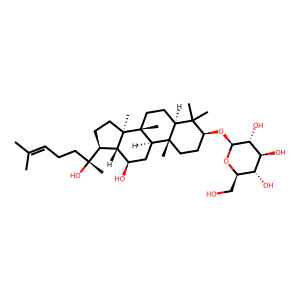
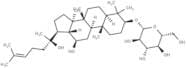
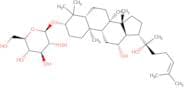
![(2R,3R,4S,5R,6R)-2-[[(10S,12S,14R,17S)-12-hydroxy-17-[(2R)-2-hydroxy-6 -methyl-hept-5-en-2-yl]-4,4…](/_next/image/?url=https%3A%2Fstatic.cymitquimica.com%2Fcas-image%2Fthumb-webp%2F166941-2r-3r-4s-5r-6r-2-10s-12s-14r-17s-12-hydroxy-17-2r-2-hydroxy-6-methyl-hept-5-en-2-yl-44101417-pentamethyl-235678911121-31516-dodecahydro-1h-cyclopenta-a-phenanthren-3-yl-oxy-6-hydroxyme-thyl-oxane-345-triol.webp&w=3840&q=75)
CAS 112246-15-8
:(2R,3R,4S,5R,6R)-2-[[(10S,12S,14R,17S)-12-hidroxi-17-[(2R)-2-hidroxi-6-metil-hept-5-en-2-il]-4,4,10,14,17-pentametil-2,3,5,6,7,8,9,11,12,13,15,16-dodecahidro-1H-ciclopenta[a]fenantren-3-il]oxi]-6-(hidroximetil)oxano-3,4,5-triol
Descrição:
A substância química com o nome "(2R,3R,4S,5R,6R)-2-[[[10S,12S,14R,17S)-12-hidroxido-17-[(2R)-2-hidroxido-6-metil-hept-5-en-2-il]-4,4,10,14,17-pentametil-2,3,5,6,7,8,9,11,12,13,15,16-dodecahidro-1H-ciclopenta[a]fenantreno-3-il]óxido]-6-(hidroximetil)oxano-3,4,5-triol" e número CAS "112246-15-8" é uma molécula orgânica complexa caracterizada por múltiplos estereocentros e uma estrutura policíclica. Apresenta um núcleo de ciclopenta[a]fenantreno, o que indica sua potencial atividade biológica, particularmente no contexto de compostos semelhantes a esteroides. A presença de grupos hidroxila sugere que pode exibir propriedades hidrofílicas, aumentando sua solubilidade em solventes polares. Além disso, a molécula contém uma cadeia de alquilo ramificada, o que pode influenciar sua lipofilicidade e interação com membranas biológicas. Sua estereoquímica intrincada implica que pode ter interações específicas com alvos biológicos, tornando-a de interesse em química medicinal e farmacologia. No geral, a complexidade estrutural deste composto e seus grupos funcionais sugerem aplicações potenciais em contextos terapêuticos, embora mais estudos sejam necessários para elucidar seus papéis biológicos específicos e mecanismos de ação.
Fórmula:C36H62O8
InChI:InChI=1/C36H62O8/c1-20(2)10-9-14-36(8,42)35(7)17-16-34(6)21-11-12-25-32(3,4)26(13-15-33(25,5)22(21)18-23(38)30(34)35)44-31-29(41)28(40)27(39)24(19-37)43-31/h10,21-31,37-42H,9,11-19H2,1-8H3/t21?,22?,23-,24+,25?,26?,27+,28-,29+,30?,31-,33+,34+,35-,36+/m0/s1
Sinónimos:- 20(R)-Protopanaxdiol-3-O-beta-D-glycopyranoside
- (8xi,9xi,12alpha,13xi,14beta,17beta)-12-hydroxy-17-[(2R)-2-hydroxy-6-methylhept-5-en-2-yl]-4,4,10,14,17-pentamethylgonan-3-yl beta-D-glucopyranoside
Ordenar por
Pureza (%)
0
100
|
0
|
50
|
90
|
95
|
100
7 produtos.
20(R)-Ginsenoside Rh2
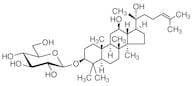
CAS:Fórmula:C36H62O8Pureza:>97.0%(HPLC)Cor e Forma:White to Light yellow powder to crystalPeso molecular:622.8820(R)-Ginsenoside Rh2
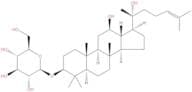
CAS:Ginsenoside Rh2 is one of the most active components of red ginseng, controlling cancer and other metabolic diseases including osteoclast differentiation; ginsenoside Rh2 can suppress RANKL-induced osteoclast differentiation in vitro and in vivo through the regulation of c-Fos and NFATc1 expressions, not excluding the involvement of NF-κB and ERK, it is also suggested to be developed as a therapeutic drug for prevention and treatment of osteoporosis.Fórmula:C36H62O8Pureza:20%, 95%, 98%Peso molecular:622.87320(R)-Ginsenoside Rh2
CAS:20(R)-Ginsenoside Rh2 (Ginsenoside Rh2) is a minor stereoisomer of ginsenoside Rh2, possesses matrix metalloproteinase inhibitory.Fórmula:C36H62O8Pureza:99.58%Cor e Forma:SolidPeso molecular:622.87Ref: TM-T3813
1mg46,00€5mg87,00€1mL*10mM (DMSO)119,00€10mg123,00€25mg192,00€50mg264,00€100mg378,00€200mg552,00€20(R)Ginsenoside Rh2
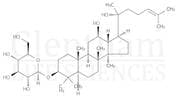
CAS:20(R)Ginsenoside Rh2 is a bioactive compound, specifically a ginsenoside, which is derived from the roots of Panax ginseng. This compound is categorized as a rare saponin, produced through the enzymatic or acidic hydrolysis of protopanaxadiol-type ginsenosides found naturally in ginseng. Its mode of action involves modulating various cellular pathways, including signaling pathways related to apoptosis, inflammation, and immune responses. It has been shown to exert anticancer effects through induction of apoptosis, inhibition of cell proliferation, and disruption of cell cycle progression in cancer cells. Additionally, it may influence the immune system by enhancing or regulating immune cell activity.Fórmula:C36H62O8Pureza:Min. 98 Area-%Cor e Forma:PowderPeso molecular:622.87 g/mol20(R)-Ginsenoside Rh2-d6
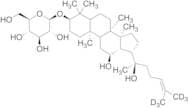
CAS:Produto ControladoFórmula:C36D6H56O8Cor e Forma:NeatPeso molecular:628.91