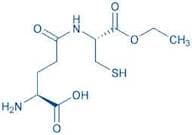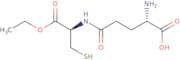
CAS 114627-30-4
:Éster etílico de N-gama-glutamilcisteína
Descrição:
Éster etílico de N-gama-glutamilcisteína, com o número CAS 114627-30-4, é um composto sintético que serve como um derivado do glutationa, um antioxidante crucial nos sistemas biológicos. Este composto apresenta uma estrutura que inclui um grupo gama-glutamil ligado a uma parte de cisteína, com uma modificação de éster etílico que aumenta sua lipofilicidade e potencial biodisponibilidade. É estudado principalmente por seu papel na defesa antioxidante celular e suas potenciais aplicações terapêuticas, particularmente em condições relacionadas ao estresse oxidativo. A forma de éster etílico pode facilitar a captação celular, tornando-se um assunto de interesse na pesquisa farmacológica. Em termos de solubilidade, é geralmente solúvel em solventes orgânicos, e sua estabilidade pode ser influenciada pelo pH e temperatura. Assim como muitos derivados de aminoácidos, pode apresentar várias atividades biológicas, incluindo a modulação de vias de sinalização celular. No entanto, mais pesquisas são necessárias para elucidar completamente seus mecanismos de ação e potenciais aplicações em medicina e bioquímica.
Fórmula:C10H18N2O5S
InChI:InChI=1/C10H18N2O5S/c1-2-17-10(16)7(5-18)12-8(13)4-3-6(11)9(14)15/h6-7,18H,2-5,11H2,1H3,(H,12,13)(H,14,15)
SMILES:CCOC(=O)C(CS)N=C(CCC(C(=O)O)N)O
Sinónimos:- Glu-cys-oet
- N-gamma-L-Glutamyl-L-cysteine ethyl ester
- gamma-Gce
- gamma-Glutamylcysteinylethyl ester
- L-Cysteine, N-L-gamma-glutamyl-, 1-ethyl ester
- ethyl L-gamma-glutamyl-L-cysteinate
- Ethyl Gamma-Glutamylcysteinate
- N-gamma-Glutamylcysteine ethyl ester
Ordenar por
Pureza (%)
0
100
|
0
|
50
|
90
|
95
|
100
2 produtos.
(Des-Gly)-Glutathione-monoethyl ester (reduced)
CAS:γ-GCE has been shown to be much more easily transported into isolated rat hepatocytes than glutathione. Within the cells it could be converted into reduced glutathione. Therefore it could – better than glutathione – prevent immunological cell injury in isolated rat hepatocytes treated with anti-rat liver plasma membrane rabbit antiserum. γ-GCE may help to reduce oxidative stress in various biological systems by promoting the biosynthesis of glutathion. For this reason, administration of GCEE and N-acetyl-cysteine (NAC) was discussed as a potential therapeutic approach for Alzheimer disease.Fórmula:C10H18N2O5SPureza:> 87%Cor e Forma:White PowderPeso molecular:278.33(Des-Gly)-Glutathione-monoethyl ester (reduced)
CAS:Glutathione (GSH) is a tripeptide that is synthesized in the liver by the enzyme glutathione synthetase and plays an important role in protecting cells from oxidative damage. The reduced form of glutathione is produced by the enzyme glutathione reductase, which reduces oxidized glutathione using NADPH as a cofactor. Glutathione monoethyl ester (GME) is a reversible covalent inhibitor of aminotransferases that has been shown to have hepatoprotective effects in animal models and clinical use. GME reversibly binds to the active site of aminotransferases, preventing their catalytic activity. It also has been shown to inhibit mitochondrial membrane potential and reactive oxygen species production, leading to an increase in cellular energy metabolism. Glutathione monoethyl ester (GME) was initially developed as a means of increasing blood levels of reduced glutathione and of interfering withFórmula:C10H18N2O5SPureza:Min. 95%Peso molecular:278.33 g/mol