CAS 115-80-0
:Trietil ortopropionato
Descrição:
Trietil ortopropionato, com o número CAS 115-80-0, é um composto orgânico classificado como um éster. É caracterizado por sua forma líquida clara e incolor e um odor frutado, que é típico de muitos ésteres. A fórmula molecular de Trietil ortopropionato é C11H22O4, indicando que contém três grupos etila e um grupo propionato. Este composto é solúvel em solventes orgânicos como etanol e éter, mas tem solubilidade limitada em água. Trietil ortopropionato é utilizado principalmente como um reagente na síntese orgânica e como um solvente em vários processos químicos. Também pode servir como um agente aromatizante na indústria alimentícia devido ao seu aroma agradável. Além disso, é utilizado na produção de certos polímeros e como um intermediário na síntese de produtos farmacêuticos. Devem ser observadas precauções de segurança ao manusear este composto, pois pode causar irritação na pele e nos olhos, e uma ventilação adequada é recomendada para evitar a inalação de vapores.
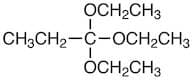
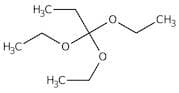
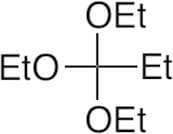
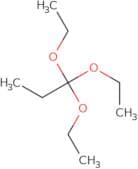
Fórmula:C9H20O3
InChI:InChI=1/C9H20O3/c1-5-9(10-6-2,11-7-3)12-8-4/h5-8H2,1-4H3
Chave InChI:InChIKey=FGWYWKIOMUZSQF-UHFFFAOYSA-N
SMILES:C(OCC)(OCC)(OCC)CC
Sinónimos:- 1,1,1-Triethoxypropane
- Ethyl orthopropionate
- NSC 5604
- Orthopropionic acid triethyl ester
- Propane, 1,1,1-triethoxy-
- Teop
- Triethyl orthopropanoate
- Triethyl orthopropionate
- Orthopropionic acid ethyl
- 1,1,1-triethoxy-propan
- Orthopropionic acid ethyl ester
- O-PROPIONIC ACID TRIETHYL ESTER
- triethjyl orthopropionate
- TRIETHYL ORTHOPROPRIONATE
- Triethyl orthopropionate, 98+%
- TRIETHYL-O-PROPIONATE
- Triethylorthopropionat
- Triethyl-O-propionic acid
- Triethyl orthopiopionate
- Ver mais sinónimos
Ordenar por
Pureza (%)
0
100
|
0
|
50
|
90
|
95
|
100
6 produtos.
Triethyl Orthopropionate
CAS:Fórmula:C9H20O3Pureza:>96.0%(GC)Cor e Forma:Colorless to Almost colorless clear liquidPeso molecular:176.26Triethyl orthopropionate, 97%
CAS:Used as intermediates in pharmaceutical chemical and organic synthesize. It can react with N-benzoyl-glycine in the presence of 4-(dimethylamino)pyridine and acetic anhydride to produce 4-(1-ethoxy-propylidene)-2-phenyl-4H-oxazol-5-one. It is also applied as a starting material in the synthesis ofFórmula:C9H20O3Pureza:97%Cor e Forma:Clear colorless, LiquidPeso molecular:176.26Triethyl Orthopropionate (Technical Grade)
CAS:Produto ControladoStability Moisture Sensitive
Applications Triethyl orthopropionate is used as a starting material in the synthesis of Triethyl orthoacrylate. Triethyl orthopropionate is also commonly used in Claisen rearrangement reactions that yield γ,δ-unsaturated esters.
Not a dangerous good if item is equal to or less than 1g/ml and there is less than 100g/ml in the package
References Ghosh, A. & Moon, D.: Org. Lett., 9, 2425 (2007); Ito, H. & Taguchi, T.: Tetrahedron Lett., 38, 5829 (1997); Sarkar, D., et al.: Tetrahedron Lett., 50, 1431 (2009)Fórmula:C9H20O3Cor e Forma:NeatPeso molecular:176.251,1,1-Triethoxypropane
CAS:Fórmula:C9H20O3Pureza:95.0%Cor e Forma:Liquid, ClearPeso molecular:176.256Triethyl orthopropionate
CAS:Triethyl orthopropionate is a triester derived from propionic acid and ethanol. It has been shown to have receptor activity in the toll-like receptor family, which are molecules that bind to specific molecules on the surface of cells and activate an immune response. Triethyl orthopropionate also inhibits fatty acid synthesis by binding to the pyrazole ring of the enzyme acetyl-CoA carboxylase, thereby inhibiting its activity. This inhibition leads to higher levels of free fatty acids in the bloodstream, which can lead to metabolic disorders such as diabetes mellitus and autoimmune diseases like lupus erythematosus. The molecule also has a hydroxyl group that can form hydrogen bonds with other molecules, such as methanol solvent or dinucleotide phosphate. These interactions can be used in synthesis methods involving intramolecular hydrogen transfer reactions.Fórmula:C9H20O3Pureza:Min. 95%Cor e Forma:Clear LiquidPeso molecular:176.25 g/mol