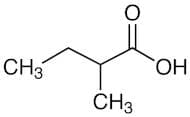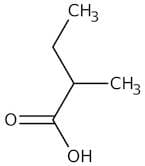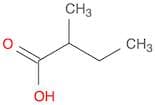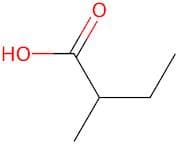
CAS 116-53-0
:Ácido 2-metilbutanoico
Descrição:
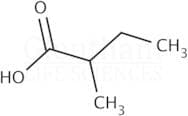
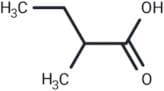
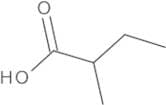
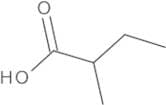
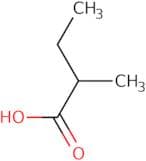
Ácido 2-metilbutanoico, também conhecido como ácido isovalérico, é um ácido carboxílico de cadeia ramificada caracterizado por sua estrutura de cinco carbonos com um grupo metila ligado ao segundo carbono. Possui a fórmula molecular C5H10O2 e apresenta um grupo funcional carboxila (-COOH), que confere propriedades ácidas. Este composto é tipicamente um líquido incolor com um odor pungente que lembra queijo ou pés suados, frequentemente associado à sua presença em certos processos de fermentação. Ácido 2-metilbutanoico é solúvel em água e solventes orgânicos, tornando-o versátil em várias aplicações. É utilizado na síntese de ésteres para as indústrias de sabor e fragrância, bem como na produção de produtos farmacêuticos e agroquímicos. Além disso, pode ser encontrado em algumas fontes naturais, incluindo certos óleos essenciais e como um subproduto do metabolismo microbiano. Sua reatividade inclui o comportamento típico dos ácidos carboxílicos, como a esterificação e a participação em várias reações orgânicas. Precauções de segurança são necessárias ao manusear esta substância devido ao seu forte odor e potenciais propriedades irritantes.
Fórmula:C5H10O2
InChI:InChI=1S/C5H10O2/c1-3-4(2)5(6)7/h4H,3H2,1-2H3,(H,6,7)
Chave InChI:InChIKey=WLAMNBDJUVNPJU-UHFFFAOYSA-N
SMILES:C(C(O)=O)(CC)C
Sinónimos:- (+/-)-2-Methyl Butyric Acid
- (.+-.)-2-Methylbutanoic acid
- (.+-.)-2-Methylbutyric Acid
- (.+-.)-Methylethylacetic acid
- (.+-.)-α-Methylbutyric acid
- 2-Ethylpropanoic acid
- 2-Methyl-n-butyric acid
- 2-Methylbuttersaure
- <span class="text-smallcaps">DL</span>-2-Methylbutanoic acid
- <span class="text-smallcaps">DL</span>-2-Methylbutyric acid
- <span class="text-smallcaps">DL</span>-α-Methylbutyric acid
- Acide 2-methylbutyrique
- Acido 2-Metilbutirico
- Active valeric acid
- Butyric acid, 2-methyl-
- Butyric acid, α-methyl-
- DL-2-Methylbutanoic acid
- DL-2-Methylbutyric acid
- DL-α-Methylbutyric acid
- Ethylmethylacetic acid
- Hydroangelic acid
- Methyl-2-Butyric Acid
- Nsc 7304
- α-Methyl-n-butyric acid
- Ver mais sinónimos
Ordenar por
Pureza (%)
0
100
|
0
|
50
|
90
|
95
|
100
11 produtos.
DL-2-Methylbutyric Acid
CAS:Fórmula:C5H10O2Pureza:>97.0%(GC)Cor e Forma:Colorless to Light yellow clear liquidPeso molecular:102.132-Methylbutyric acid, 98%
CAS:2-Methylbutyric acid, can be used as food additive for butter, cream, cheese flavor deployment. It is an important raw material and intermediate used in Organic Synthesis, Pharmaceuticals, Agrochemicals and Dyestuff. It is also used in the synthesis of 2-methylbutyric anhydride. This Thermo ScientiFórmula:C5H10O2Pureza:98%Cor e Forma:Liquid, Clear colorlessPeso molecular:102.132-Methylbutanoic acid
CAS:2-Methylbutanoic acid has inhibitory activity against the Solute Carrier Family 22 and can be used in research and experiments in the life sciences field.Fórmula:C5H10O2Pureza:99.4%Cor e Forma:SolidPeso molecular:102.13DL-2-Methylbutyric Acid
CAS:Produto ControladoApplications DL-2-Methylbutyric Acid is a common chemical reagent used in the synthesis of anticancer naphthoquinione aliphatic amides. Also used in the synthesis of novel erythromycins.
Not a dangerous good if item is equal to or less than 1g/ml and there is less than 100g/ml in the package
References Kongkathip, B. et al.: Eur. J. Med. Chem., 60, 271 (2013); Pacey, M. et al.: J. Antibio. 51, 1029 (1998);Fórmula:C5H10O2Cor e Forma:NeatPeso molecular:102.132-Methyl butyric acid
CAS:2-Methyl butyric acid is a fatty acid that is produced by the fungus Monascus purpureus. 2-Methyl butyric acid has been shown to inhibit the activity of a number of enzymes in gland cells, including proteases, lipases, and amylases. This effect may be due to its ability to inhibit lipid peroxidation. Further research into the metabolic profiles of 2-methyl butyric acid has shown that it inhibits the activity of enzymes involved in fatty acid synthesis and metabolism, such as tiglic acid synthase and ketoacyl CoA reductase. It also shows some potential as a solid catalyst for kinetic studies.Fórmula:C5H10O2Pureza:Min. 95%Cor e Forma:Clear LiquidPeso molecular:102.13 g/mol