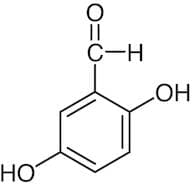
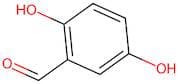
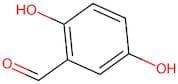
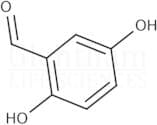
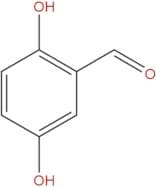
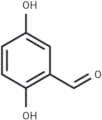
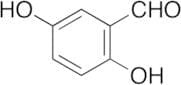
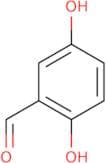
CAS 1194-98-5
:2,5-Diidroxibenzaldeído
- Formylhydroquinone
- 2,5-Dihydroxybenzaldehyde
- Gentisaldehyde
- 5-Hydroxysalicylaldehyde
- Benzaldehyde, 2,5-dihydroxy-
2,5-Dihydroxybenzaldehyde
CAS:Fórmula:C7H6O3Pureza:>98.0%(GC)Cor e Forma:Light yellow to Amber to Dark green powder to crystalPeso molecular:138.122,5-Dihydroxybenzaldehyde, 98+%
CAS:It is an important raw material and intermediate used in organic Synthesis, pharmaceuticals, agrochemicals and dyestuff. This Thermo Scientific Chemicals brand product was originally part of the Alfa Aesar product portfolio. Some documentation and label information may refer to the legacy brand. TheFórmula:C7H6O3Pureza:98+%Cor e Forma:Yellow to dark green to green to brown, Crystals or powder or crystalline powderPeso molecular:138.12Ref: IN-DA000IP8
1kgA consultar5kgA consultar10kgA consultar25kgA consultar1g24,00€5g25,00€10g37,00€25g63,00€100g141,00€2,5-Dihydroxybenzaldehyde
CAS:2,5-DihydroxybenzaldehydeFórmula:C7H6O3Pureza:98%Cor e Forma: yellow to green powderPeso molecular:138.12g/mol2,5-Dihydroxybenzaldehyde, 10mM (in DMSO)
CAS:2,5-Dihydroxybenzaldehyde, 10mM (in DMSO)Pureza:≥98%Peso molecular:138.12g/mol2,5-Dihydroxybenzaldehyde
CAS:2,5-Dihydroxybenzaldehyde (Gentisaldehyde) has antioxidant activity against Mycobacterium avium subsp.Fórmula:C7H6O3Pureza:99.55% - 99.75%Cor e Forma:SolidPeso molecular:138.122,5-Dihydroxybenzaldehyde
CAS:Produto ControladoApplications 2,5-Dihydroxybenzaldehyde (cas# 1194-98-5) is a compound useful in organic synthesis.
Fórmula:C7H6O3Cor e Forma:NeatPeso molecular:138.122,5-Dihydroxybenzaldehyde
CAS:2,5-Dihydroxybenzaldehyde is a compound that can be used as an antioxidant. It is also a precursor for the synthesis of benzalkonium chloride. 2,5-Dihydroxybenzaldehyde reacts with p-hydroxybenzoic acid to form 2,5-dihydroxyphenylacetic acid and benzoic acid. The reaction mechanism of 2,5-dihydroxybenzaldehyde has been studied in detail using hl-60 cells and has been shown to be significant cytotoxicity. The hydroxyl group in this molecule creates a hydrogen bond with the carbonyl group in p-hydroxybenzoic acid and the two react together to form products. This reaction is catalyzed by Michaelis–Menten kinetics and proceeds via an electrochemical detector. Nitrogen atoms are not present in this molecule but do exist in benzalkonium chloride, which is synthesized from 2
Fórmula:C7H6O3Pureza:Min. 95%Cor e Forma:Yellow PowderPeso molecular:138.12 g/mol2,5-Dihydroxybenzaldehyde
CAS:Fórmula:C7H6O3Pureza:97%Cor e Forma:Solid, Crystalline Powder or PowderPeso molecular:138.122