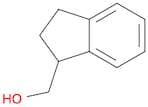
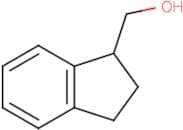
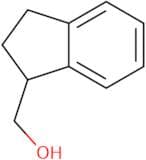
CAS 1196-17-4
:2,3-diidro-1H-inden-1-ilmetanol
Descrição:
2,3-diidro-1H-inden-1-ilmetanol, com o número CAS 1196-17-4, é um composto orgânico caracterizado por sua estrutura bicíclica, que inclui um grupo de indeno. Este composto apresenta um grupo hidroximetil (-CH2OH) ligado à estrutura do indeno, contribuindo para sua reatividade e aplicações potenciais na síntese orgânica. Normalmente, é um líquido incolor a amarelo pálido à temperatura ambiente, exibindo solubilidade moderada em solventes polares devido à presença do grupo hidroxila. O composto pode participar de várias reações químicas, incluindo oxidação e substituição, tornando-o de interesse nos campos da química medicinal e da ciência dos materiais. Suas propriedades físicas, como ponto de ebulição e densidade, podem variar com base na pureza e nas condições ambientais. Além disso, 2,3-diidro-1H-inden-1-ilmetanol pode exibir atividade biológica, embora efeitos farmacológicos específicos exijam investigação adicional. Os dados de segurança devem ser consultados para garantir o manuseio adequado, como acontece com qualquer substância química.
Fórmula:C10H12O
InChI:InChI=1/C10H12O/c11-7-9-6-5-8-3-1-2-4-10(8)9/h1-4,9,11H,5-7H2
SMILES:c1ccc2c(c1)CCC2CO
Sinónimos:- 1-Indanmethanol
Ordenar por
Pureza (%)
0
100
|
0
|
50
|
90
|
95
|
100
4 produtos.
1-(Hydroxymethyl)indan
CAS:<p>1-(Hydroxymethyl)indan is a molecule that contains a 6-chloropurine core. It has been shown to have anti-inflammatory properties and is a potential therapeutic agent for the treatment of inflammatory diseases. The conformation of 1-(hydroxymethyl)indan can be altered by the substitution of chlorine for methoxy groups at positions 2 and 3. This can produce optical isomers, which are chiral molecules with one mirror image and one enantiomer. The optical isomers of 1-(hydroxymethyl)indan have different effects on inflammation and tumor cells, with the (R)-enantiomer being more potent against tumors than its mirror image, the (S)-enantiomer.<br>1-(Hydroxymethyl)indan also has an interesting molecular structure because it contains a furan ring in addition to a phenyl group. Furans are not common in organic chemistry due to their instability, but they are found in nature as components</p>Fórmula:C10H12OPureza:Min. 95%Peso molecular:148.2 g/mol