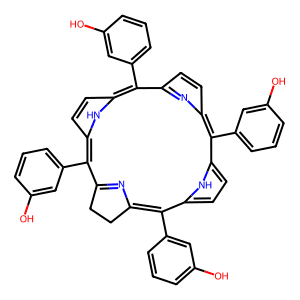
CAS 122341-38-2
:mTHPC
- 3,3',3'',3'''-(2,3-Dihydroporphyrin-5,10,15,20-Tetrayl)Tetraphenol
- 3,3',3',3''-(7,8-Dihydroporphyrin-5,10,15,20-Tetrayl)Tetraphenol
- 3,3′,3′′,3′′′-(7,8-Dihydro-21H,23H-porphine-5,10,15,20-tetrayl)tetrakis[phenol]
- 3,3′,3′′,3′′′-(7,8-Dihydroporphyrin-5,10,15,20-tetrayl)tetraphenol
- 5,10,15,20-Tetra(M-Hydroxyphenyl)Chlorin
- 5,10,15,20-Tetrakis(m-hydroxyphenyl)chlorin
- 8-Dihydroporphyrin-5
- Foscan
- Fosgel
- Foslip
- Foslipos
- Fospeg
- Phenol, 3,3′,3′′,3′′′-(7,8-dihydro-21H,23H-porphine-5,10,15,20-tetrayl)tetrakis-
- Sml 1707
- m-Tetrahydroxyphenylchlorin
- mTHPC
- Ver mais sinónimos
Phenol, 3,3',3'',3'''-(7,8-dihydro-21H,23H-porphine-5,10,15,20-tetrayl)tetrakis-
CAS:Fórmula:C44H32N4O4Pureza:95%Cor e Forma:SolidPeso molecular:680.7493Ref: IN-DA00174L
25mgA consultar50mgA consultar100mgA consultar1mg202,00€2mg212,00€5mg324,00€10mg529,00€Temoporfin
CAS:Temoporfin used in photodynamic therapy for the treatment of squamous cell carcinoma of the head and neck.Fórmula:C44H32N4O4Pureza:99.71%Cor e Forma:SolidPeso molecular:680.75Ref: TM-T17035
1mg50,00€2mg66,00€5mg100,00€1mL*10mM (DMSO)150,00€10mg168,00€25mg344,00€50mg512,00€100mg735,00€Temoporfin
CAS:Temoporfin is a photosensitizer, which is a compound used in photodynamic therapy (PDT). It is derived from chlorin, a naturally occurring macrocycle related to porphyrin. The mode of action involves the administration of Temoporfin, followed by its selective accumulation in cancerous tissues. Once accumulated, the target area is exposed to a specific wavelength of light, activating the Temoporfin. This activation leads to the production of reactive oxygen species, inducing cell death through apoptosis or necrosis.Temoporfin is primarily used in the treatment of various cancers, notably head and neck squamous cell carcinomas. Its ability to provide a targeted therapeutic effect while minimizing damage to surrounding healthy tissues makes it a significant tool in oncological treatments. The specificity and efficacy of Temoporfin in PDT highlight its importance as a minimally invasive therapeutic option within clinical settings. Continued research and development in its application are likely to expand its use to other types of malignancies and enhance patient outcomes.
Fórmula:C44H32N4O4Pureza:Min. 95%Peso molecular:680.75 g/molTemoporfin, ~ 90%
CAS:Produto ControladoApplications Temoporfin is a synthetic chlorin with light-activated actions. It accumulates in tumor cells and through light activation and oxygen radical formation, it leads to necrosis and cell death.
References Alian, W. et al.: Br. J. Cancer, 70, 880 (1994); Ris, H. et al.: Br. J. Cancer., 64, 1116 (1991);Fórmula:C44H32N4O4Pureza:~90%Cor e Forma:PurplePeso molecular:680.75