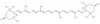
CAS 126-29-4
:violaxantina
Descrição:
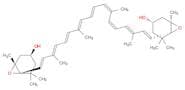
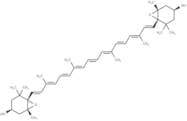
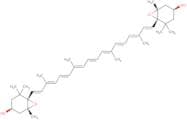
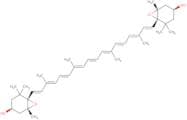
violaxantina é um pigmento carotenoide encontrado principalmente em plantas, particularmente em vegetais de folhas verdes e certas frutas. Desempenha um papel crucial na fotossíntese, participando do processo de captura de luz e protegendo as plantas de danos fotográficos. Este composto é caracterizado por sua cor amarelo-alaranjada, que se deve ao seu sistema de ligações duplas conjugadas. violaxantina é uma xantofila, uma subclasse de carotenoides que contêm oxigênio, e é conhecida por suas propriedades antioxidantes. A estrutura química de violaxantina inclui uma série de unidades de isopreno, contribuindo para sua natureza hidrofóbica. É solúvel em solventes orgânicos, mas menos em água. Além de seu papel na fisiologia das plantas, violaxantina despertou interesse por seus potenciais benefícios à saúde em humanos, incluindo sua atividade antioxidante e possíveis contribuições para a saúde ocular. O número CAS 126-29-4 identifica exclusivamente este composto em bancos de dados químicos, facilitando a pesquisa e os processos regulatórios. No geral, violaxantina é significativo tanto ecologicamente quanto nutricionalmente, destacando a interconexão da bioquímica vegetal e da saúde humana.
Fórmula:C40H56O4
InChI:InChI=1/C40H56O4/c1-29(17-13-19-31(3)21-23-39-35(5,6)25-33(41)27-37(39,9)43-39)15-11-12-16-30(2)18-14-20-32(4)22-24-40-36(7,8)26-34(42)28-38(40,10)44-40/h11-24,33-34,41-42H,25-28H2,1-10H3/b12-11+,17-13+,18-14+,23-21+,24-22+,29-15+,30-16+,31-19+,32-20+/t33-,34-,37+,38+,39-,40-/m0/s1
Chave InChI:InChIKey=SZCBXWMUOPQSOX-WVJDLNGLSA-N
SMILES:C(=C/C(=C/C=C/C(=C/C=C/C=C(/C=C/C=C(/C=C/[C@]12[C@](C)(O1)C[C@@H](O)CC2(C)C)\C)\C)/C)/C)\[C@]34[C@](C)(O3)C[C@@H](O)CC4(C)C
Sinónimos:- (3S,3'S,5R,5'R, 6S,6'S)-5,6:5',6'-Diepoxy-5,5',6,6'-tetrahydro-beta,beta-carotene-3,3'-diol
- (3S,3'S,5R,5'R,6S,6'S)-5,5',6,6'-tetrahydro-5,6:5',6'-diepoxy-beta,beta-carotene-3,3'-diol
- (3S,3′S,5R,5′R,6S,6′S)-5,6:5′,6′-Diepoxy-5,5′,6,6′-tetrahydro-β,β-carotene-3,3′-diol
- 5,6:5',6'-Diepoxy-5,5',6,6'-tetrahydro-beta-carotene-3,3'-diol
- 7-Oxabicyclo[4.1.0]heptane, β,β-carotene-3,3′-diol deriv.
- C Orange 15
- E 161e
- Violaxanthin, all-trans-
- Zeaxanthin diepoxide
- all-E-Violaxanthin
- all-trans-Violaxanthin
- anti,anti-Violaxanthin
- trans-Violaxanthin
- β,β-Carotene-3,3′-diol, 5,6:5′,6′-diepoxy-5,5′,6,6′-tetrahydro-, (3S,3′S,5R,5′R,6S,6′S)-
- β-Carotene-3,3′-diol, 5,6:5′,6′-diepoxy-5,5′,6,6′-tetrahydro-
- β-Carotene-3,3′-diol, 5,6:5′,6′-diepoxy-5,5′,6,6′-tetrahydro-, all-trans-
- Violaxanthin
- trans-ViolaxanthinDiscontinued See V634510
- (3S,3'S,5R,5'R,6S,6'S,9E)-5,6:5',6'-Bisepoxy-5,5',6,6'-tetrahydro-β,β-carotene-3,3'-diol
- β,β-Carotene-3,3'-diol, 5,6:5',6'-diepoxy-5,5',6,6'-tetrahydro-, (3S,3'S,5R,5'R,6S,6'S)-
- Violoxanthin - 0.897 mg/L solution in ethanol
- (1S,4S,6R)-1-[(1E,3E,5E,7E,9E,11E,13E,15E,17E)-18-[(1S,4S,6R)-4-hydroxy-2,2,6-trimethyl-7-oxabicyclo[4.1.0]heptan-1-yl]-3,7,12,16-tetramethyl-octadeca-1,3,5,7,9,11,13,15,17-nonaenyl]-2,2,6-trimethyl-7-oxabicyclo[4.1.0]heptan-4-ol
- Violoxanthin
- 5α,6α:5'α,6'α-Bisoxy-5,5',6,6'-tetrahydro-β,β-carotene-3β,3'β-diol
- (1S,4S,6R)-1-[(1E,3E,5E,7E,9E,11E,13E,15E,17E)-18-[(1S,4S,6R)-4-hydroxy-2,2,6-trimethyl-7-oxabicyclo[4.1.0]heptan-1-yl]-3,7,12,16-tetramethyloctadeca-1,3,5,7,9,11,13,15,17-nonaenyl]-2,2,6-trimethyl-7-oxabicyclo[4.1.0]heptan-4-ol
- (1R,3S,6S)-6-[18-[(1R,3S,6S)-3-hydroxy-1,5,5-trimethyl-7-oxabicyclo[4.1.0]hept-6-yl]-3,7,12,16-tetramethyl-octadeca-1,3,5,7,9,11,13,15,17-nonaenyl]-1,5,5-trimethyl-7-oxabicyclo[4.1.0]heptan-3-ol
- Ver mais sinónimos
Ordenar por
Pureza (%)
0
100
|
0
|
50
|
90
|
95
|
100
6 produtos.
β,β-Carotene-3,3'-diol, 5,6:5',6'-diepoxy-5,5',6,6'-tetrahydro-, (3S,3'S,5R,5'R,6S,6'S)-
CAS:Fórmula:C40H56O4Pureza:≥90% (HPLC)Cor e Forma:SolidPeso molecular:600.8702Violaxanthin
CAS:Violaxanthin is a natural product.Fórmula:C40H56O4Cor e Forma:SolidPeso molecular:600.87Violaxanthin - solution in ethanol
CAS:Violaxanthin - solution in ethanol is a carotenoid compound, typically used in biochemical and physiological research. This product is derived from natural sources, such as plants and algae, where violaxanthin plays a crucial role in the xanthophyll cycle, contributing to thermal energy dissipation and photoprotection in photosynthetic organisms. The mode of action involves the reversible conversion of violaxanthin to other xanthophylls such as antheraxanthin and zeaxanthin, depending on light conditions, to regulate energy flux and protect against photooxidative damage.
Fórmula:C40H56O4Pureza:Min. 98 Area-%Cor e Forma:Clear LiquidPeso molecular:600.87 g/molVioloxanthin
CAS:Violoxanthin is a naturally occurring carotenoid, which is a type of pigment found primarily in plants. As a product of the xanthophyll cycle, it plays a significant role in photosynthesis by protecting plants from photooxidative damage. Violoxanthin is derived from plant sources, including various fruits and vegetables that exhibit vivid colors due to the presence of carotenoids.Fórmula:C40H56O4Pureza:Min. 95%Peso molecular:600.89 g/mol