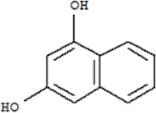
CAS 132-86-5
:1,3-Dihidroxinaftaleno
Descrição:
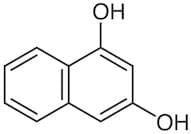
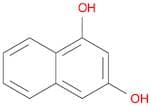
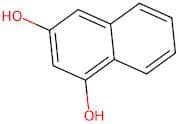
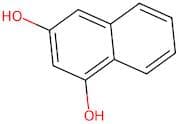
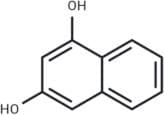
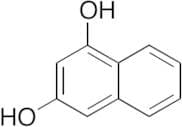
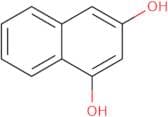
1,3-Dihidroxinaftaleno, também conhecido como 1,3-naftalenodiol, é um composto orgânico caracterizado pela presença de dois grupos hidroxila (-OH) ligados a um anel de naftaleno nas posições 1 e 3. Este composto aparece como um sólido cristalino branco a amarelo claro e é solúvel em álcool e éter, mas menos solúvel em água. Exibe propriedades típicas de compostos fenólicos, incluindo a capacidade de formar ligações de hidrogênio e participar em várias reações químicas, como oxidação e substituição. 1,3-Dihidroxinaftaleno é frequentemente utilizado na síntese orgânica e como intermediário na produção de corantes, produtos farmacêuticos e outros produtos químicos. Além disso, tem aplicações em pesquisa, particularmente em estudos relacionados às suas propriedades antioxidantes e potenciais atividades biológicas. Os dados de segurança indicam que deve ser manuseado com cuidado, pois pode causar irritação ao entrar em contato com a pele ou os olhos. Medidas de segurança adequadas, incluindo o uso de equipamentos de proteção individual, são recomendadas ao trabalhar com esta substância.
Fórmula:C10H8O2
InChI:InChI=1S/C10H8O2/c11-8-5-7-3-1-2-4-9(7)10(12)6-8/h1-6,11-12H
Chave InChI:InChIKey=XOOMNEFVDUTJPP-UHFFFAOYSA-N
SMILES:OC=1C2=C(C=C(O)C1)C=CC=C2
Sinónimos:- 1,3-Naphthalenediol
- NSC 115890
- Naphthalene-1,3-Diol
- Naphtharesorcinol
- Naphthoresorcinol
- Naphtoresorcine
- 1,3-Dihydroxynaphthalene
Ordenar por
Pureza (%)
0
100
|
0
|
50
|
90
|
95
|
100
11 produtos.
1,3-Dihydroxynaphthalene
CAS:Fórmula:C10H8O2Pureza:>98.0%(GC)(T)Cor e Forma:White to Gray to Brown powder to crystalPeso molecular:160.171,3-Dihydroxynaphthalene, 98%
CAS:It is used in the naphthoresorcinol test for uronic acids of Tollens and Rorive, a blue color can be extracted with ethanol after heating of uronic acids with naphthoresorcinol in hydrochloric acid. It is also employed as a reagent for various medical tests. It can also be used as a spot test reagenFórmula:C10H8O2Pureza:98%Cor e Forma:Cream to brown, PowderPeso molecular:160.171,3-Dihydroxynaphthalene
CAS:1,3-Dihydroxynaphthalene
Fórmula:C10H8O2Pureza:98%Cor e Forma: light orange to brown powderPeso molecular:160.16932g/mol1,3-Dihydroxynaphthalene
CAS:Fórmula:C10H8O2Pureza:≥ 98.0%Cor e Forma:Off-white to grey, orange or brown crystalline powderPeso molecular:160.17Naphthoresorcinol, 10mM (in DMSO)
CAS:Naphthoresorcinol, 10mM (in DMSO)Pureza:≥98%Peso molecular:160.17g/molNaphthoresorcinol
CAS:Naphthoresorcinol (1,3-Dihydroxynaphthalene) is a fluorescent dye (λex=330 nm, λem=380 nm).Fórmula:C10H8O2Pureza:99.56%Cor e Forma:White To Tan CrystallinePeso molecular:160.171,3-Naphthalenediol
CAS:Applications 1,3-Naphthalenediol is a derivative of naphthalene (N345600) and may have antibacterial activity against oral bacteria.Dyes and metabolites.
References Song, H-Y., et al.: J Korean Soc Appl Biol Chem, 55, 183-187 (2012)Fórmula:C10H8O2Cor e Forma:NeatPeso molecular:160.171,3-Dihydroxynaphthalene
CAS:1,3-Dihydroxynaphthalene is an organic compound that has been shown to inhibit HIV infection in vitro. The optimum concentration of 1,3-dihydroxynaphthalene for inhibition of HIV infection is 0.5% (w/v). This compound can be synthesized by the reaction of epoxy and a sulfonamide drug. In addition, 1,3-dihydroxynaphthalene has been shown to have anti-inflammatory properties and can be used as a potential treatment for metabolic disorders such as diabetes mellitus.Fórmula:C10H8O2Pureza:Min. 95%Cor e Forma:PowderPeso molecular:160.17 g/mol1,3-Dihydroxynaphthalene (Naphthoresorcinol) extrapure AR, 99%
CAS:Fórmula:C10H8O2Pureza:min. 99%Cor e Forma:White to gray to brown, Powder to crystalPeso molecular:160.17