CAS 1321-74-0
:Divinilbenzeno
Descrição:
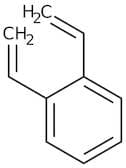
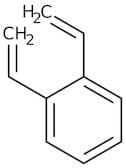
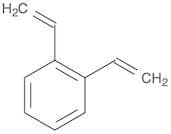
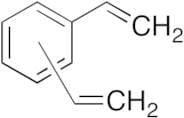
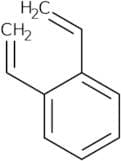
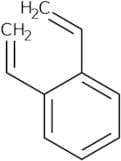
Divinilbenzeno (DVB) é um composto orgânico caracterizado por sua estrutura, que contém dois grupos vinílicos ligados a um anel de benzeno. É um líquido incolor a amarelo pálido com um odor aromático distinto. O DVB é conhecido por sua alta reatividade devido à presença dos grupos vinílicos, tornando-se um monômero valioso na produção de polímeros e resinas reticuladas. É comumente utilizado na síntese de resinas de troca iônica, bem como na fabricação de vários plásticos e revestimentos. O composto é solúvel em solventes orgânicos, mas tem solubilidade limitada em água. O DVB pode passar por polimerização, levando à formação de estruturas reticuladas que melhoram as propriedades mecânicas e térmicas dos materiais resultantes. Considerações de segurança são importantes ao manusear o DVB, pois pode ser um irritante para a pele e os olhos, e precauções adequadas devem ser tomadas para minimizar a exposição. No geral, Divinilbenzeno é um composto versátil com aplicações significativas na indústria química.
Fórmula:C10H10
InChI:InChI=1/2C10H10/c1-3-9-5-7-10(4-2)8-6-9;1-3-9-6-5-7-10(4-2)8-9/h2*3-8H,1-2H2
SMILES:C=Cc1ccc(C=C)cc1.C=Cc1cccc(C=C)c1
Sinónimos:- Benzene, Divinyl
- Benzene, diethenyl-
- Diethenylbenzene
- Divinilbenceno
- Divinilbenceno, Puro
- Divinilbenzene
- Divinylbenzen
- Divinylbenzene
- Divinylbenzene Mixed Isomers
- Divinylbenzene, Mixture Of Isomers
- Divinylbenzenetechmixedisomers
- Divinylbenzol
- Dvb 810
- Dvb 96
- Dvb 960
- Dvb Hp
- Dvb-H
- Dvr 960
- Ethylvinyl Benzene
- Vinilestireno
- Vinilstirene
- Vinyl styrène
- Vinyl-Styrol
- Vinylethylbenzene
- Vinylstyren
- Vinylstyrene
- ジビニルベンゼン
- Ver mais sinónimos
Ordenar por
Pureza (%)
0
100
|
0
|
50
|
90
|
95
|
100
10 produtos.
Divinylbenzene (m- and p- mixture) (contains Ethylvinylbenzene, Diethylbenzene) (stabilized with TBC)
CAS:Fórmula:C10H10Pureza:>50.0%(GC)Cor e Forma:Colorless to Light orange to Yellow clear liquidPeso molecular:130.19Divinylbenzene, 80%, mixture of isomers, stab. with 1000ppm 4-tert-butylcatechol
CAS:Divinylbenzene is used as a reactive monomer in polyester resins and for the synthesis of highly crosslinked macroporous styrene as well as a crosslinking agent. It acts as an intermediate in the production of ion exchange resin. Further, it is used in making rubber, petroleum production and polymerFórmula:C10H10Pureza:80%Cor e Forma:Colorless to yellow, LiquidPeso molecular:130.19Divinylbenzene, 55%, mixture of isomers, stab. with 1000ppm 4-tert-butylcatechol
CAS:Crosslinking monomerFórmula:C10H10Cor e Forma:LiquidPeso molecular:130.19Divinylbenzene (ortho-, meta-, or para- substituted) (~80%)
CAS:Produto ControladoApplications Divinylbenzene;m-(or p-)Divinylbenzene (cas# 1321-74-0) is a useful research chemical.
Fórmula:C10H10Pureza:~80%Cor e Forma:ColourlessPeso molecular:130.19Divinylbenzene (m- and p- mixture) (contains Ethylvinylbenzene, Diethylbenzene) - 80%
CAS:Divinylbenzene is a glycol ester that undergoes a palladium-catalyzed coupling reaction with an alkyne to produce a model system. The resulting polymer has high values of optical sensor, kinetic data, and thermal expansion. Divinylbenzene's chemical stability and particle size make it an appropriate sample preparation for various types of analytical techniques such as optical sensor, which can measure the concentration of divinylbenzene in polymers. Divinylbenzene contains nitrogen atoms that can react with fatty acids to form liver lesions in rats.Fórmula:C10H10Pureza:Min. 80 Area-%Cor e Forma:Clear LiquidPeso molecular:130.19 g/molDivinylbenzene (m- and p- mixture) (contains Ethylvinylbenzene, Diethylbenzene) - 55%
CAS:Divinylbenzene is a glycol ether that is used as a solvent and an intermediate in the production of polyvinyl chloride. It has been shown to be harmful to the liver in animal studies, causing lesions. It also causes an increase in the levels of water vapor in the air and high values for thermal expansion. Divinylbenzene undergoes a reaction with phosphorus pentoxide, yielding polyvinyl chloride and hydrogen gas. The mechanism of this reaction is catalyzed by palladium.Fórmula:C10H10Pureza:Min. 55 Area-%Peso molecular:130.19 g/mol