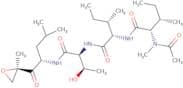
CAS 134381-21-8
:Epoxomicina
Descrição:
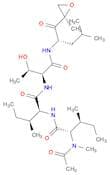
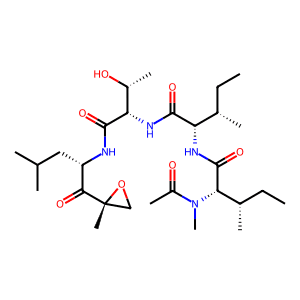
Epoxomicina é um inibidor potente e seletivo do proteassoma, conhecido principalmente por seu papel em pesquisas relacionadas ao câncer e doenças neurodegenerativas. É um produto natural derivado da fermentação da bactéria *Streptomyces*. O composto apresenta um grupo funcional epóxido único, que contribui ao seu mecanismo de ação ao se ligar covalentemente ao sítio ativo do proteassoma, inibindo assim sua função. Essa inibição leva ao acúmulo de proteínas reguladoras e apoptose em células cancerosas, tornando-se uma ferramenta valiosa na pesquisa do câncer. Epoxomicina também foi estudado por seus potenciais efeitos neuroprotetores, pois pode influenciar a degradação de proteínas mal dobradas associadas a distúrbios neurodegenerativos. Em termos de propriedades físicas, Epoxomicina é tipicamente caracterizado por seu estado sólido à temperatura ambiente e é solúvel em solventes orgânicos. Seu uso em ambientes laboratoriais requer manuseio cuidadoso devido à sua atividade biológica e potencial toxicidade. No geral, Epoxomicina serve como um composto importante no estudo da função do proteassoma e suas implicações em várias doenças.
Fórmula:C28H50N4O7
InChI:InChI=1/C28H50N4O7/c1-11-16(5)21(30-27(38)23(17(6)12-2)32(10)19(8)34)25(36)31-26(37)22(18(7)33)29-20(13-15(3)4)24(35)28(9)14-39-28/h15-18,20-23,29,33H,11-14H2,1-10H3,(H,30,38)(H,31,36,37)/t16-,17-,18+,20?,21-,22-,23-,28+/m0/s1
Chave InChI:InChIKey=DOGIDQKFVLKMLQ-JTHVHQAWSA-N
SMILES:C([C@@H](NC([C@@H](NC([C@@H](NC([C@@H](N(C(C)=O)C)[C@H](CC)C)=O)[C@H](CC)C)=O)[C@@H](C)O)=O)CC(C)C)(=O)[C@@]1(C)CO1
Sinónimos:- (2R)-2-[Acetyl-(N-Methyl-L-Isoleucyl)-L-Isoleucyl-L-Threonyl-L-Leucyl]-2-Methyloxirane
- <span class="text-smallcaps">L</smallcap>-Threoninamide, N-acetyl-N-methyl-<smallcap>L</smallcap>-isoleucyl-<smallcap>L</span>-isoleucyl-N-[(1S)-3-methyl-1-[[(2R)-2-methyl-2-oxiranyl]carbonyl]butyl]-
- <span class="text-smallcaps">L</smallcap>-Threoninamide, N-acetyl-N-methyl-<smallcap>L</smallcap>-isoleucyl-<smallcap>L</span>-isoleucyl-N-[(1S)-3-methyl-1-[[(2R)-2-methyloxiranyl]carbonyl]butyl]-
- Bu-4061T
- Epoxomicin, Synthetic
- N-Acetyl-N-Methyl-L-Isoleucyl-L-Isoleucyl-N-[(1S)-3-Methyl-1-[[(2R)-2-Methyloxiranyl]Carbonyl]Butyl]-L-Threoninamide
- N-Acetyl-N-methyl-<span class="text-smallcaps">L</smallcap>-isoleucyl-<smallcap>L</smallcap>-isoleucyl-N-[(1S)-3-methyl-1-[[(2R)-2-methyl-2-oxiranyl]carbonyl]butyl]-<smallcap>L</span>-threoninamide
- N-acetyl-N-methyl-L-isoleucyl-L-isoleucyl-L-threonyl-N-{2-[(2R)-2-methyloxiran-2-yl]-2-oxoethyl}-L-leucinamide
- N-acetyl-N-methyl-L-isoleucyl-N-{(2S,3R)-3-hydroxy-2-[(3-methyl-1-{[(2R)-2-methyloxiran-2-yl]carbonyl}butyl)amino]butanoyl}-L-isoleucinamide
- N-Acetyl-N-methyl-L-isoleucyl-L-isoleucyl-N-[(1S)-3-methyl-1-[[(2R)-2-methyl-2-oxiranyl]carbonyl]butyl]-L-threoninamide
- L-Threoninamide, N-acetyl-N-methyl-L-isoleucyl-L-isoleucyl-N-[(1S)-3-methyl-1-[[(2R)-2-methyloxiranyl]carbonyl]butyl]-
- L-Threoninamide, N-acetyl-N-methyl-L-isoleucyl-L-isoleucyl-N-[(1S)-3-methyl-1-[[(2R)-2-methyl-2-oxiranyl]carbonyl]butyl]-
- Epoxomicin
- Epoxomicin(BU-4061T)
- Aids010837
- CS-1626
- Aids-010837
- Epoxomicin, 97%, a selective proteasome inhibitor
- BU-4061T,Aids010837
- (2S,3S)-2-[[(2S,3S)-2-[acetyl(Methyl)aMino]-3-Methylpentanoyl]aMino]-N-[(2S,3R)-3-hydroxy-2-[[(2S)-4-Methyl-1-[(2R)-2-Methyloxiran-2-yl]-1-oxopentan-2-yl]aMino]butanoyl]-3-MethylpentanaMide
- EPOXOMICIN;BU4061T;BU-4061T
- 134381-21-8 supplier in China
- Ver mais sinónimos
Ordenar por
Pureza (%)
0
100
|
0
|
50
|
90
|
95
|
100
6 produtos.
Epoxomicin
CAS:Fórmula:C28H50N4O7Pureza:≥ 98.0%Cor e Forma:White to off-white or light-yellow solidPeso molecular:554.7Epoxomicin
CAS:Epoxomicin, a selective proteasome inhibitor, chiefly blocks CH-L activity, mildly affecting T-L and PGPH at lower rates.Fórmula:C28H50N4O7Pureza:98.65% - 98.86%Cor e Forma:White To Off-White SolidPeso molecular:554.72Ref: TM-T6830
1mg125,00€5mg311,00€1mL*10mM (DMSO)375,00€10mg502,00€25mg817,00€50mg1.130,00€100mg1.501,00€500mg3.022,00€Epoxomicin
CAS:Epoxomicin is an activator that binds to the ligand-binding site of a receptor. It has been used as a research tool in cell biology, pharmacology, and immunology. Epoxomicin has been shown to inhibit ion channels by binding to them and blocking their activity. This property makes epoxomicin a good candidate for the treatment of epilepsy. Epoxomicin also inhibits protein synthesis through inhibition of ribosomal S6 kinase, which is involved in signal transduction pathways.
Fórmula:C28H50N4O7Pureza:Min. 95%Peso molecular:554.72 g/molEpoxomicin
CAS:Epoxomicin is a macrolide antibiotic that inhibits the production of inflammatory mediators by suppressing the activity of protein kinase C. Epoxomicin has been shown to have anti-inflammatory properties in low doses. This drug also inhibits the proteasome, an enzyme that breaks down proteins into amino acids or small peptides, and is used as an inhibitor of cancer cell proliferation. Epoxomicin binds to the 20S proteasome at a site that is distinct from that for other proteasome inhibitors such as lactacystin and bortezomib, which are used for cancer treatment. The binding site for epoxomicin is adjacent to the ATP-binding site and may be due to its inhibitory effect on ATP hydrolysis.Fórmula:C28H50N4O7Pureza:Min. 95%Cor e Forma:PowderPeso molecular:554.72 g/mol