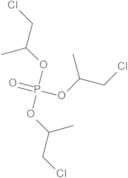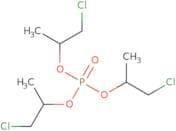
CAS 13674-84-5
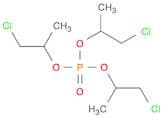
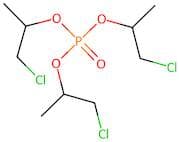
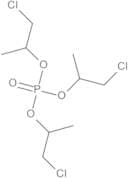
:Tris(2-cloroisopropil) fosfato
Descrição:
Tris(2-cloroisopropil) fosfato, comumente referido como TCPP, é um composto organofosforado caracterizado por seu uso como retardante de chama e plastificante em várias aplicações, incluindo têxteis, plásticos e revestimentos. É um líquido incolor a amarelo pálido com um ponto de ebulição relativamente alto e baixa volatilidade, o que contribui para sua eficácia na resistência ao fogo. O TCPP é conhecido por sua capacidade de melhorar a estabilidade térmica dos materiais, ao mesmo tempo em que proporciona um grau de flexibilidade. A presença de átomos de cloro em sua estrutura confere propriedades adicionais de retardante de chama, tornando-o particularmente útil em aplicações onde a segurança contra incêndios é uma preocupação. No entanto, como muitos organofosforados, o TCPP levantou preocupações ambientais e de saúde devido à sua potencial toxicidade e persistência no meio ambiente. É importante manusear essa substância com cuidado, seguindo as diretrizes de segurança apropriadas para minimizar a exposição. No geral, o TCPP desempenha um papel significativo na ciência dos materiais, particularmente na melhoria da segurança e desempenho de vários produtos.
Fórmula:C9H18Cl3O4P
InChI:InChI=1S/C9H18Cl3O4P/c1-7(4-10)14-17(13,15-8(2)5-11)16-9(3)6-12/h7-9H,4-6H2,1-3H3
Chave InChI:InChIKey=KVMPUXDNESXNOH-UHFFFAOYSA-N
SMILES:P(OC(CCl)C)(OC(CCl)C)(OC(CCl)C)=O
Sinónimos:- 1,3-Dichloro-2-propanol phosphate
- 1-Chloro-2-Propanophosphate(3:1)
- 1-Chloro-2-propanolphosphate(3:1)
- 2-Propanol, 1-chloro-, 2,2′,2′′-phosphate
- 2-Propanol, 1-chloro-, phosphate (3:1)
- Amgard TMCP
- Antiblaze 80
- Antiblaze AB 80
- Antiblaze TMCP
- Bs 5852
- Daltoguard F
- Fyrol PCF
- Hostaflam OP 820
- Levagard PP
- Levagard PP 2
- Levagard PP-Z
- Levagard TCPP
- Pc 1389
- Phireguard TCPP
- Phosphoric acid tris(2-chloro-1-methylethyl) ester
- ProFlame PC 1389
- Puma 4010
- Tcpp
- Tmpcc
- Tolgard TMCP
- Tri(2-chloroisopropyl) phosphate
- Tri(chloropropyl) phosphate
- Tris(1-chloro-2-isopropyl)phosphate
- Tris(1-chloropropan-2-yl) phosphate
- Tris(1-chloropropyl)phosphate
- Tris(1-methyl-2-chloroethyl) phosphate
- Tris(2-chloro-1-methyl-ethyl) phosphate
- Tris(2-chloro-1-methylethyl) phosphate
- Tris(2-chloroisopropyl) phosphate
- Tris(2-chloropropyl) phosphate
- Tris(chloroISOPROPYL)phosphate
- Tris(chloropropyl)phosphate
- Tris(clorisopropyl)phosphate
- Tris(monochloropropyl) phosphate
- Tris(β-chloroisopropyl) phosphate
- Wsfr-Tcpp
- Yoke TCPP
- Tris(1-chloro-2-propyl)phosphate
- Tris(1-chloro-2-propyl) phosphate
- Ver mais sinónimos
Ordenar por
Pureza (%)
0
100
|
0
|
50
|
90
|
95
|
100
7 produtos.
Tris(1-chloropropan-2-yl) phosphate
CAS:Fórmula:C9H18Cl3O4PPureza:85.0%Cor e Forma:LiquidPeso molecular:327.56Tris(2-chloroisopropyl) phosphate
CAS:Fórmula:C9H18Cl3O4PPureza:98%Cor e Forma:LiquidPeso molecular:327.5696Tris(2-Chloro-1-Methylethyl) Phosphate
CAS:Tris(2-Chloro-1-Methylethyl) PhosphatePureza:P:9.5%Peso molecular:327.57g/molTris(1-chloro-2-propyl) Phosphate
CAS:Produto ControladoStability Moisture Sensitive
Applications Tris(1-chloro-2-propyl) Phosphate is a flame retardant of low hydrolytic stability, used in polyurethane (PU) rigid and flexible foam, PVC, EVA, phenolics and epoxy resin.
References Grump, D., et al.: Toxicol. Sci., 126, 140 (2012); Paciorek, S.J., et al.: J. Porous. Mater., 19, 161 (2012);Fórmula:C9H18Cl3O4PCor e Forma:ColourlessPeso molecular:327.57Tris(1-chloro-2-propyl) phosphate - mixture of isomers
CAS:Tris(1-chloro-2-propyl) phosphate is a synthetic compound that belongs to the class of diphenyl ethers. It is used as an intermediate in the production of other chemicals, such as plastics and pesticides. Tris(1-chloro-2-propyl) phosphate has been shown to be toxic to cells by inhibiting mitochondrial membrane potential and interfering with cellular metabolism. This chemical can cause severe health effects, such as liver damage and death, at high doses. Tris(1-chloro-2-propyl) phosphate can also be detected in human serum and urine samples with high sensitivity.Fórmula:C9H18Cl3O4PPureza:Min. 95%Peso molecular:327.57 g/mol