CAS 13965-03-2
:Diclorobis(trifenilfosfina)paládio
Descrição:
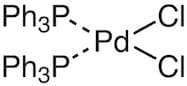
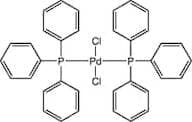
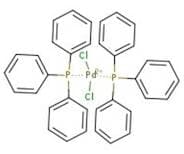
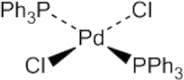
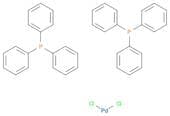
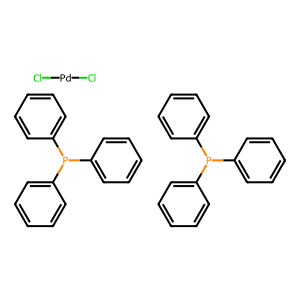
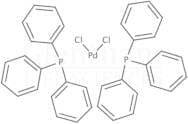
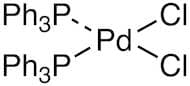
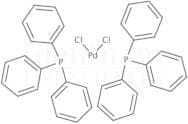
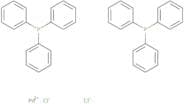
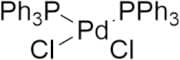
Diclorobis(trifenilfosfina)paládio, comumente referido como Pd(PPh₃)₂Cl₂, é um complexo de coordenação de paládio que apresenta dois ligandos de triphenilfosfina e dois íons cloreto. Este composto é caracterizado por sua geometria quadrada plana, típica de muitos complexos metálicos d⁸, o que contribui para sua estabilidade e reatividade. É frequentemente utilizado como catalisador em várias reações orgânicas, particularmente em reações de acoplamento cruzado, como as reações de Suzuki e Heck, devido à sua capacidade de facilitar a formação de ligações carbono-carbono. A presença dos ligandos de triphenilfosfina aumenta a solubilidade do complexo em solventes orgânicos e fornece volume estérico, o que pode influenciar a seletividade da reação. Pd(PPh₃)₂Cl₂ é tipicamente manuseado em atmosferas inertes para evitar degradação e é sensível à umidade. Suas aplicações se estendem à síntese de produtos farmacêuticos, agroquímicos e materiais avançados, tornando-o um composto valioso tanto na química acadêmica quanto na industrial.
Fórmula:C36H30Cl2P2Pd
InChI:InChI=1S/2C18H15P.2ClH.Pd/c2*1-4-10-16(11-5-1)19(17-12-6-2-7-13-17)18-14-8-3-9-15-18;;;/h2*1-15H;2*1H;/q;;;;+2/p-2
Chave InChI:InChIKey=YNHIGQDRGKUECZ-UHFFFAOYSA-L
SMILES:[P]([Pd+2]([P](C1=CC=CC=C1)(C2=CC=CC=C2)C3=CC=CC=C3)([Cl-])[Cl-])(C4=CC=CC=C4)(C5=CC=CC=C5)C6=CC=CC=C6
Sinónimos:- B 1667
- Bis(triphenylphosphine)dichloropalladium
- Bis(triphenylphosphine)dichloropalladium(II)
- Bis(triphenylphosphine)palladium chloride
- Bis(triphenylphosphine)palladium dichloride
- Bis(triphenylphosphine)palladium(II) dichloride
- Bis(triphenylphosphino)-palladium(II) dichloride
- Bis(triphenylphosphino)palladium chloride
- Cis-Bis(Triphenylphosphine)Platinum(Ii) Dichloride
- Dichlorobis(Triphenylphosphine)Palladate (Ii)
- Dichlorobis(Triphenylphosphine)Palladium
- Dichlorobis(triphenylphosphin)palladium
- Dichlorobis(triphenylphosphine)palladium(II)
- Dichlorobis(triphenylphosphine)platinum (II)
- Diclorobis(Trifenilfosfina)Paladio
- Nsc 122924
- Palladium(2+) Chloride-Triphenylphosphane (1:2:2)
- Palladium, dichlorobis(triphenylphosphine)-
- Palladiumbis(triphenylphosphine) dichloride
- Phosphine, Triphenyl-, Palladium(2+) Salt, Dihydrochloride
- Trans-Dichlorobis(triphenyl-phosphine) Palladium(II)
- cis-Bis(triphenylphosphine)platinum(II) chloride
- trans-Bis(triphenylphosphine)palladium dichloride
- Ver mais sinónimos
Ordenar por
Pureza (%)
0
100
|
0
|
50
|
90
|
95
|
100
Foram encontrados 15 produtos.
Bis(triphenylphosphine)palladium(II) Dichloride
CAS:Fórmula:C36H30Cl2P2PdPureza:>98.0%(T)Cor e Forma:Light yellow to Brown powder to crystalPeso molecular:701.90trans-Dichlorobis(triphenylphosphine)palladium(II), Pd 14.0% min
CAS:Hydrogenation, hydrosilation, carbonylation, oxidation, and C-C bond formationFórmula:C36H30Cl2P2PdPeso molecular:701.90trans-Dichlorobis(triphenylphosphine)palladium(II), Premion™, 99.95% (metals basis), Pd 14.7% min
CAS:As a catalyst of choice in hydrogenation, hydrosilation, carbonylation, oxidation, elimination, reduction, allyl aceate isomerization, dimerization of 1,3-dienes, and C-C bond formation such as Negishi coupling, Suzuki coupling, Kumada coupling, Sonogashira coupling, Heck coupling and Sonogashira-HFórmula:C36H30Cl2P2PdPureza:99.95%Peso molecular:701.90Bis(triphenylphosphine)palladium(II) dichloride
CAS:Pureza:98%Cor e Forma:White to yellow powder or crystalsPeso molecular:701.90trans-Dichlorobis(triphenylphosphine)palladium(II), 99% (99.9+%-Pd)
CAS:trans-Dichlorobis(triphenylphosphine)palladium(II), 99% (99.9+%-Pd)
Fórmula:PdCl2(P(C6H5)3Pureza:(99.9+%-Pd)Cor e Forma:yellow pwdr.Peso molecular:701.89Dichlorobis(triphenylphosphine)palladium
CAS:Fórmula:C36H30Cl2P2PdPureza:98%Cor e Forma:SolidPeso molecular:701.8969Ref: IN-DA001BFX
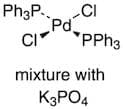
1gA consultar5gA consultar10gA consultar25gA consultar50gA consultar100mgA consultar250mgA consultartrans-Dichlorobis(triphenylphosphine)palladium(II)/potassium phosphate admixture [CatKit single-use vials - 6.32 wt% Pd complex]
CAS:trans-Dichlorobis(triphenylphosphine)palladium(II)/potassium phosphate admixture [CatKit single-use vials - 6.32 wt% Pd complex]
Fórmula:PdCl2P(C6H5)3K3PO4Cor e Forma:off-white pwdr.Peso molecular:701.89Bis(triphenylphosphine)palladium(II) chloride
CAS:Bis(triphenylphosphine)palladium(II) chlorideFórmula:·2C18H15P·Cl2PdPureza:98%Cor e Forma: yellow solidPeso molecular:701.89692g/molBis(triphenylphosphine)palladium(II)chloride
CAS:Fórmula:C36H30Cl2P2PdCor e Forma:Yellow to gold crystalline powderPeso molecular:701.91PdCl2(PPh3)2 (HPMC encapsulated)
CAS:Fórmula:C36H30Cl2P2PdCor e Forma:White to Light yellow to Light orange capsulePeso molecular:701.90Bis(Triphenylphosphine)palladium (II) chloride
CAS:Fórmula:C36H30Cl2P2PdPureza:98.0%Cor e Forma:Solid, Crystalline Powder or PowderPeso molecular:701.9Bis(triphenylphosphine) palladium(II) chloride, 99.95% (metals basis)
CAS:Fórmula:(C6H5)3PPdCI2Pureza:≥ 99.95%Cor e Forma:Pale yellow to brown powder or crystalsPeso molecular:701.89Bis(triphenylphosphine)palladium(II) dichloride
CAS:Bis(triphenylphosphine)palladium(II) dichloride is an organometallic compound that has antibiotic activity. It is the active methylene in a number of drug molecules, including methyldopa, which is used to treat high blood pressure and postural hypotension. Bis(triphenylphosphine)palladium(II) dichloride also has potential use as a target enzyme for cross-coupling reactions. Cross-coupling reactions involve the coupling of organic compounds with organometallic reagents using palladium as a catalyst. The mechanism of this reaction involves the formation of a palladium-carbon bond by oxidative addition and reductive elimination, followed by the release of carbon monoxide. This process leads to the formation of an organometallic compound and an aryl halide. Bis(triphenylphosphine)palladium(II) dichloride can also be used in gel permeation chromFórmula:C36H30Cl2P2PdPureza:Min. 95%Cor e Forma:Yellow PowderPeso molecular:701.9 g/molBis(Triphenylphosphine) Palladium(II) Dichloride extrapure, 14%-15.50% Pd
CAS:Fórmula:C36H30Cl2P2PdPeso molecular:701.90Dichlorobis(triphenylphosphine) Palladium (II)
CAS:Produto ControladoApplications Dichlorobis(triphenylphosphine) Palladium (II) is used primarily in organometallic catalytic reactions due to the palladium content of the compound. It is also involved in crystalized structures of metallacyclic complexes which show antiinflammatory and antifungal properties.
References Paul, P. et al.: J. Organometal. Chem., 724, 281 (2013); Pandiarajan, D. et al.: J. Organometal. Chem., 708-709, 18, (2012); Shhaheen, F. et al.: J. Organometal. Chem., 693, 315 (2010);Fórmula:C36H30Cl2P2PdCor e Forma:NeatPeso molecular:701.89